Sad News: The MFDJ will be on hiatus for a few days while The Comtesse is off wandering the desert, looking for bones. But don’t despair, she’ll be back even more miserable than ever… next week!
Today’s Fiery Yet Truly Morbid Fact!
When a Concorde belonging to Air France crashed in a fireball near Charles de Gaulle airport in Paris in July 2000, it was, incredibly, the only time the beautiful and iconic airliner had been involved in a fatal incident. And, for once, ‘incredibly’ is the correct word. Despite having been designed in the primitive 1960s, despite being the only serious supersonic passenger aircraft, and despite having flown millions of miles, for over 30 years, at hitherto unknown speeds and altitudes, she was still statistically, the safest thing in the skies. Concorde hadn’t merely pushed the aviation envelope – she had scrawled all over it, screwed it up and tossed it in the bin.
This would have been of little consolation to the 109 people on board that fateful day – 100 of them German tourists heading to New York to join a luxury cruise to the Caribbean – or the four who died on the ground, or their families. Ultimately, the tragedy would also spell the death of the Concorde herself – though that was as much down to economics as issues of safety. More than a decade later, argument still rages over what caused the Paris disaster. Officially, the answer is simple enough.
France’s BEA decided – and was backed in December 2010 by a French court – that Continental Airlines was to blame, along with one of its mechanics who had fitted a 16-inch strip of titanium to one of its DC10s. This metal strip had fallen from the US jet as it took off five minutes before the Air France flight used the same CDG runway, and it ripped into one of the Concorde’s highly pressurized tires as she roared down the tarmac. The tire exploded, and one or more thick shards of rubber, weighing several kilogrammes, smashed into the underside of the wing fuel tanks. Although the chunks of tire did not themselves penetrate the tanks, the impact set up shockwaves which led to a rupture; aviation fuel streamed out, was somehow ignited – probably by electrical arcing – and the aircraft was immediately ablaze.
She had passed ‘V1’ – the speed at which a take-off can safely be aborted – so the crew, thinking at this stage that they had a relatively simple engine failure, continued with the take-off. Had they somehow aborted, it’s possible – though not certain – that everyone aboard would have died in an inferno anyway; photographs taken by plane spotters and passengers on a nearby aircraft showed the doomed jet at the moment its front wheels lifted, with a golden-orange trail of fire and thick, black smoke already streaming out from its left wing and tail.
Almost simultaneously, an air traffic controller was telling the flight crew, ‘Four-five-nine-zero, you have strong flames behind you… It’s really burning and I’m not sure it’s coming from the engines!’
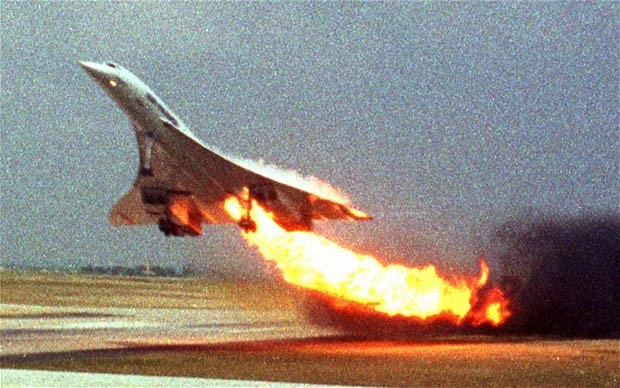
The Crippled airliner, her engines surging and dying, her undercarriage unable to retract, her left wing melting, and shedding fuel and debris behind her, labored to around 200 feet; the cockpit voice recorder reveals the three-man crew struggling in vain to comprehend the problem, and to deal with the crippled Concorde, as multiple fire, airspeed and undercarriage alarms sounded.
A few seconds later – as Captain Christian Marty said, ‘Too late. No time, no…’ – the plane crashed into a hotel near the airport and exploded. Eyewitnesses later said that Captain Marty – a daredevil skier who had once windsurfed across the Atlantic Ocean – had steered the stricken jet away from a village, thus saving many lives. All one hundred passengers and nine crew members on board the flight died. On the ground, four people were killed and one critically injured.
Culled from: Black Box: Inside the World’s Worst Air Crashes

So sad! I got to ride the Concorde once. New York to London in less than 4 hours! It was beautiful and tiny.