Today’s Splintered Yet Truly Morbid Fact!
In 1559, King Henri II, aka Le Roi, brought peace to France when he signed a treaty with Spain, thus ending a ruinous military campaign. Two important clauses in the treaty established alliances through marriage – an immediate wedding for Henri and his wife Catherine’s fourteen-year-old daughter to the king of Spain, and a second for Henri’s spinster sister to an Italian duke. To celebrate the marriages, Henri organized a five-day jousting tournament.
On the third day of festivities, a Friday, June 30, Henri himself decided to joust. Despite the heat he wore fifty pounds of gold-plated armor. Whatever his faults, Henri looked regal upon a horse, and he entered the list on a handsome, chestnut-colored steed. During his first run he unmanned (which is to say, unhorsed) his future brother-in-law with a blow from his lance; a short while later he unmanned a local duke, knocking him onto his arse as well. When young, Henri had a reputation as a brooding sort, but he was in high spirits that day, and arranged for a third and final joust against a powerful young Scotsman, Gabriel Montgomery.
The king and Montgomery put perhaps a hundred yards between them, and when a trumpet sounded, they took off. They clashed – and Henri got his bell rung. Montgomery bludgeoned him just below the neck, and Henri lost a stirrup and nearly careened off his horse.
Embarrassed, the king wheeled around and announced that “we” would tilt with Montgomery again – a bad idea for any number of reasons. It violated the laws of chivalry, as he’d already jousted the maximum three times. It also spooked his court. Catherine had dreamed the night before of Henri lying facedown in blood, and two of her astrologers had already prophesied the king’s doom. (One of them, Nostradamus, had written a quatrain four years earlier that read, “The young lion overcomes the old / on the field of war in single combat. / He pierces his eyes in a cage of gold. / Two wounds one, then dies a cruel death.”)
Finally, Henri had been suffering from vertigo and headaches recently, and his attendants found him shaken after his latest joust. Cruelly, though, a blow to the head can cloud someone’s judgment when he needs it most, and like a linebacker or boxer of today, Henri insisted on jousting again. Montgomery demurred, and the crowd watched in embarrassment as Henri berated him and challenged him to tilt again. At 5 p.m. they lined up. Some eyewitnesses later claimed that an attendant fastened the king’s visor improperly. Others said that Henri wiped his brow and, in his fog, forgot to refasten the visor. Still others insisted that he cocked it up, in spite. Regardless, this time Henri didn’t wait for the trumpet before charging.
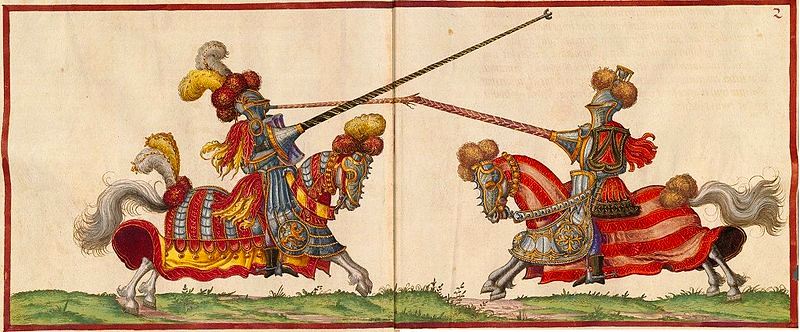
During a joust, a low timber fence separated the combatants, and they charged each other left shoulder to left shoulder, shield hand to shield hand. They held their fourteen-foot wooden lances in their right arms and had to angle them across their bodies to strike. A proper blow therefore not only jolted but twisted the opponent, and the force often broke the lance. Sure enough, the king’s lance shattered when it met Montgomery, and Montgomery’s lance exploded into splinters when it struck the king just below the neck. Both men, jerked, and the courtiers in hose and doublets, the women adorned with ostrich feathers, the peasants hanging on the eaves, all of them whooped at the teeth-rattling blow.
The action, though, was not over. Given the commotion, no one quite knows what happened next. Perhaps Montgomery’s broken shaft buckled upward like an uppercut, or perhaps a splinter of wood leapt up like shrapnel. But somewhere in the melee, something knocked open the king’s gold-plated visor.
Now, many contemporaries blamed Montgomery for what happened next , because the moment his lance splintered he should have flung it aside. But the brain can react only so quickly to stimulus – a few tenths of a second at best – and a brain fogged from jousting would have responded more slowly still. Besides, Montgomery had an awful momentum, and even as the crowd’s roar lingered, his horse took another gallop. An instant later the jagged lance butt in his hand struck the king dead between his eyebrows. It raked across his naked face, wrenching his skull sideways and digging into his right eye.
But Nostradamus spoke of two wounds, and a second, deeper wound, to Henri’s brain, proved worse. Compared to those of most mammals, the four lobes of the human brain are grotesquely swollen. And while our skulls provide some good protection, the very hardness of the cranial bones also poses a threat, especially since the skull is surprisingly jagged on the inside, full of edges and ridges. What’s more, the brain actually floats semifreely inside the skull; it’s attached to the body really only at the bottom, near the stalk of the brainstem. We do have cerebrospinal fluid between the skull and brain to buoy and cushion it, but the fluid can absorb only so much energy. During impact, the brain can actually slide counter to the skull’s motion and slam into its bones at high speed.
As the butt of Montgomery’s lance struck home, Henri would have felt both a blow and a twist, like a mean hook to the jaw. The blow likely sent a small shock wave through his brain, a ripple of trauma. The rotational force was likely even worse, since torque stresses the brain unequally at different points, tearing its soft seams and opening up thousands of micro-hemorrhages. Henri, an expert equestrian, nevertheless kept his saddle after the impact: the muscle-memory circuits in his brain kept him balanced and kept his thighs squeezing the horse. But on a deeper level, the twist and blow tore open millions of neurons, allowing neurotransmitters to leak out and flood the brain.The would have caused untold numbers of other neurons to fire in panic, a surge of electrical activity reminiscent of a mini-seizure. Henri had suffered a mammoth concussion.
After the clash Montgomery yanked his horses reins and whirled to see what he’d done. Henri had slumped down onto the neck of his Turkish steed, a horse forevermore known as Malheureux, unlucky. But however unlucky, Malheureux was disciplined, and when it felt its reins slacken upon Henri’s collapse, it kept galloping. The now-unconscious king bobbed on his horse’s back, as if keeping time, his visor clanging down on the shards of wood protruding from his eye.
Although he initially regained consciousness and it was thought that he might recover, the king eventually fell into a coma and finally succumbed to an intracranial hemorrhage at 1 p.m. on July 10.
