Today’s Afflicted Yet Truly Morbid Fact!
Between February, 1864 and April, 1865 it is estimated that 45,000 Union prisoners were confined in the Confederate stockade, Camp Sumter, near Anderson Station, Georgia, forever to be remembered as Andersonville. Of that number, approximately 25,000 men survived their prison experience and returned home to tell their tale of suffering. It is unknown how many survivors, with their health and lives shattered, died as a direct result of their captivity after returning to civilian life. Close to 13,000 Union soldiers did “give up the ghost” at Andersonville, and it was the ghost of Andersonville that haunted the survivors for the rest of their lives.
The following is an excerpt from the account of Private George Weiser, who arrived in Andersonville on May 25, 1864.
“There were four or five hundred colored prisoners in this prison and nearly all of them were lame or wounded. Theirs was a sad fate indeed, some of them said that they had been wounded after they were captured. All the prisoners seemed to be affected with the scurvy; many were broke out in black spots and some were so bad that their teeth fell out, many were so bad that they would swell up to twice their size and the black spots would break and burst out, and large gangrene sores would eat the flesh from their bones, and I often seen the bare bones through the sores for many days before the men were dead. Many of the men were troubled with the diarrhea, many died from this cause. The corn meal did not agree with them and they had no way to cure themselves. The men were troubled much with fever; some would be taken and die soon, this we called the yellow fever and some would be taken and linger long, this kind we called the slow fever. They were so reduced that their hip bones had nothing on them but the thin skin and sometimes they would get so sore that we could see the bone. This made the men sleep in all ways. Most of the time in this prison I slept in a sitting position with my knees drawn up and my head and arms resting on my knees. I remember one day standing at the dead line near the gate, it was about the time of the sick call and I was standing there counting the dead that had been brought up to the gate that morning, seventy-eight in number, but they had not yet been carried out to the dead house, and the prison seemed to have on all of its agony when I looked and saw six women looking over the top of the stockade, and I heard one of them remark, “I have often wondered why the Confederacy did not succeed but now I know, no nation can prosper who does a thing like this,” and the women turned from the sight.
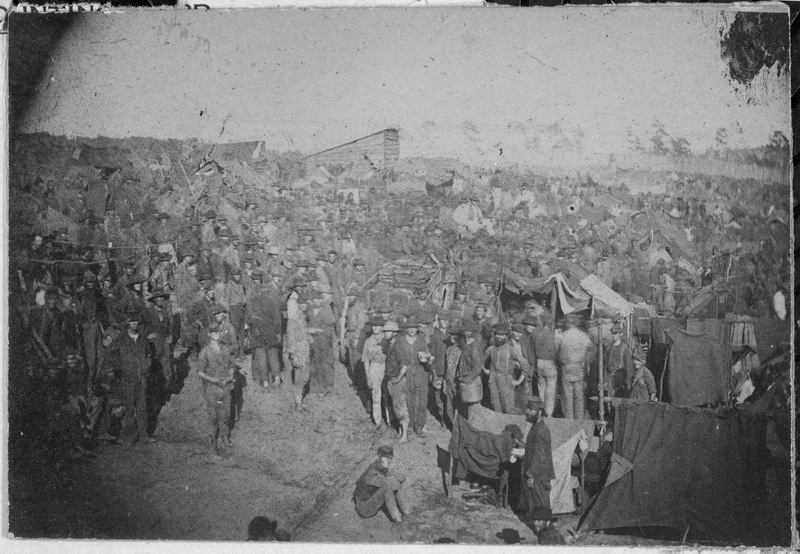
Culled from: Andersonville Giving Up the Ghost: Diaries & Recollections of the Prisoners
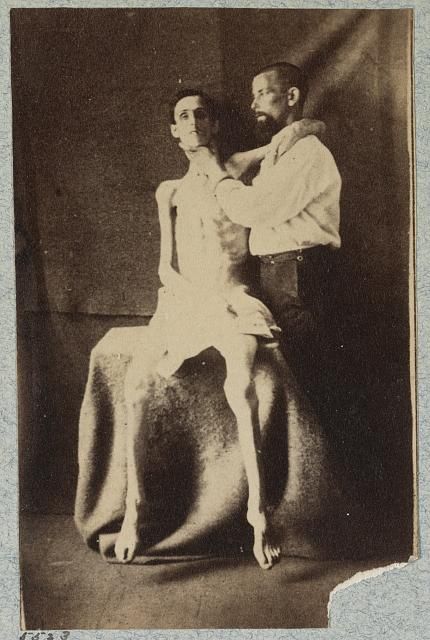
Ghastly! – Andersonville Edition
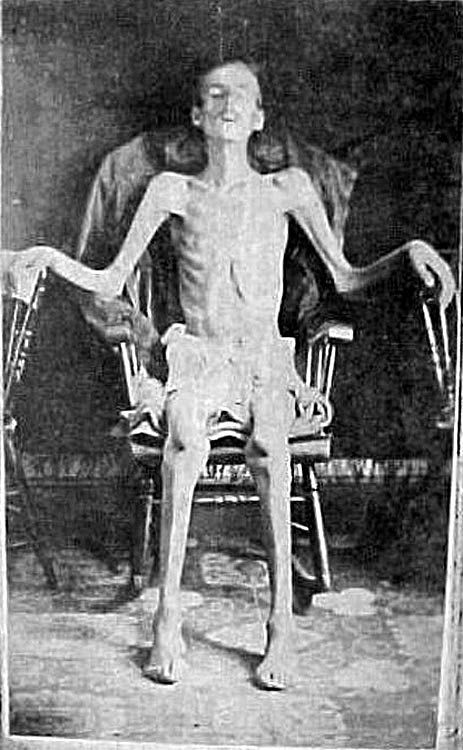
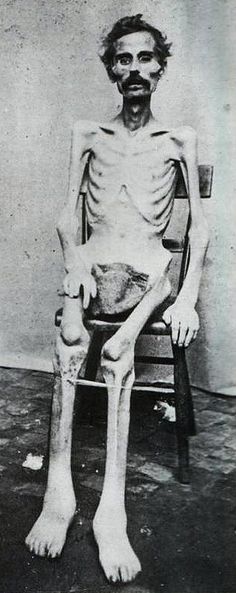
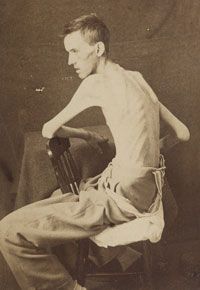
Long before Auschwitz and Bergen-Belsen, the world knew the horrors of the starvation of concentration camp victims from these images taken of the survivors of Andersonville.


A Comtesse Travelogue!
 |
|
Here’s a travelogue I put together of a 2003 trip to Andersonville. Enjoy!
|
I read your travelogue on your visit to Andersonville and viewed the photographs you had taken of the cemetery there. While I find military cemeteries somewhat mundane, they are nonetheless interesting.
What surprised me about the photogaphs you had taken of your visit to the cemetery was not what you had taken, but what you may have missed. Among the rows of headstones are 6 headstones that are kept seperate from the others. Those would be the Andersonville Raiders, a group of rogue Union soldiers who preyed upon their fellow prisoners, robbing, beating and often killing them for their processions. They were vile men with no military discipline. The prisoners finally had enough of their criminal activity and attacked the raiders en masse. After capturing them, they approached Col Wirtz, the Confederate Camp Commander and requested a hanging. Col. Wirtz demanded they conduct a military court martial and assured the prisoners that he would honor whatever punishment was appropriate.
A court martial was conducted according to military regulations, with a defense attorney provided. The 6 ring leaders were found guilty and sentenced to hang, which was carried out June 11, 1964. They were buried apart from the others who died at Andersonville and their graves are still there.
The following NPS site has additional information: http://www.nps.gov/ande/learn/historyculture/the_raiders.htm