Today’s Pus-Laden Yet Truly Morbid Fact!
As a young man, Friedrich Miescher had trained to practice the family trade, medicine, in his native Switzerland. But a boyhood typhoid infection had left him hard of hearing and unable to use a stethoscope or hear an invalid’s beside bellyaching. Miescher’s father, a prominent gynecologist, suggested a career in research instead. So in 1868 the young Miescher moved into a lab run by the biochemist Felix Hoppe-Seyler, in Tübingen, Germany. Though headquartered in an impressive medieval castle, Hoppe-Seyler’s lab occupied the royal laundry room in the basement; he found Miescher space next door, in the old kitchen.
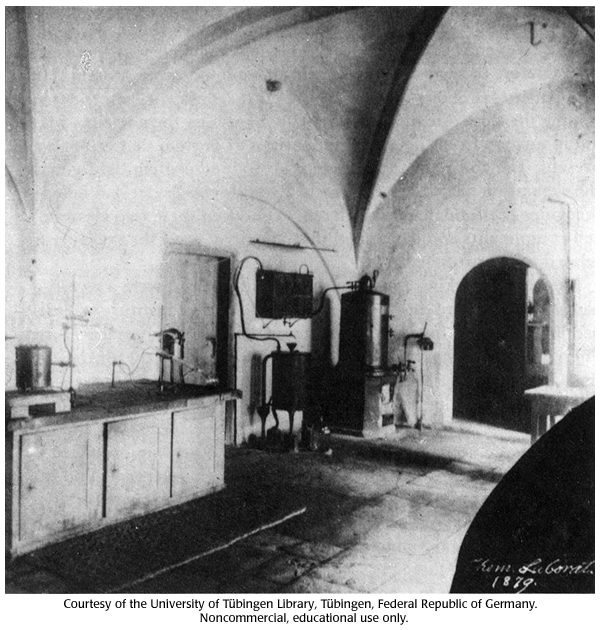
The Comtesse’s Dream Lab.
Hoppe-Seyler wanted to catalog the chemicals present in human blood cells. He had already investigated red blood cells, so he assigned white ones to Miescher – a fortuitous decision for his new assistant, since white blood cells (unlike red ones) contain a tiny internal capsule called a nucleus. At the time, most scientists ignored the nucleus – it had no known function – and quite reasonably concentrated on the cytoplasm instead, the slurry that makes up most of a cell’s volume. But the chance to analyze something unknown appealed to Miescher.
To study the nucleus, Miescher needed a steady supply of white blood cells, so he approached a local hospital. According to legend, the hospital catered to veterans who’d endured gruesome battlefield amputations and other mishaps. Regardless, the clinic did house many chronic patients, and each day a hospital orderly collected pus-soaked bandages and delivered the yellowed rags to Miescher. The pus often degraded into slime in the open air and Miescher had to smell each suppurated-on cloth and throw out the putrid ones (most of them). But the remaining “fresh” pus was swimming with white blood cells.
Eager to impress – and, in truth, doubtful of his own talents – Miescher threw himself into studying the nucleus, as if sheer labor would make up for any shortcomings. A colleague later described him as “driven by a demon,” and Miescher exposed himself daily to all manner of chemicals in his work. But without this focus, he probably wouldn’t have discovered what he did, since the key substance inside the nucleus proved elusive. Miescher first washed his pus in warm alcohol, then acid extracted from a pig’s stomach, to dissolve away the cell membranes. This allowed him to isolate a gray paste. Assuming it was protein, he ran tests to identify it. But the paste resisted protein digestion and, unlike any known protein, wouldn’t dissolve in salt water, boiling vinegar, or dilute hydrochloric acid. So he tried elementary analysis, charring until it decomposed. He got the expected elements, carbon, hydrogen, oxygen, and nitrogen, but also discovered 3 percent phosphorus, an element proteins lack. Convinced he’d found something unique, he named the substance “nuclein” – what later scientists called deoxyribonucleic acid, or DNA.
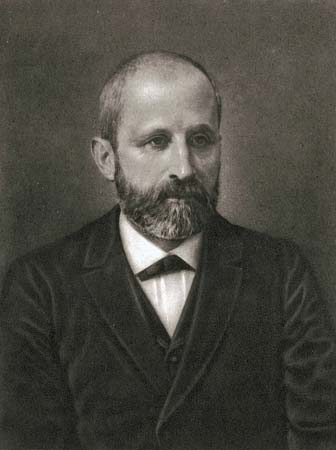
Friedrich Miescher, Pus-Sniffer Extraordinaire!
Culled from: The Violinist’s Thumb
Morbid Trinkets Du Jour!
Who wants a bat keyholder? I do!

Available from Design Toscano by way of Amazon.Com.
Oh, and while I’m here… I need this, dammit!

Also available from Design Toscano by way of Amazon.Com.