I had a request to provide more distinctive titles to my e-mails instead of the usual “Morbid Fact Du Jour for [date]” so that it’s easier to tell if you’ve already perused one or not. In response, I’ve started playing with the title format a bit. If you have suggestions, please let me know.
Oh, and yes – I did miss last night due to a bad case of hives necessitating a Benadryl coma. Darn – two days missed now!
Today’s Grainy Yet Truly Morbid Fact!
“St. Anthony’s Fire” was a frequently described disease-condition in Europe during the Middle Ages. Nowadays scholars can be reduced to guesswork when trying to find for it a name with medical meaning. In most cases St. Anthony’s Fire probably meant ergotism – a disease that August Hirsch, the great German epidemiologist of the nineteenth century, listed as epidemic some 130 times in Europe between 591 and 1879 while, at the same time, acknowledging that these occurrences probably represented just a tip of the proverbial iceberg.
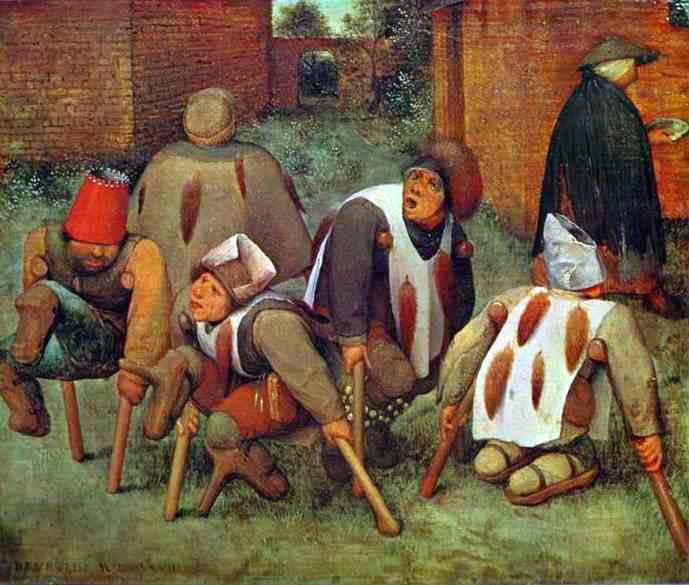
Victims of Ergotism, “The Beggars”, Peter Bruegel, 1568
Ergotism is a form of fungal poisoning caused by the ingestion of the ergot fungus (Claviceps purpurea) which can form on cereal grains, especially on rye ears, and infect the porridge and breads made from the grain. The disease takes two forms. One, called convulsive, afflicts the central nervous system, whereas a second, gangrenous, form affects the cardiovascular system by constricting arteries and veins that deliver blood to the extremities. The disease has exterior symptoms such as reddening or blistering skin, which presumably were seen as manifestations of the fire in question. Certainly, the gangrenous form of the disease was another.
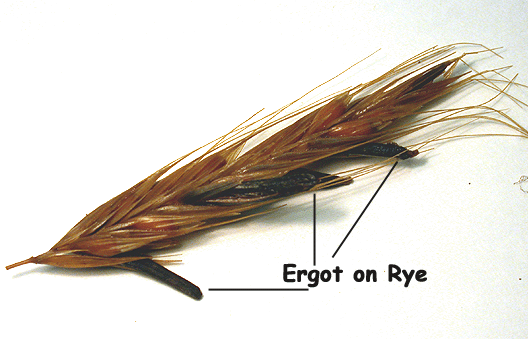
Because the ergot fungus grows best in damp conditions, epidemics were most likely to occur after a severe winter, that reduced the resistance of the grain, and a rainy spring, or when rye was planted in marshy land, such as that which is newly cultivated. Wetness is the reason why the French districts of Sologne and Dauphiné – subjected to frequent flooding – were so plagued by the disease. But from at least the eighteenth century until the end of World War II, it was the Russian people, forced by the cold climate to depend on rye – a hardy grass – as their dietary staple, who suffered most from fungal poisoning. The earliest diagnosed epidemic in Russia took place in 1785-6, but that county’s literature from the fifteenth through the seventeenth centuries contains frequent references to epidemic nervous disorders and to widespread gangrene – significantly, often associated with famine. In the 19th century ergotism was extraordinarily widespread in Russia during the years 1832, 1837, and 1863-4, and in the twentieth century in 1909, 1926, 1928-9, 1932, 1933, and 1938. To single out just one year, 1933 – which saw a very wet spring and summer – as many as 75% of the rye ears were infected in some parts of the country. Without a steady increase in potato production and consumption throughout the twentieth century, ergot poisoning would have been even more widespread and the situation even more disastrous. In the absence of dependable mortality data, we cannot even guess at the death toll, but it is worth noting that ergot toxins can pass through mother’s milk to poison nursing infants and that at the turn of the twentieth century Russians suffered the highest rates of infant mortality in Europe.
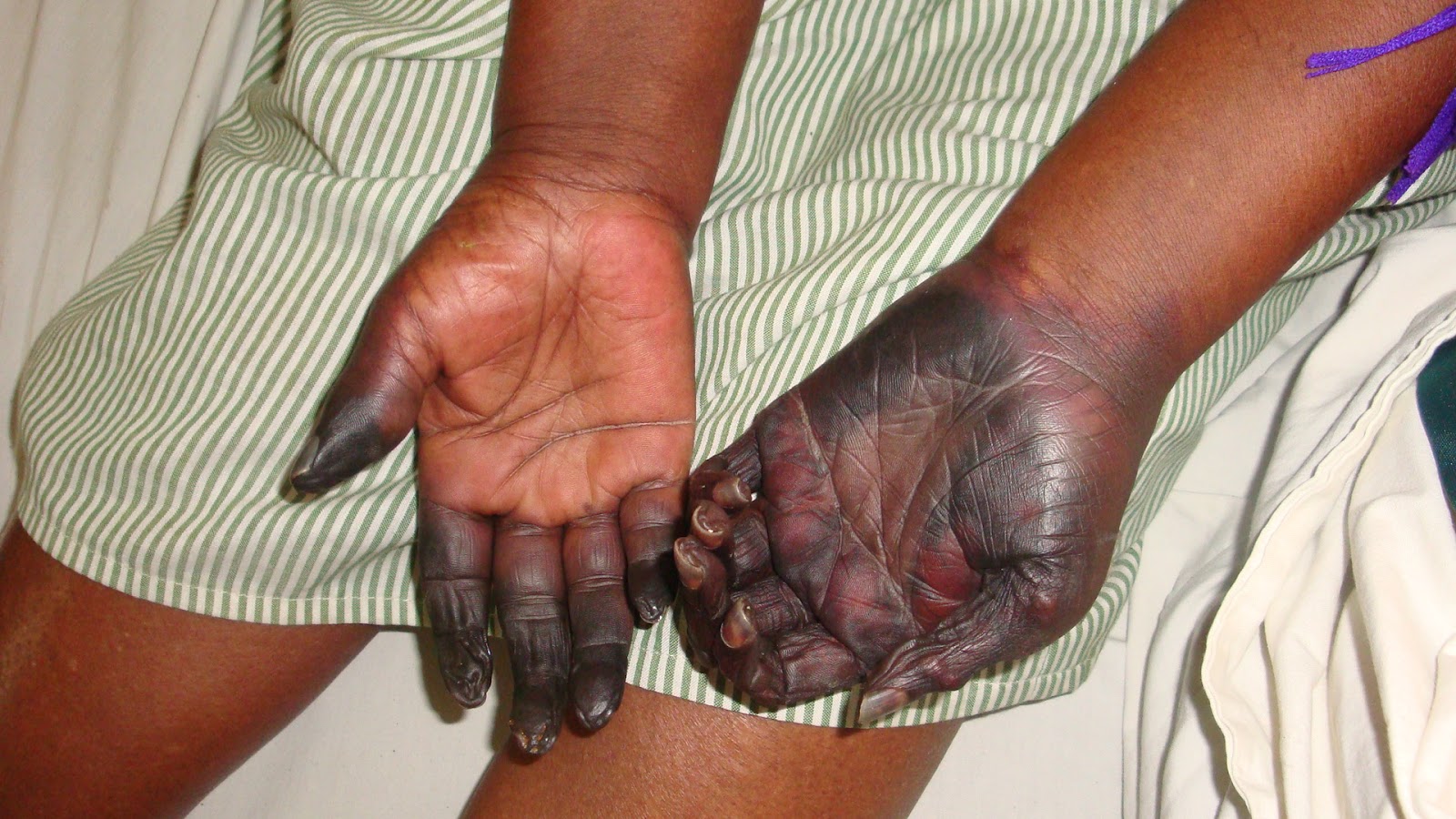
A modern case of Ergotism
Culled from: Plague, Pox, and Pestilence: Disease in History
Ghastly: Amputation Edition
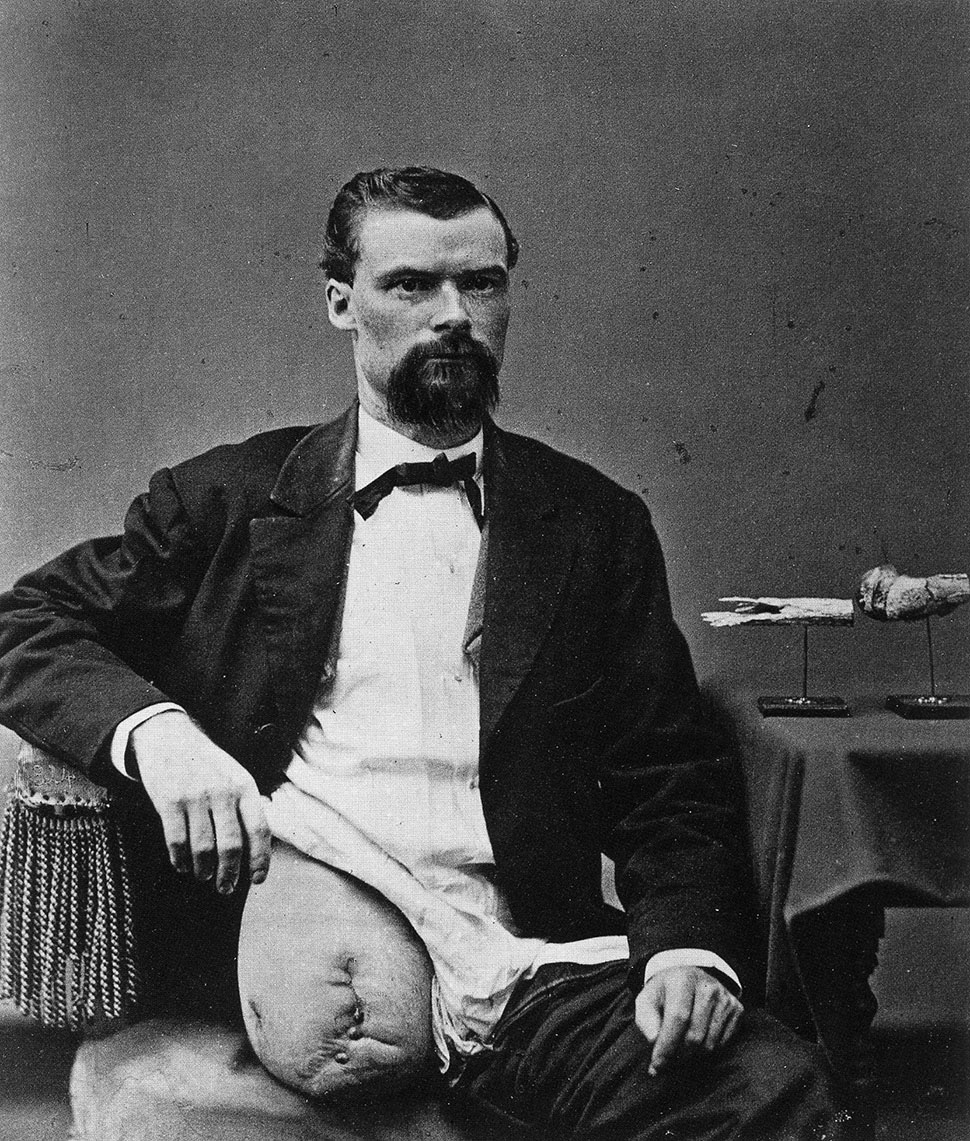
William Cotter, Reamputation, Army Medical Museum Photograph No. 324
Mütter Museum Archives, albumen print
Successful reamputation in 1871 of William Cotter, age thirty-two, at right hip for osteomyelitis following prior amputation for musket ball injury in the lower third of the thigh received in front of Petersburg as a private of Company E, 9th New Hampshire Volunteers, in 1864. Photographed in 1872; from the series of photographs taken at the Army Medical Museum to document results of medical treatment during and after the Civil War.
*****
The book puts this photo side-by-side with the following one. I can’t help but notice that the black man is not provided the dignity of clothing, and is treated more like an animal specimen, even in his placement in an “outdoor” setting. Of course, it may just be the difference in the photographer’s preference, but it still seemed worth noting.
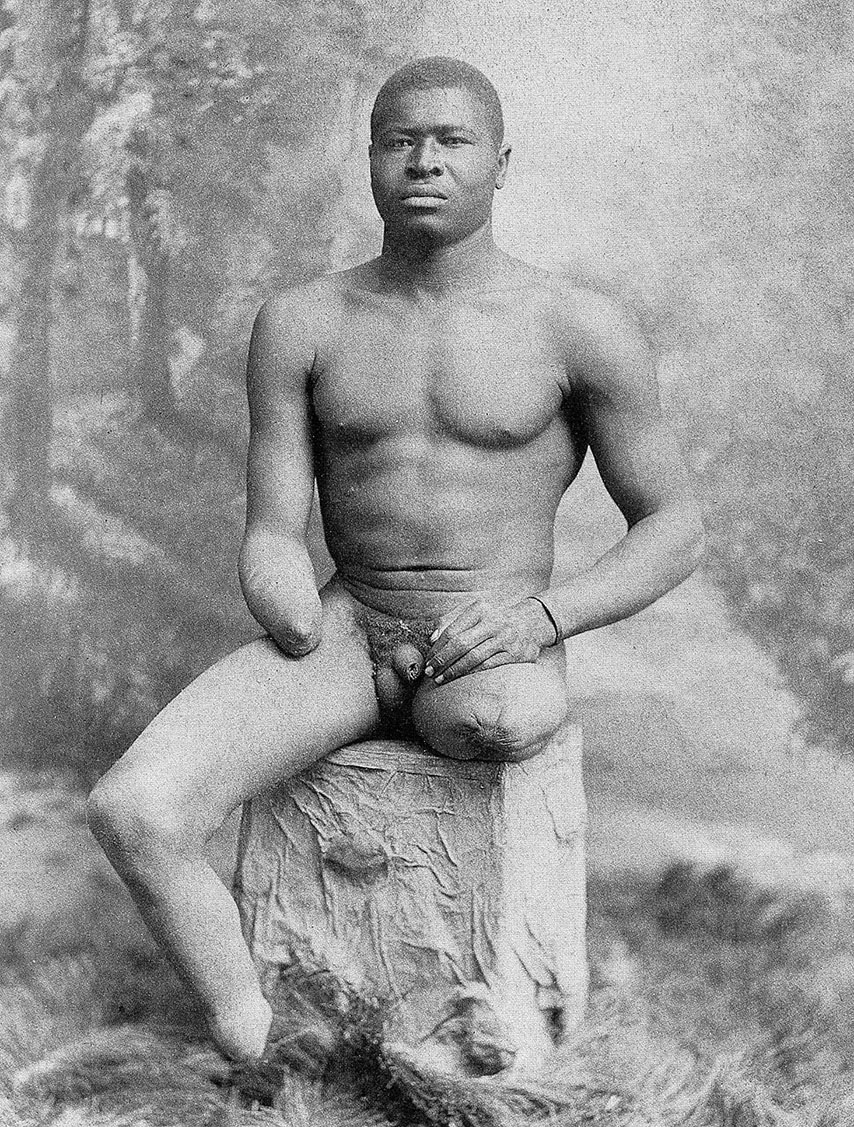
Triple Amputation, Dr. J. B. Luckie’s First Case
Mütter Museum Archives, albumen print
James Buckner Luckie, M.D. (1833-1908) of Birmingham, Alabama, performed the first and second successful triple amputations in the United States. Photograph by Wallins, Montgomery, Alabama.
Culled from: The Mütter Museum of the College of Physicians of Philadelphia