Today’s Curious Yet Truly Morbid Fact!
Charles Byrne (1761 – 1783), also known as Charles O’Brien or the “Irish Giant”, was a human curiosity in London in the 1780s. His exact height is unknown: most accounts refer to him as from 8 ft 2 in (2.48 m) to 8 ft 4 in (2.54 m) tall, but skeletal evidence suggests that he was just over 7 ft 7 in (2.31 m). His family lived in a remote part of north-east Tyrone called Drummullan, not far from the shores of Lough Neagh. Local tales tell that Byrne was conceived on top of a haystack to explain the cause of his unusual height. Little is known of Byrne’s family other than that his parents were ordinary people, and that they were not unusually tall.
At 21, Byrne left his home in Littlebridge, Ireland and traveled to London seeking his fortune. The city was a magnet for every manner of human oddity at the time. Londoners were eager to pay to see ‘freaks’ and ‘wonders’ — people with deformed and extra limbs, great or diminutive height, or with visually shocking medical conditions. He found work at Cox’s Museum and moved into an elegant adjacent apartment, stocked with custom-built furniture. Charles soon became the toast of the town. A 6 May 1782 newspaper report noted: ‘However striking a curiosity may be, there is generally some difficulty in engaging the attention of the public; but even this was not the case with the modern living Colossus, or wonderful Irish Giant.’
Among those whose attention was drawn to London’s latest wonder was the anatomist John Hunter. Driven – even possessed — by a deep curiosity about unusual bodies and preoccupied by scientific studies of human malformation Hunter became obsessed with procuring Byrne’s body for his anatomical collection, whatever the cost. Under permanent surveillance from Hunter’s spies, Byrne, a stout Catholic, began to fear for his soul and afterlife. Indeed Byrne was so afraid that Hunter would dissect his corpse that on his deathbed requested to be buried at sea.
Fame and wealth soon overtook Byrne, and he gained a reputation for excessive drinking. According to newspaper reports he was drunk when his pocket was picked of his 700-pound life savings. Inconsolable, he drowned his sorrows and died in his apartment on Cockspurstreet, Charing Cross, in June 1783, at the age of only twenty-two.
Against his explicit wishes, Byrne’s corpse was purchased by John Hunter for five hundred pounds (2011: £50,000). To achieve this end, Hunter bribed a member of the funeral party and filled the coffin with rocks at an overnight stop as Byrne’s body was taken from London to the sea where he had wished to be buried. For reasons unknown, Hunter who had put so much effort into procuring Byrne’s body, never displayed the skeleton during his lifetime. Today it remains on display at the Royal College of Surgeon’s Hunterian Museum in London, where it continues to elicit controversy.
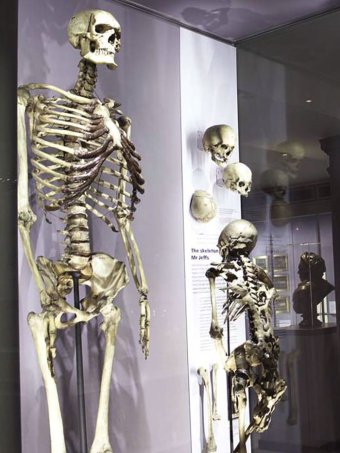
The Irish Giant on display at the Hunterian Museum
Culled from: Warwick University
There’s a book, by Hilary Mantell, I think, called “The Giant O’Brien” and is a fictionalized account of his life and his efforts to avoid Dr. Hunter.