Today’s Skillful Yet Truly Morbid Fact!
I have just started reading Dr. Mütter’s Marvels, about the life of Dr. Thomas Dent Mütter (1811-59), who is responsible for collecting the medical oddities that make up the indispensable Mütter Museum. This excerpt is about the surgical lectures in Mütter’s native Philadelphia at the time:
Mütter had always loved surgical lectures and made sure he secured seats as close to the front as possible. In Philadelphia, there were two great medical colleges – the University of Pennsylvania and Jefferson Medical College – and it was customary for the rival schools to hold surgical demonstrations so that prospective students could choose between them, a glorified public relations exercise. Mütter loved the daringness of the surgeries attempted during this time. The lectures were often packed, as eager established and prospective doctors thrilled at the city’s best surgeons attempting to outdo one another with their skill and showmanship. However, the combination of ambitious surgeries and unprepared young men sometimes proved disastrous. On one occasion, a Jefferson Medical College professor attempted a daring removal of a patient’s upper jaw, using marvelous speed to incise the face and rip out the bones with a huge forceps. But the surgery was perhaps too much for a public display. Doctors who were present would later recall the spectacle of it, how the partially conscious patient spat out blood, bones, and teeth, while unnerved students in the audience vomited and fainted in their seats.
But regardless of how brutal or simple the case, all surgical lectures were a challenge to watch. The anxious patient would be publicly examined and forced to listen to his surgery loudly outlined to an audience of strangers. Next, the patient would nervously drink some wine with the hope that it would dull the nerves and lessen the pain. (In Paris, the need for medicinal wine was so great, the hospital system maintained its very own wine vaults, spending more than 600,000 francs a year on an extensive collection of red and white wine housed exclusively for its patients.)
The patient was then instructed to lie on the surgical table, where he would be held down by the surgeon’s assistants and told to stay as still as possible. Everyone – the patient, the doctor, even the students in their seats – knew how impossible this command would be to follow.
The first incision usually brought the patient’s first scream – the first scream of many. Soon came the blood, the struggle, the shock. The patient would beg the surgeon to stop, plead and shout, and yell to the students to come save him, his voice cracking, tears streaming down his face. The surgeon was expected to ignore it all, to move forward swiftly and surely , and to hope that his assistants were strong men with equal resolve. Every student had heard stories of patients who were able to struggle free, who leapt off the table and attacked their doctors – often with the surgeon’s own instruments! – before running out of the room, leaving a trail of their own blood behind them.
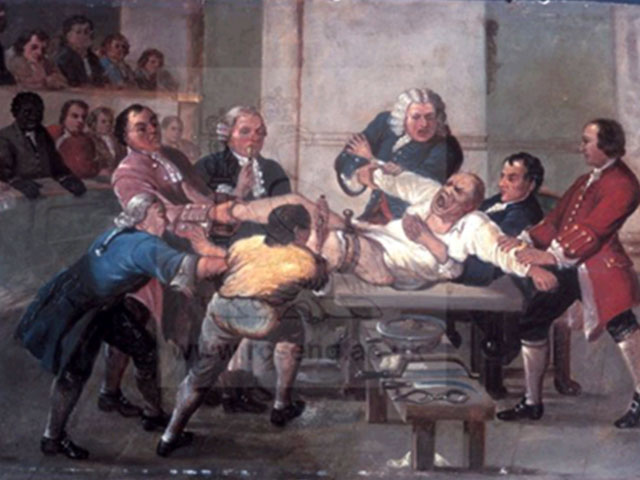
Of course, despite the skill and care of the surgeon, the patients often died. Sometimes they died in the middle of surgery, the trauma to their bodies becoming too much. Sometimes they would die after, because their wounds were unable to stop bleeding, or the unwashed tools of their own surgeon had given them a fevered infection that consumed their flesh from the inside out. Under the best circumstances, the patient not only lived but lived a better life.
Culled from: Dr. Mütter’s Marvels
Hey, look: you can visit one of Philadelphia’s old operating theaters!
America’s Oldest Operating Theater
And, wow! There’s a really cool one in England too!
The Old Operating Theatre Museum
Wretched Review: Cemetery Stories
Cemetery Stories: Haunted Graveyards, Embalming Secrets, and the Life of a Corpse After Death
by Katherine Ramsland

Okay, on the bright side, if you were reading this book and you didn’t know anything about “creepy” stuff like embalming, funeral rituals, cemeteries, etc. then this book would make for an easy and fun read. It’s a great book for airport reading because the chapters are all short and keep your interest, and it rushes by you. However, on the down side…
If you are an experienced morbiphile, this book will probably annoy you as much as it annoyed me. I guess the title is completely accurate: this is a collection of morbid “stories”. Quite a few of the “stories” I know to be true. However, nothing is documented and everything is presented in a “so I was talking to this undertaker and this is what he told me” casual conversational manner that completely shatters the idea that what you’re reading is anything other than friend-of-a-friend-of-a-friend hearsay. I bookmarked a few items that I’d love to share as Morbid Facts but first I need to research them to see if anything Ramsland shares is factual. Yeah, that’s annoying.
Also annoying – the fact that this paragraph actually exists within this book:
“Classic ghost stories often feature the image of a person who keeps going through the motions of how he or she had died. This type of incident has been reported so many times by enough credible witnesses that there’s no reason to think it does not happen.”
Really. No reason at all to believe it doesn’t happen? Alrighty, then.
I guess I shouldn’t be surprised by that sentence, after all, Ramsland doesn’t see fit to document many of her claims in the book. And that’s fine, some people will love this book, even the ghost story section. I, personally, expect a bit more accountability with my non-fiction.
BTW: If you want to read a much *better* version of this book, read Mary Roach’s “Stiff”.
1.5/5