Today’s Living Yet Truly Morbid Fact!
There is evidence that already in classical antiquity some observers were aware that the criteria of death might sometimes be fallible. The seventh book of Pliny’s Natural History contains a section on the signs of death among the Romans. Rather pessimistically, Pliny wrote that the signs of death are innumerable, but that there are no signs that health is secure. Although many in number, these death signs were not always reliable. Shockingly, the consul Acilius Aviola and the praetor Lucius Lamia had both awakened on their flaming funeral pyres after being falsely declared dead, and the attendants could save neither of them from a most horrible death. Another Roman worthy, Gaius Aelius Tubero, managed to show signs of life while actually on the pyre, fortunately before it was too late. Pliny also mentioned several instances where people had been carried out on a bier to be buried, but returned on foot. He concluded, “Such is the condition of humanity, and so uncertain is men’s judgment, that they cannot determine even death itself.”
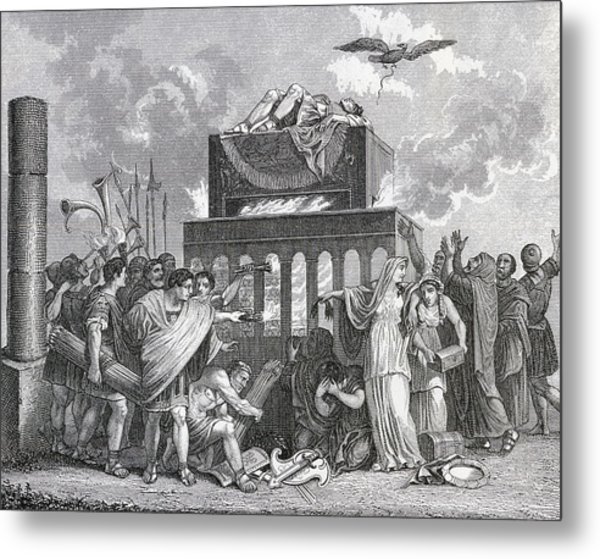
A Roman Funeral Pyre
Plutarch told of a man who had fallen from a precipice and who lay motionless for three days before returning to life as his friends carried him to the grave. In Plato’s Republic can be found the tale of an Armenian soldier named Er who was slain in battle. Ten days later, the surviving soldiers returned to bury the dead and were surprised to find that even though all other bodies were corrupted, that of Er was still intact. This finding did not weaken their conviction that he was dead, however, and they put him on a funeral pyre, where, to the great surprise of all those present, he returned to life and was saved. The very influential Greek physician Galen recommended great caution in certain diseases, like hysteria, asphyxia, coma, and catalepsy, since the signs of life could be suspended for weeks without affecting the chance for recovery. In his De Locis affectis, he commented on a case report given by Heraclides of Pontus, concerning a woman who had collapsed from “uterine suffocation” [the mind boggles – DeSpair] and was without a perceivable pulse or respiration for thirty days before reviving.
Galen was also aware that some people who died from excessive joy or grief were known to recover; moreover, he considered it unwise to consign to the grave too hastily those who had died from intoxication with alcohol or soporific drafts. In his De medicinia, the influential Roman physician Aurelius Cornelius Celsus agreed, stating that the art of medicine was conjectural, and the signs of death not always totally reliable. As evidence, he repeated the tale of Asclepiades of Prusa, who discovered that the “corpse” carried along in a funeral cortege was not really dead. But he also wrote that a sign should not be rejected if it was deceptive in just 1 out of 1,000 instances, if it held good in the other 999 patients.
Culled from: Buried Alive: The Terrifying History of Our Most Primal Fear