Today’s Oozing Yet Truly Morbid Fact!
A man did not need a medical degree to practice medicine in early 19th century Philadelphia. In fact, he didn’t even need a license – a practice that Philadelphia would not embrace until the final decade of the 19th century.
Although the tide was changing, the clear truth was that anyone who wanted to put out a shingle and call himself a doctor could do just that.
Even those doctors who followed due process – apprenticed under local doctors, went to medical colleges and studied hard, practiced often and kept as up-to-date as possible with the latest innovations – still struggled with the medical limitations of the day.
Medicine was performed literally in the dark. Electricity was newfangled and unpopular. Almost every act a doctor performed – invasive examinations, elaborate surgeries, complicated births – had to be done by sun or lamplight.
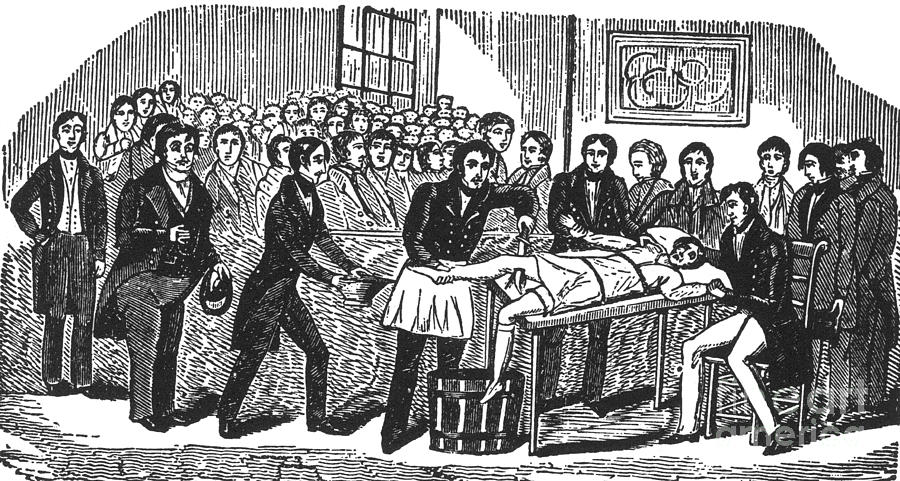
Basics of modern medicine, such as the infectiousness of diseases, were still under heavy dispute. Causes of even common diseases were confusing to doctors. Benjamin Rush thought yellow fever came from bad coffee. Tetanus was widely through to be a reflex irritation. Appendicitis was called peritonitis, and its victims were simply left to die.
The role that doctors – and their unwashed hands and tools – played in the spread of disease was not understood. “The grim spectre of sepsis” was ever present. It was absolutely expected that wounds would eventually fester with pus, so much so that classifications of pus were developed: A “yellow ooze” was seen as a good “laudable pus” while an “ichorous pus” (a thin puss teeming with shredded tissue) was viewed as “the stinking herald of cadaverous putrefaction.”
Medicine was not standardized so accidental poisoning was common. Even “professionally” made drugs were often bulky and nauseating. Bleeding the ill was still a widespread practice, and frighteningly large doses of purgatives were given by even the most conservative men. To treat a fever with a cold bath would have been “regarded as murder.”
There was no anesthesia – neither general nor local. Alcohol was commonly used when it came to enduring painful treatments, although highly addictive laudanum (a tincture of 90% alcohol and 10% opium) and pure opium were sometimes available too. If you came to a doctor with a compound fracture, you had only a 50% chance of survival. Surgery on brains and lungs and was attempted only in accident cases.Bleeding during operations was often outrageously profuse, but, as comfortingly described by one doctor, “not unusually fatal.”
Culled from: Dr. Mutter’s Marvels: A True Tale of Intrigue and Innovation at the Dawn of Modern Medicine