Today’s Saintly Yet Truly Morbid Fact!
In Classical Rome, as for centuries to come, extraction was the most common response to the torment of toothache – although there were other options. Scribonius Largus, physician to the emperor Claudius, advised his patients to fumigate their mouths with the smoke of henbane seeds, in the hope that this would drive out the tooth worms responsible for decay. He also recorded a recipe for tooth powder favored by Messalina, Clausius’ empress, composed of ammonium chloride, mastic resin and antler ashes. A near contemporary of Largus, the Syrian-Greek Archigenes, described a hand-powered trephine (hole saw) for boring into a bad tooth to release the accumulated humors. But a constant theme in early treatises on the teeth was the intractability of toothache, the drawn, haggard faces of those who suffer it over weeks or months and the great difficulty of relieving it. Celsius prescribed a soothing tonic containing mandrake root, opium and cinnamon, and Galen recommended the application of pickled chrysanthemum root directly to painful teeth; practitioners in other parts of the world tried henbane, hashish and therapies such as acupuncture.
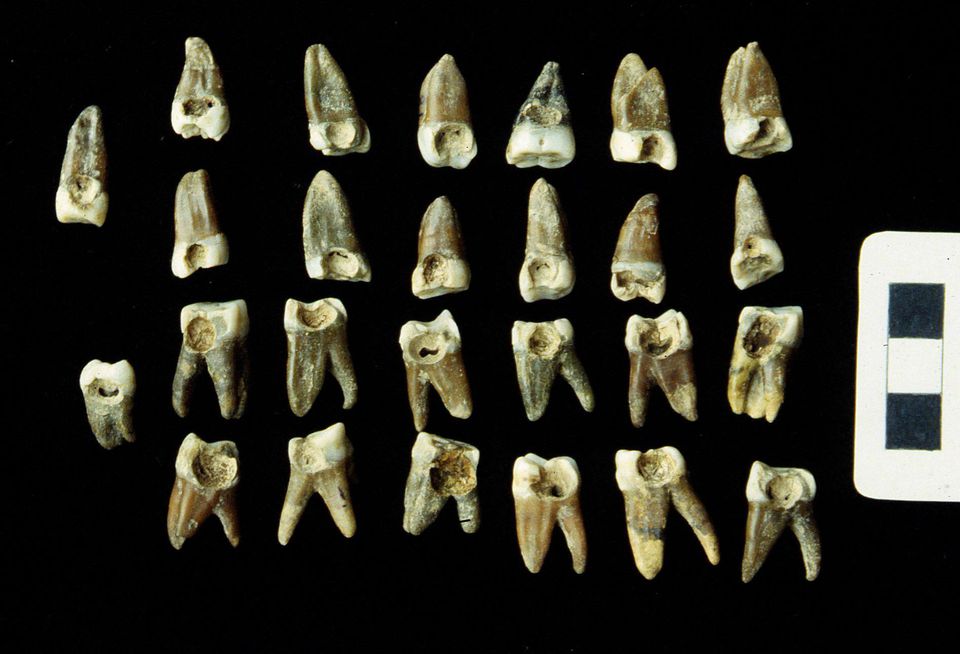
Extracted teeth discovered in the drain of a Roman dentist. (Article at Forbes.)
Given this enduring association between the teeth and excruciating pain, it is scarcely surprising that we can trace a parallel history of tooth extraction as torture and punishment. Perhaps the most notorious instance is the story of St. Apollonia, who lived and died in Egypt in the second century AD. Almost everything we know of Apollonia comes from later hagiographies, and the details – that her mother had prayed to the Virgin Mary for a child, that Apollonia became a disciple of St. Anthony of Egypt, that it was her father, a magistrate, who condemned her to death – seem like pious embroidery. But the earliest versions of her life have her meeting her end in an outbreak of anti-Christian persecution in Alexandria in 248-49. Shortly afterwards, Dionysius, bishop of Alexandria, recorded the manner of death in a letter:
At that time Apollonia, Parthenos Presbytis [literally, ‘sacred virgin’, a priest] was held in high esteem. These men seized her also and by repeated blows broke all her teeth. They then erected outside the city gates a pile of wood and threatened to burn her alive if she refused to repeat after them impious words. Given, at her own request, a little freedom, she sprang quickly into the fire and was burned to death.
In the macabre manner of medieval Catholicism St. Apollonia was taken up as the patron saint of tooth-pullers and those suffering toothache. In icons and stained-glass windows, she is depicted with the instrument of her suffering – typically a long, blunt pair of blacksmiths’ pincers – and the cathedral of Porto in Portugal possesses a jewel-encrusted reliquary said to hold a tooth taken from her jaw.
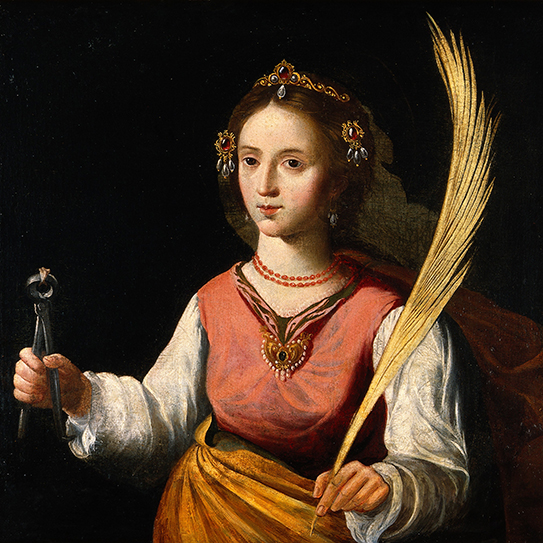
St. Apollonia. Those wacky Catholics!
Culled from: The Smile Stealers: The Fine & Foul Art of Dentistry
Garretdom!
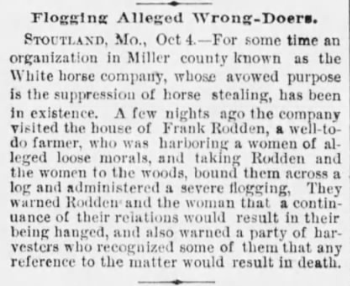
Time for another archaic article to show us how awful the good old days really were! This one is from the October 8, 1886 issue of the Walnut (Kansas) Journal. Sounds like the White Horse Company was the No Fun Club!
More archaic atrocities can be read at Garretdom.