Today’s Festering Yet Truly Morbid Fact!
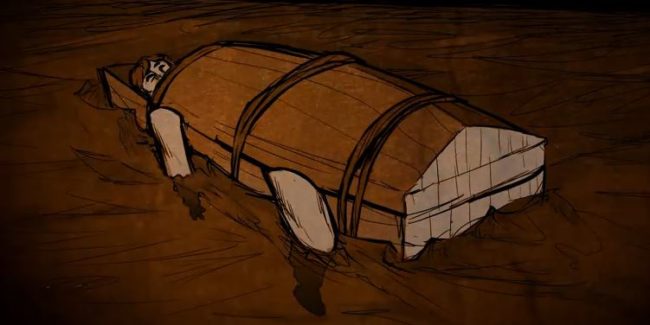
Scaphism, also known as the boats or (confusingly) cyphonism, is an alleged ancient Persian method of execution. The word comes from the Greek σκάφη, skáphe, meaning “anything scooped (or hollowed) out”. It entailed trapping the victim between two boats, feeding and covering him[a] with milk and honey, and allowing him to fester and be devoured by vermin. The primary source is Plutarch’s ‘Life of Artaxerxes II’, where he attributes the story to Ctesias, a notoriously suspect source
The first mention of scaphism is Plutarch’s description of the execution of Mithridates:
[The king] decreed that Mithridates should be put to death in boats; which execution is after the following manner: Taking two boats framed exactly to fit and answer each other, they lay down in one of them the malefactor that suffers, upon his back; then, covering it with the other, and so setting them together that the head, hands, and feet of him are left outside, and the rest of his body lies shut up within, they offer him food, and if he refuse to eat it, they force him to do it by pricking his eyes; then, after he has eaten, they drench him with a mixture of milk and honey, pouring it not only into his mouth, but all over his face. They then keep his face continually turned towards the sun; and it becomes completely covered up and hidden by the multitude of flies that settle on it. And as within the boats he does what those that eat and drink must needs do, creeping things and vermin spring out of the corruption and rottenness of the excrement, and these entering into the bowels of him, his body is consumed. When the man is manifestly dead, the uppermost boat being taken off, they find his flesh devoured, and swarms of such noisome creatures preying upon and, as it were, growing to his inwards. In this way Mithridates, after suffering for seventeen days, at last expired.
— Plutarch, Life of Artaxerxes
The 12th-century Byzantine chronicler Joannes Zonaras later described the punishment, based on Plutarch:
The Persians outvie all other barbarians in the horrid cruelty of their punishments, employing tortures that are peculiarly terrible and long-drawn, namely the ‘boats’ and sewing men up in raw hides. But what is meant by the ‘boats,’ I must now explain for the benefit of less well informed readers. Two boats are joined together one on top of the other, with holes cut in them in such a way that the victim’s head, hands, and feet only are left outside. Within these boats the man to be punished is placed lying on his back, and the boats then nailed together with bolts. Next they pour a mixture of milk and honey into the wretched man’s mouth, till he is filled to the point of nausea, smearing his face, feet, and arms with the same mixture, and so leave him exposed to the sun. This is repeated every day, the effect being that flies, wasps, and bees, attracted by the sweetness, settle on his face and all such parts of him as project outside the boats, and miserably torment and sting the wretched man. Moreover his belly, distended as it is with milk and honey, throws off liquid excrements, and these putrefying breed swarms of worms, intestinal and of all sorts. Thus the victim lying in the boats, his flesh rotting away in his own filth and devoured by worms, dies a lingering and horrible death.
— Zonaras, Annals
Culled from: Wikipedia
Generously submitted by: Joanne
Humans are absolutely the most disgusting animal on the planet. There can be no doubt!
Vintage Surgical Illustration Du Jour!
Another illustration that would make a lovely wrapping paper, don’t you think?
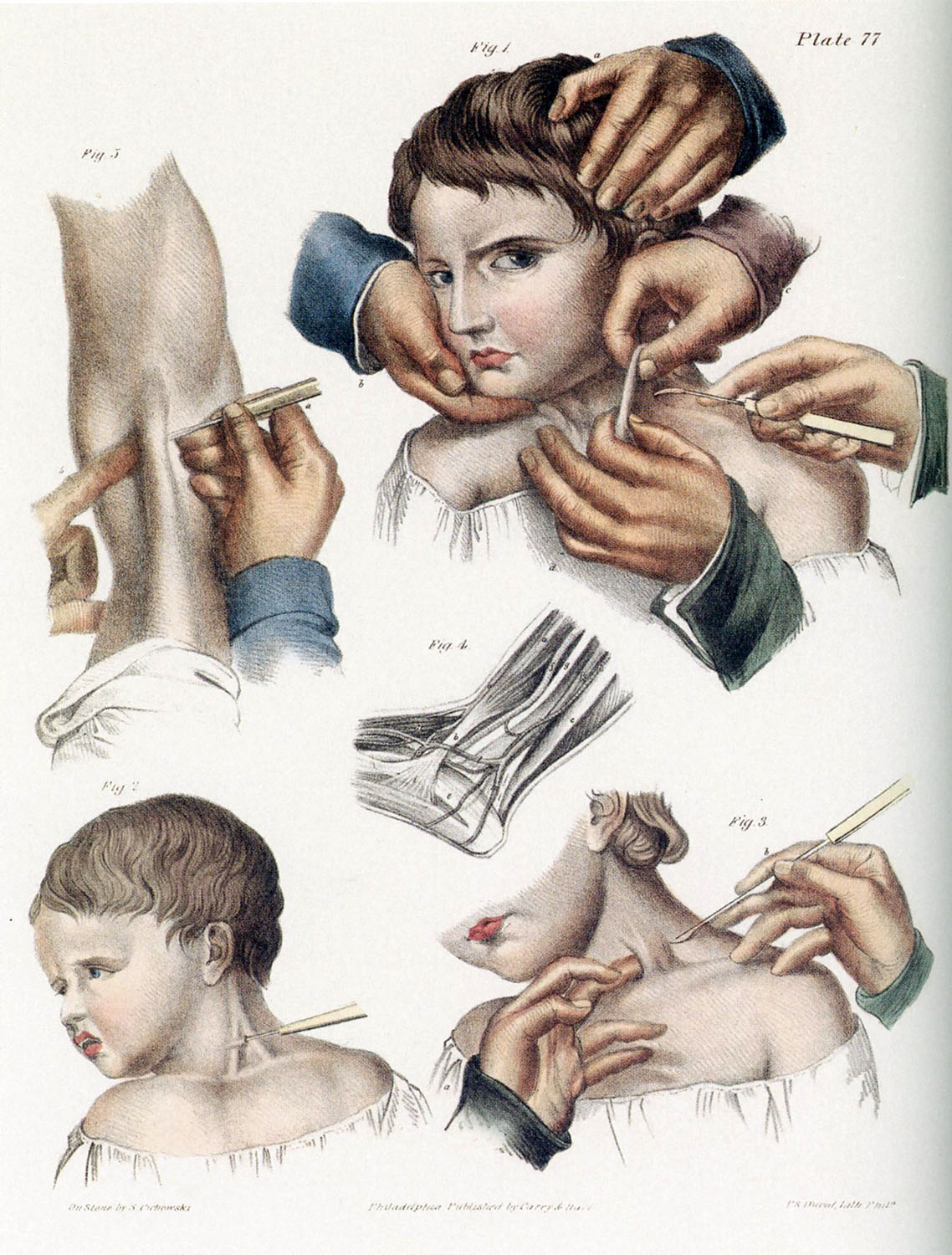
Various operations carried out through a small opening in the skin.
Culled from: Crucial Interventions: An Illustrated Treatise on the Principles & Practice of Nineteenth-Century Surgery