Today’s Blood-Slickened Yet Truly Morbid Fact!
The earliest demonstrations of ether anesthesia were performed during painful yet somewhat minor surgeries – tooth extractions and small tumors – but each one was an “unqualified triumph.” As people clamored to know more about this amazing new discovery, its originator, dentist William T. G. Morton, realized that his unique combination of sulphuric ether and nitrous oxide could be a potential moneymaking opportunity. He not only refused to tell people the makeup of this transformative gas, but he also stopped all public trials of the anesthesia – which he called Letheon, after Lethe, Greek mythology’s mythical river of forgetfulness.
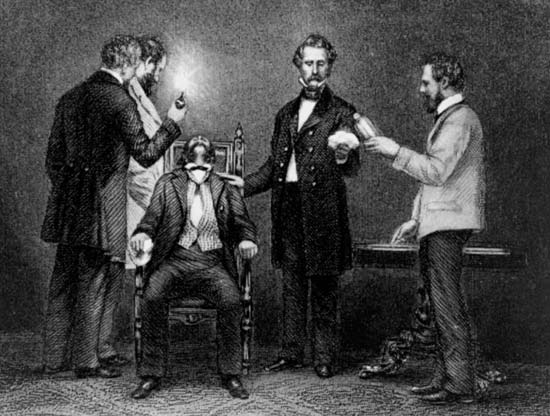
Morton Demonstrating His Anesthesia
But the medical community wouldn’t stand for it, and an enterprising young surgeon named Henry J. Bigelow specifically called out Morton to give a more ambitious demonstration. Bigelow explained that while toothaches and small tumor removals were all well and good, he wanted to know if this promising surgical tool would work in “capital” (or major) surgery.
Bigelow – who already imagined that Letheon contained sulphuric ether – challenged Morton to use his “preparation” in a leg amputation he was slated to perform. The amputation was one of the most dangerous, deadly, and painful kinds of this type of surgery: full amputation at the thigh.
This was a true test of the new anesthesia, and one that medical men were all familiar with: the image of the man held down on the table as the doctor approaches with his kit of amputation tools; the first jolt and yelp of pain as the long, curved blade of the amputation knife slashes the man’s skin, ripping into it violently; as the saw makes it way through veins and arteries and on to muscle, everyone’s clothing becomes dark, wet, and heavy with sweat and the eruptive spurts of salty blood; as the doctor pauses to switch tools, the man might receive a surge of adrenaline like an electrical shock, and the men tasked with holding him down redouble their efforts as he bucks wildly, his skin now hard to grab because of the slick coating of his own blood; and then everyone hears it, the sound of the amputation saw’s blade hitting the bone; minutes pass as the room fills with the slow growl of the saw, the cracking of bone, and the screams of the poor man tasked to endure it all.
Now imagine being the surgeons who had to face this scenario so often, and who – because of the calling of their profession – had to be the traumatizing source of so much agony, even as a deep desire to relieve the pain of others was the reason so many of them wanted to become physicians in the first place.
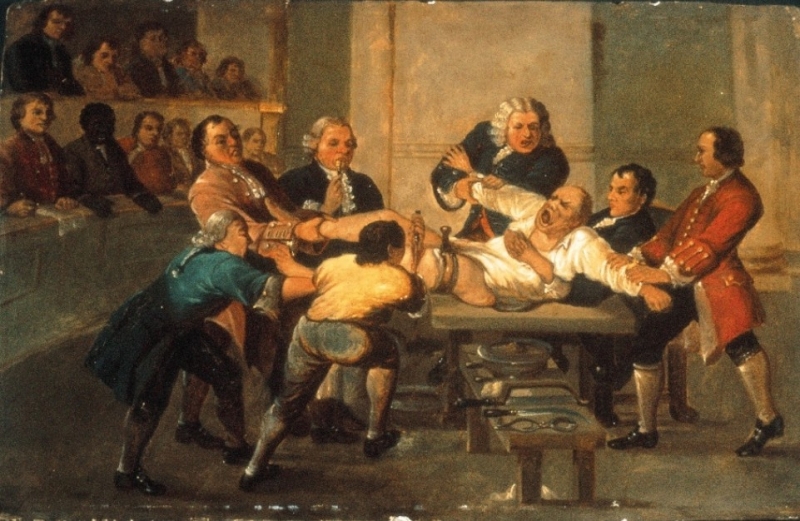
“I changed my mind!!!”
It is no mystery why surgeons often prized the speed of a surgery over its precision. Warren himself described how difficult these types of surgeries were to perform in the early to middle nineteenth century, writing:
It was the custom to bring the patient into the operation room and place him upon the table. The surgeon would stand with both hands behind his back and say to the patient,
“Will you have your leg off, or will you not have it off?”
If the patient lost courage and said, “No,” he had decided not to have the leg amputated, he was at once carried back to his bed in the ward.
If, however, he said, “Yes,” he was immediately taken firmly in hand by a number of strong assistants and the operation went on regardless of whatever he might say thereafter.
If his courage failed him after this crucial moment, it was too late and no attention was paid to his cries of protest.
It was found to be the only practicable method by which an operation could be performed under the gruesome conditions which prevailed before the advent of anesthesia.
Having been publicly called out, Morton felt forced to accept the challenge. In front of Bigelow’s watchful eyes, Morton was able to render the patine “unconscious and insensitive to pain.” And the amputation surgery was a complete success. Not only that, but Bigelow was able to convince Morton to share his recipe of how to create Letheon simply and cheaply and to give authorization to Bigelow to write the first truly detailed public announcement of his discovery.
Culled from: Dr. Mütter’s Marvels: A True Tale of Intrigue and Innovation at the Dawn of Modern Medicine
Vintage Surgical Illustration Du Jour!
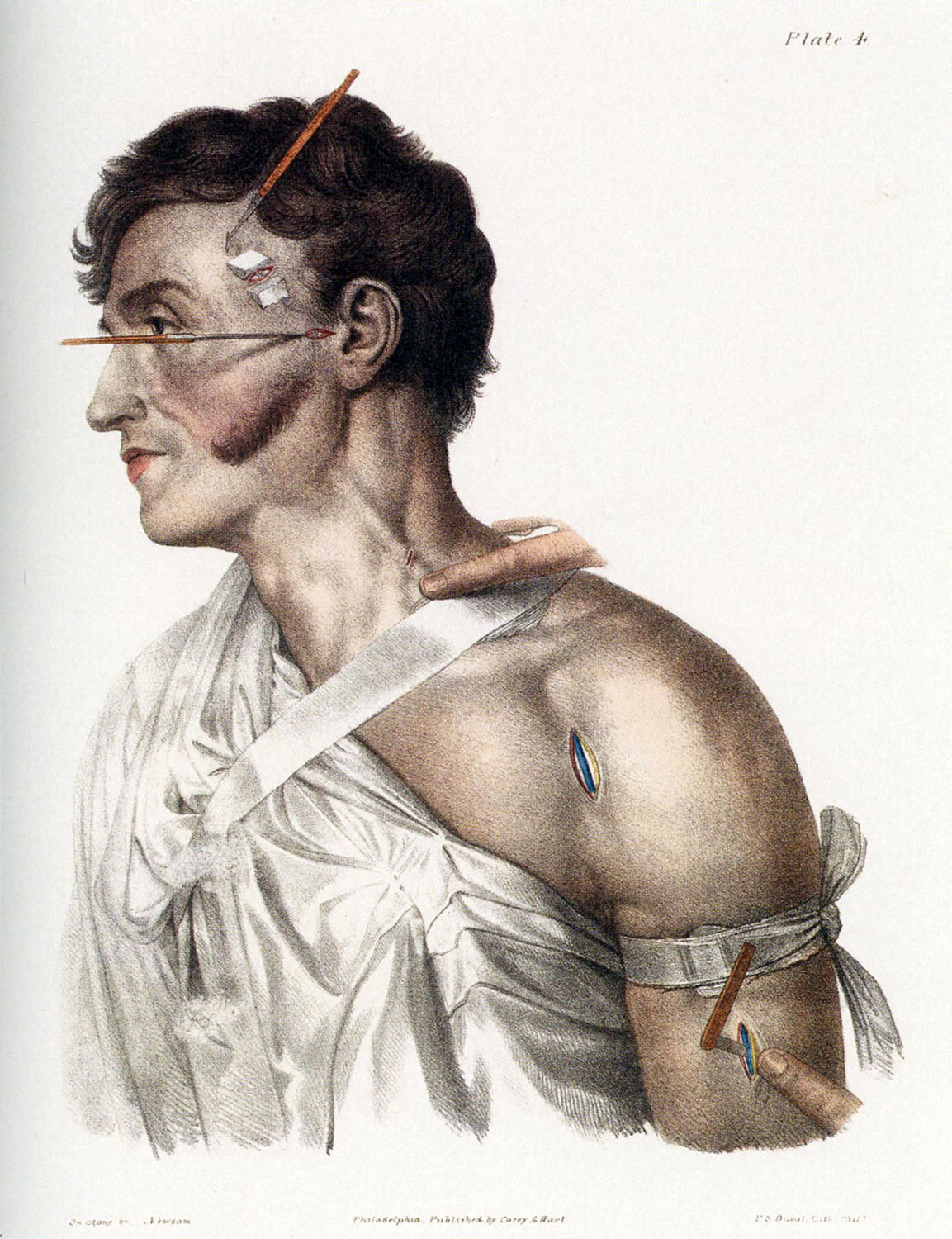
Surgical incisions in the jugular and cephalic arteries.
Culled from: Crucial Interventions: An Illustrated Treatise on the Principles & Practice of Nineteenth-Century Surgery