Today’s Unfortunate, Unavoidable Yet Truly Morbid Fact!
Infectious diseases had always been a problem for Philadelphia – and as its population exploded, the problem only grew worse.
While the city had enjoyed a decline in the mortality rate among its citizens during the years between 1825 and 1850 – a triumph considering that similar cities like Boston, Baltimore, and New York City saw increases – their good fortune had begun to run out.
An outbreak of Asiatic cholera killed 1,012 Philadelphians in 1849. An eruption of smallpox took 427 lives in 1852. Yellow fever swept into the city in the following year and left 128 corpses in its wake. These numbers were in addition to the deaths caused by illnesses that had become so common in Philadelphia that people thought suffering from them was just an unfortunate, but unavoidable, part of city life.
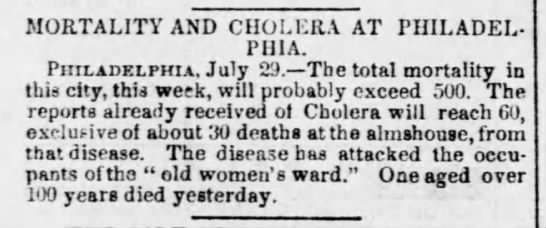
The frequently recurring disease, typhus, struck the city throughout the 1840s, killing 205 people in 1848 alone. Dysentery terrorized the city every summer, especially the poorest neighborhoods, and would go on to kill more than 1,700 citizens between 1848 and 1851. Meanwhile, malarial fevers spread easily and frequently in the city’s low, flat lands between the rivers, and tuberculosis, often called consumption, was also a constant presence.
Ten times as many people died of malaria and tuberculosis in Philadelphia than died of the much more feared cholera, but because the malaria and tuberculosis victims passed away gradually and quietly – they died “romantically,” as it was termed – the general public took to dreading cholera more, for it was known for killing its sufferers “with terrifying speed and ugliness.”
It was not uncommon for several diseases to have devastating outbreaks at once. In 1852 – the same year that smallpox killed more than 400 Philadelphians – 443 died of scarlet fever, 558 more of dysentery, and more than 1,200 were claimed by tuberculosis.
Culled from: Dr. Mütter’s Marvels: A True Tale of Intrigue and Innovation at the Dawn of Modern Medicine
Vintage Surgical Illustration Du Jour!
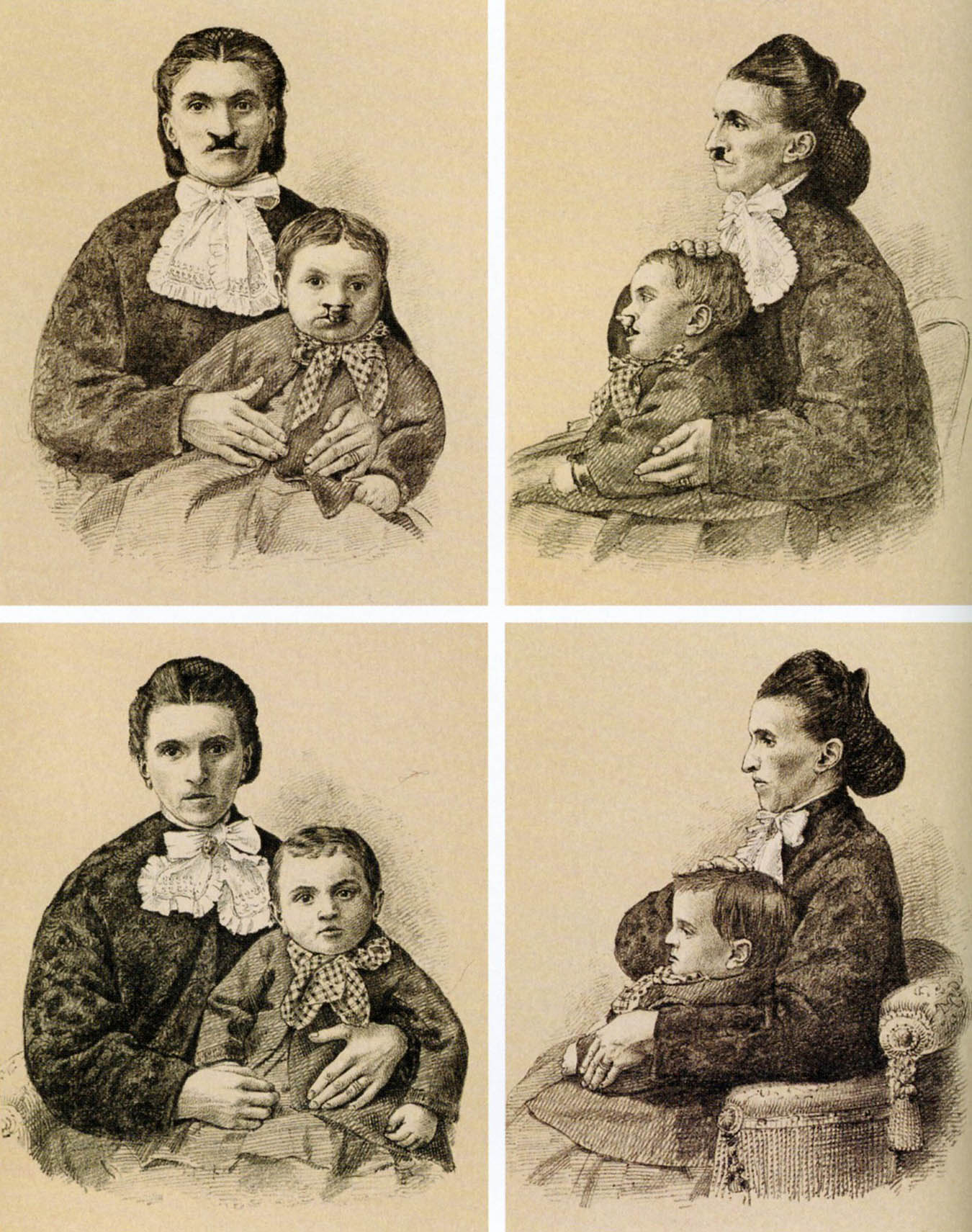
Double complicated harelip in mother and child. Front and side views before (top) and after (bottom) surgery.
Culled from: Crucial Interventions: An Illustrated Treatise on the Principles & Practice of Nineteenth-Century Surgery
The diseases might be different today, but I guess Philly hasn’t changed all that much; my dad has always referred to it as Filthadelphia, and he’s not the only one.
It was Ground Zero for the very first known outbreak of Legionnaire’s disease, in 1976, in case you’re ever on Jeopardy! and need to know that.