Today’s Curious Yet Truly Morbid Fact!
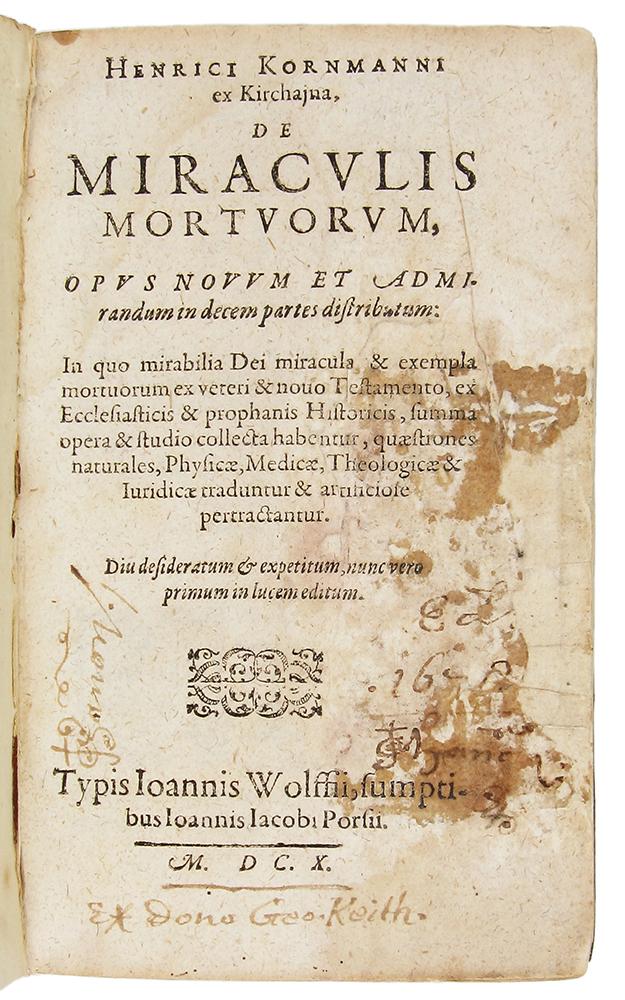
Why did the body of a murdered man start to bleed profusely when the murderer entered the room, and why was a ghostly rattle of the bones from the tomb of Pope Sylvester II always heard just before the death of a pope? Why did the hair and nails of some cadavers keep growing after death, and why did some of them even cut new teeth? Who are the more happy, the dead or the living, and are all humans, even the most hideous monsters, resurrected in heaven? These were some of the questions addressed in Dr. Heinrich Kornmann’s curious book De miraculis mortuorum, a treatise on the miracles of the dead, first published in 1610. Among the sections on incorruptible saints, screaming corpses, speaking skulls, and jumping specters in Kornmann’s book is to be found a brief note concerning a certain Cardinal Andreas, who died in Rome and was to be buried in a cathedral, where the pope and a body of clergy attended a service to honor his memory. But during the service the cardinal groaned and sat up in his coffin. This was looked on as a miracle and ascribed to the influence of Saint Jerome, to whom the cardinal was greatly attached. Another note describes the death of Archbishop Geron of Cologne, who was prematurely buried in a tomb in his own cathedral, and expired in the most lamentable manner; his sad fate was deemed just as miraculous as the phenomena discussed earlier.
Another view of the miracles of the dead is given in the German medical practitioner Christian Friedrich Garmann’s similarly titled treatise De miraculis mortuourum. Like many other seventeenth-century doctors and scientists, he was immensely erudite and preferred the compilation of numerous quotations from the classical literature, and the ancient repositories of curious medical anecdotes, to actual observations by himself or other contemporaries. The first edition of Garmann’s book appeared in 1670, but he kept compiling more and more miracles,so the ultimate version of his book, posthumously published in 1709, was an encyclopedic work of more than twelve hundred pages. It provides a veritable dictionary of sixteenth- and seventeenth-century observations, beliefs and superstitions about the dark underground world of cadavers.
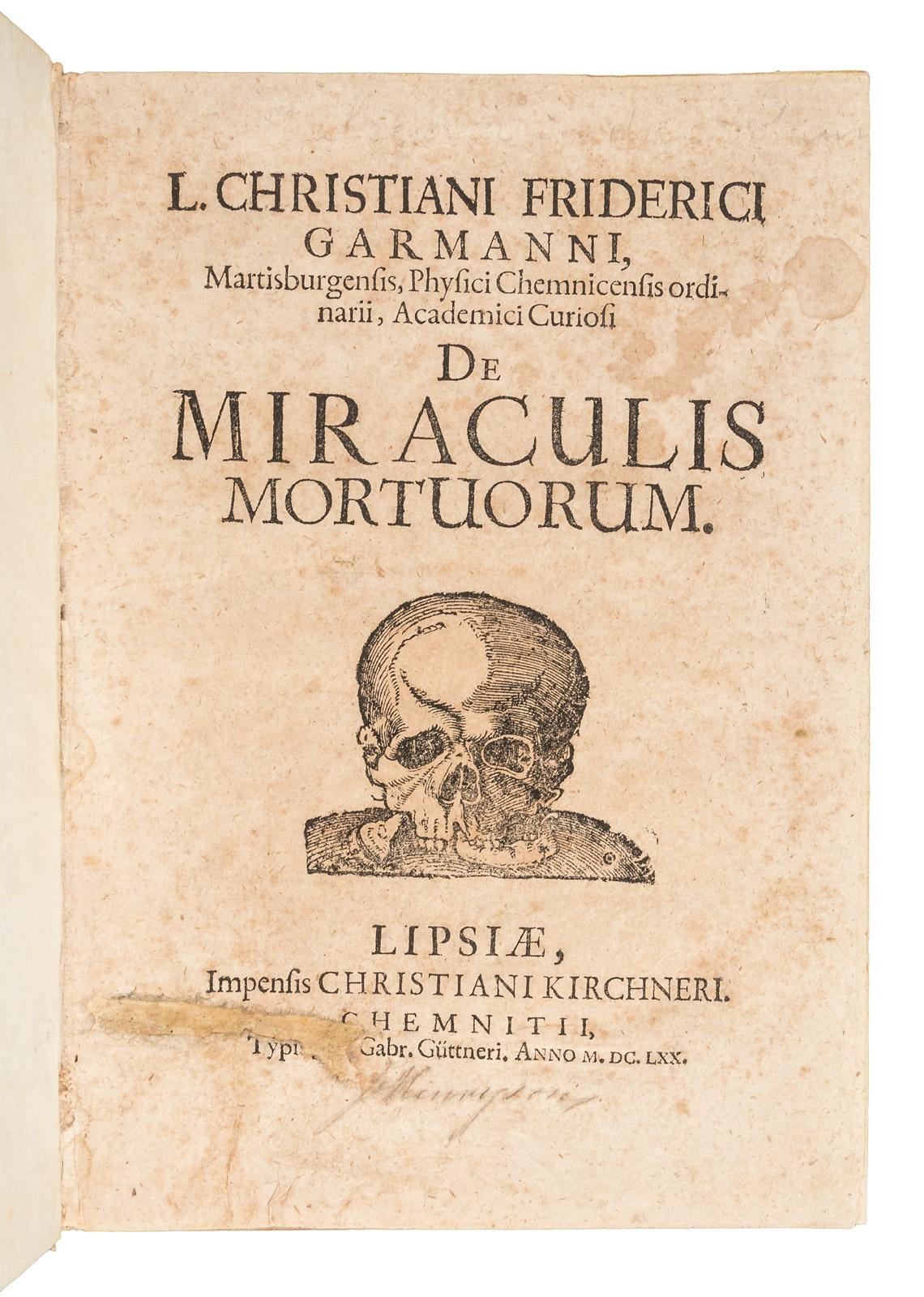
The theme of the still-living dead is even stronger in Garmann’s book. Garmann gives examples of corpses that grew in size, moved, laughed, or wept, corpses whose facial expression changed, and even corpses whose hearts kept on beating. He cites instances of living children delivered from a dead mother by means of cesarean section, so it could be concluded that corpses could give birth. He also reports many observations of corpses with an erect penis. Indeed, when the corpses of dead soldiers were once undressed after a fierce battle, Garmann writes, many of them were in a state as if the engagement had taken place in the bedroom. The concluding forty-five pages of his book deal with the miracles of resuscitated and resurrected corpses. Garmann had read about a certain Zoroaster, who revived on the funeral pyre twelve days after being considered dead, and a boy described by a certain Dr. Valvasor, who came to life when his coffin was put into the grave. The learned Velschius told a story that was well known at the time: when grave robbers dug up the coffin of a recently buried woman in Cologne, she revived as they cut her finger to steal a valuable ring; exactly the same story was current about a young lady from Bohemia. Nowhere in Garmann’s treatise is it concluded that these latter instances should perhaps prompt more careful scrutiny of individuals presumed dead to prevent the interment of still-living people, the events are interpreted as miraculous resurrections rather than as actual rescues from the tomb.
Culled from: Buried Alive: The Terrifying History of Our Most Primal Fear
Prisoner Du Jour!
Prisoners: Murder, Mayhem, and Petit Larceny is a collection of seventy portraits of turn-of-the-century prisoners in the town of Marysville, California and the fascinating contemporary newspaper and prison accounts describing the crimes of which they were accused. The photos themselves are more fascinating than most of the crimes. There’s something magical about glass plate negatives that you just can’t reproduce with modern photography. And I think people just had more character back in the day – or at least it seems that way.
Check out today’s fresh-faced young fellow!
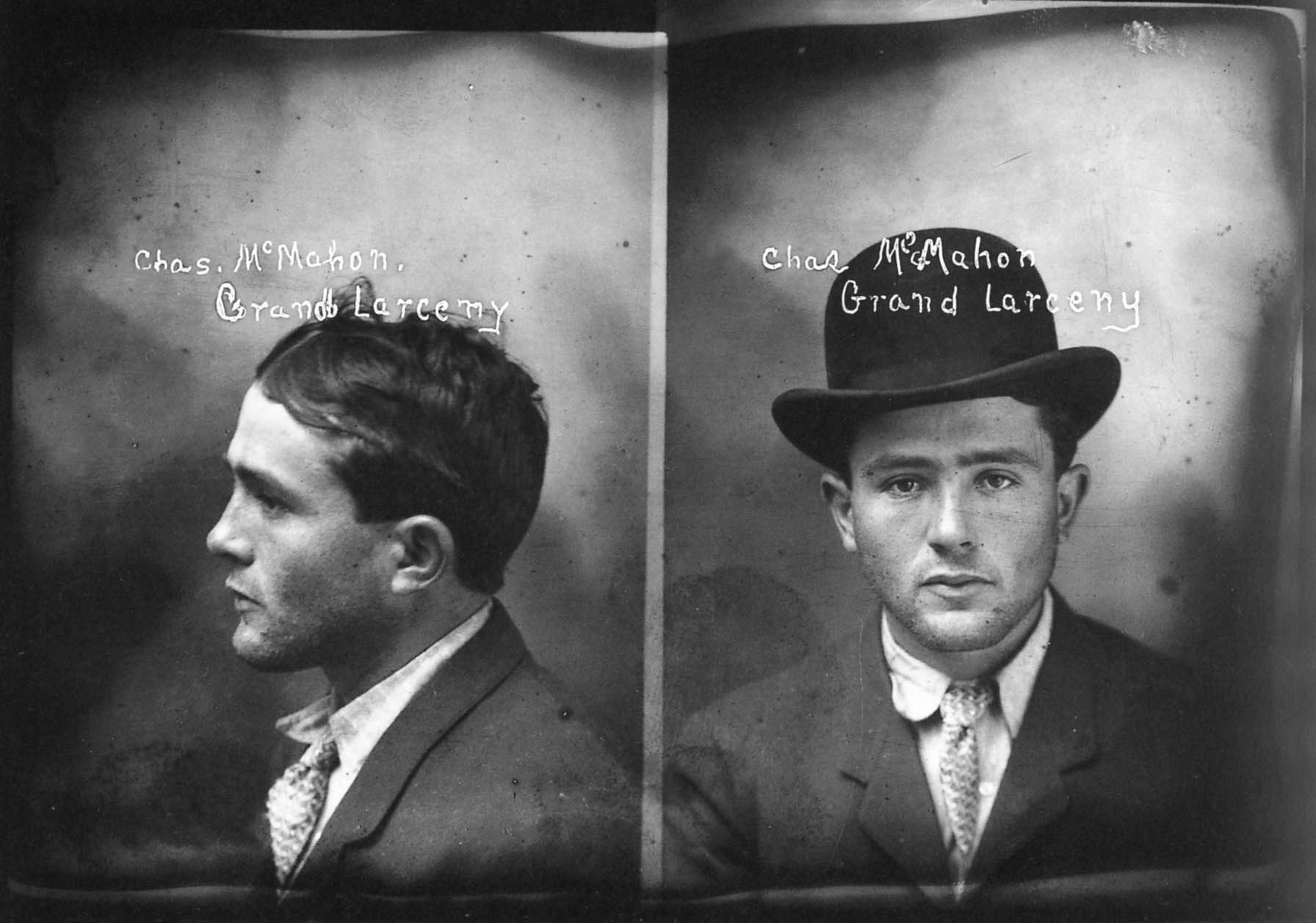
Chas. McMahon
M’MAHON MUST ANSWER FOR CRIME
HIS COMPANION IS RELEASED BUT GETS SENTENCED FOR CONTEMPT OF COURT.
Charles McMahon and Harry Wilson had their preliminary examinations in the Police Court last evening on a charge of grand larceny. McMahon was held to answer before the Superior Court with bail fixed at $2000, but Wilson was discharged, there being insufficient evidence to connect him with the crime.
The offense charged was that of robbing John Kelly while all three men were drinking at the Cliff House on election day.
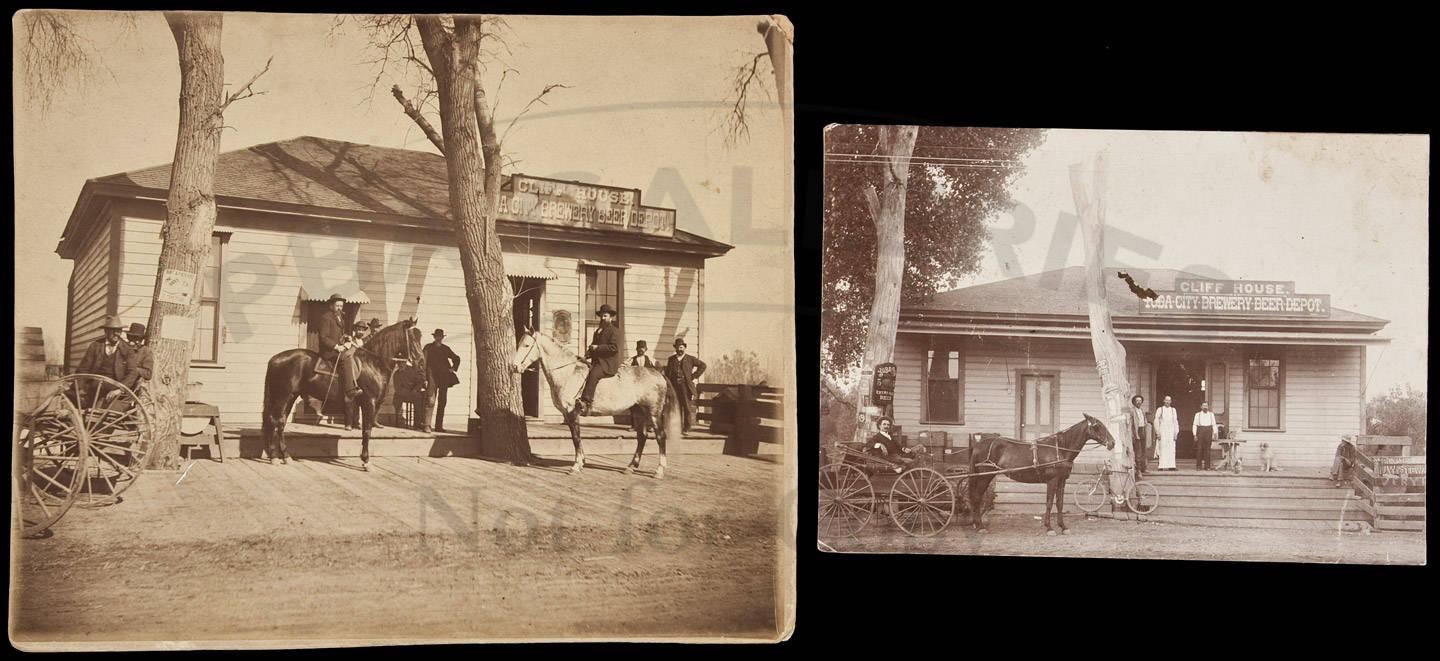
(Note: This Cliff House, in Yuba City – not the San Francisco one! – DeSpair)
The case was complete against McMahon; the watch stolen from Kelly being found in his pocket and there being plenty more evidence to connect him with the robbery.
Wilson took the stand in his own behalf and claimed he was not at the Cliff House at the time the robbery was committed. There as not sufficient evidence, in the estimation of the Court, to offset this testimony.
McMahon was unable to furnish bail and was taken to the County Jail this morning. Wilson and McMahon had been “floated” from this city after being convicted of vagrancy, and when Wilson was released from the grand larceny charge he was at once arrested and charged with contempt of Court, for which he got a sentence of four months in the County Jail this morning. [November 10, 1906]
CHARLES M’MAHON ACQUITTED
Charles McMahon, who was charged with grand larceny on election day, November 6th, appeared for trial in the Superior Court at 10 o’clock yesterday morning.
John Kelly, a blacksmith, who swore to the complaint, accused McMahon of having stolen his watch and chain.
District Attorney Brittan represented the people and Attorneys Wallace Dinsmore and E. B. Stanwood appeared for the defendant.
When Kelly, who is known as “Baldy” Kelly by his friends in Sutter County [some friends! – DeSpair], was called to the witness stand, it was evidently apparent that he was under the influence of liquor and made several contradictory statements to those made when he swore to the complaint. He stated that he had told McMahon to take the watch and chain and keep it for him and made several other contradictory statements evidently trying to shield McMahon.
Judge McDaniel could not help but notice his condition and when the noon hour arrived and the jury had retired he ordered Kelly to be brought before the Court, when he adjudged him guilty of contempt in appearing before the Court in a drunken condition and ordered that he be confined in the County Jail for twenty-four hours. When that time expires it is expected that District Attorney Brittan will have him rearrested on a charge of perjury.
The following other witnesses were examined: Deputy Sheriff J. G. Cannon and Constable W. H. Chism of Sutter county, who testified as to the arrest of McMahon and the finding of Kelly’s watch in his pocket. He was very drunk at the time.
The names of Joseph R. Williams, Henry Reed and W.A. Bevan, employees of Shattuck and Desmond on the pile driver near the Cliff House at that time, were called and as they did not respond, a bench warrant was issued for their arrest. Those men it was claimed were eye witnesses to the robbery.
Attorney Wallace Dinsmore in order to not cause delay, agreed to have their testimony given at the preliminary examination read to the jury, and the District Attorney read the testimony. Two of the missing witnesses had testified that they saw Kelly rolled on the porch of the Cliff House on election day and saw his watch and chain taken. This happened between the hours of 8 and 11 o’clock in the morning on that day.
The prosecution then rested.
Charles McMahon was the first witness on his own behalf to take the stand and he stated that Kelly and himself were at work on the Marcuse ranch in Sutter county and they came into Yuba City the day before election. On election day they went to the Cliff House, had several drinks and then Kelly went to sleep. He hit him with his hat a few times on the head and tried to wake him up. Kelly when he woke up told McMahon to leave him alone and keep the watch for him. He had taken the watch not with the intention of stealing it, but to keep it for his friend Kelly. On cross examination he admitted having been in the Wittier Reform School.
John J. Black of Yuba City testified that he heard Kelly tell McMahon to keep the watch for him.
Attorney Dinsmore then asked the Court to instruct the jury to acquit the defendant. Judge McDaniel advised the jury to bring in a verdict of not guilty and had handed to them a form of verdict.
When the jury returned into Court five minutes later Foreman J. O. Gates handed in a verdict of not guilty and the prisoner was ordered discharged.
Ten minutes after McMahon was released last evening, he was placed under arrest by Officer Sayles on a charge of contempt, McMahon having been arrested for vagrancy last March and given a “floater” and then having come back to Marysville. The grand larceny charge that was placed against him was alleged to have been committed at the Cliff House and by being at that place the young man violated his floater. Hew as tried before Judge Raish in the Police Court this morning and Attorneys Dinsmore and Stanwood who defended him in the Superior Court appeared in his behalf. On the promise that McMahon would reform and cease to be a trouble to his relatives and the officers [suckers! – DeSpair] his fine was placed at $20, which was paid and he was released. [December 7, 1906]
PRIOR AND SUBSEQUENT CRIMES
October 10, 1905
DRANK CARBOLIC ACID BUT SOON RECOVERED
Dr. G. W. Stratton was summoned to John Peters’ ranch in Sutter county about 5 o’clock on Sunday evening, Charles McMahon, one of the employees having taken a dose of carbolic acid. The remedies administered were very effective and the doctor returned to this city with his patient about 7:30 the same evening.
March 17, 1906
NEWS EPITOMIZED
Charles Sharkey, alias Jack Williams, and Charles McMahon were arrested last evening after they had handled a Jap in a very rough manner. It is thought they attempted to rob him and the matter was being more thoroughly investigated this afternoon.
January 4, 1907
IN THE POLICE COURT
Charles McMahon was charged with petty larceny having stolen a pair of corduroy trousers from M. Schwab’s store of the value of $2.50. He at first pleaded not guilty and stated that he wanted to consult a lawyer. He, however, changed his mind in a few minutes and entered a plea of guilty and waived time.
Judge Raish ordered him confined in the County Jail for four months.
It will be remembered that McMahon was recently tried in the Superior Court and acquitted on a charge of stealing a watch. His attorneys, Wallace Disnmore and E. B. Stanwood, made a successful fight on his behalf. They probably did not expect that he would so soon again commit a crime and admit his guilt.
June 9, 1907
IN THE POLICE COURT
Charles McMahon was charged under the State law with indecent exposure. His offense was so aggravating that after being convicted he was ordered confined in the county jail for three months.
September 13, 1907
HELD FOR GRAND LARCENY
Fred Roland and Charles McMahon, who were charged with grand larceny, had their preliminary hearing yesterday afternoon.
The men were accused of stealing a watch from Martin Daley last Sunday. Roland stated that he was responsible for the theft and made a statement clearing McMahon. Roland was held over to the Superior Court with bail fixed at $1500 and McMahon was discharged.
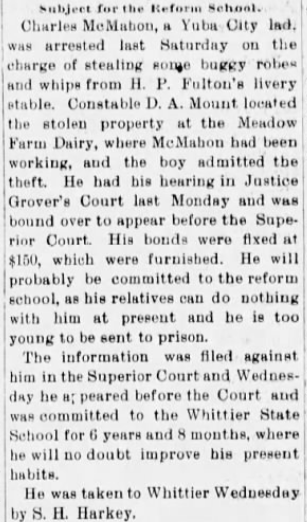
I did some sleuthing of my own and found his boyhood crime. He was always good-for-nuthin’, that Charles!
From the October 7, 1898 Sutter County Farmer
But during the service the cardinal groaned and sat up in his coffin.
Did he stay alive, or was this just a parting word?