Today’s Unbelievably Congested Yet Truly Morbid Fact!
On December 12, 1937, as the Japanese military was invading the Chinese city of Nanking, the Chinese military leaders ordered the troops to retreat. Not surprisingly, this order threw the Chinese military into an uproar. Some officers ran about the city haphazardly informing anyone they came into contact with to pull out. These soldiers took off. Other officers told no one, not even their own troops. Instead, they saved their own hides. Their soldiers continued to fight the Japanese; thinking they were witnessing a mass desertion when they saw other troops fleeing, they machine-gunned hundreds of their fleeing comrades in an effort to stop them. In the haste and confusion to leave the city, at least one Chinese tank rolled over countless Chinese soldiers in its path, stopping only when blown up by a hand grenade.
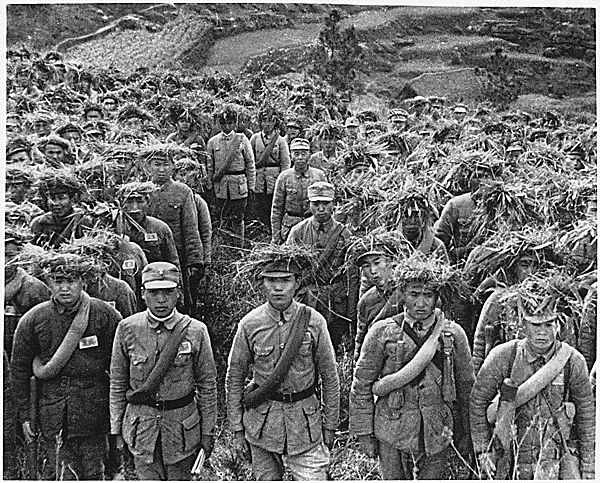
Chinese Troops in Nanking
Even in the larger, tragic scheme of things, the retreat had its comic moments. As soldiers grew desperate to blend into the populace and thereby elude capture, they broke into shops to steal civilian clothes and undressed in the open. The streets soon filled not only with half-naked soldiers but with half-naked police officers, who had discarded their uniforms to avoid being mistaken as soldiers. One man roamed about wearing nothing but his underwear and a top hat, probably stolen from the home of a wealthy government official. In the early stages of the retreat, when a semblance of order remained, entire sections of the Chinese army were shedding their uniforms, changing into civilian clothes, and marching in formation, simultaneously. But when the retreat turned into a rout, the scramble for clothes grew urgent. Soldiers were actually seen throwing themselves on pedestrians and ripping clothes off their backs.
There was only one way to get out of the city safely without encountering the Japanese, and that was through the northern harbor to the Yangtze River, where a fleet of junks were waiting for those who could get their first. In order to reach the harbor, soldiers had to first move up the main artery of Chungshan Road, and then pass through the northwest gate of the city, called the Ichang, or Water Gate, before they could enter the northern port suburb of Hsiakwan.
But before the gate lay a scene of almost unbelievable congestion. One problem was that thousands of soldiers, many in trucks, cars, and horse-drawn wagons, were trying to squeeze themselves through the narrow seventy-foot tunnel. The trickle of men had turned into a river by 5:00 p.m., and a flood by late evening, as everyone tried to funnel through the tiny opening of the gate. Another problem was that the retreating soldiers had discarded countless armaments and supplies to lighten their load for the journey across the river, and the resulting heaps of hand grenades, buses, machine guns, coats, shoes, and helmets near the gate of the city blocked traffic. A barricade that had been built near the gate also blocked half the road. The area was ripe for disaster.
Military commander Tang Sheng-chih, who had been tasked with defending Nanking and had given the order to retreat, witnessed much of this chaos from the window of his chauffeured black car on his way to the docks. As the car maneuvered through tangles of people, he heard pedestrians curse him. How can you ride in a car at a time like this? they yelled, unaware that the passenger in the car was Tang Sheng-chih. Tang pretended not to hear and shut his eyes as the car inched turtlelike to its final destination. He was supposed to arrive at the docks by 6:00 p.m., but it was 8:00 p.m. before he finally got there.
Absolute bedlam greeted Tang at the riverfront. Military officers were arguing with each other over which pieces of equipment to destroy and which to ferry across the Yangtze River, while soldiers tried to balance tanks on rows of boats bound together. Much of it capsized and sank anyway.
As the night progressed, the soldiers focused on getting themselves cross and abandoned the tanks and equipment. The scene grew violent as boats grew scarce, and in the end some ten thousand men would fight over two or three vessels, struggling to cram themselves aboard or scare off others by firing shots in the air. Terrified crews tried to ward off the surging mob by swinging axes down on the fingers of soldiers who clung to the sides of their junks and sampans.
Innumerable men died trying to cross the river that night. Many never even made it past the gate. That evening a fire broke out on Chungshan Road, and the flames swept through heaps of ammunition, engulfing houses and vehicles. Horses ensnarled in traffic panicked and reared, heightening the confusion of the mob. The terror-mad soldiers surged forward, their momentum pushing hundreds of men into the flames and hundreds more into the tunnel, where they were trampled underfoot. With the gate blocked and an inferno raging nearby, the soldiers who could break free from the mob made a wild rush to climb over the walls. Hundreds tore their clothing into strips and knotted them with belts and puttees to make rope ladders. One after another, they scaled the battlements and tossed down rifles and machine guns from the parapets. Many fell and plummeted to their deaths.
When the last boats disappeared, soldiers dove into the water on makeshift flotation devices, hugging or sitting on wooden railroad tracks, logs, boards, buckets, bathtubs, or doors stolen from nearby houses. When the last pieces of wood disappeared, many attempted to swim across, meeting almost certain death.
Tang and two vice commanders boarded a tiny coal-driven launch and waited until 9:00 P.M. for two more military staff members who never arrived. From the launch Tang would have heard the noise and screams of people fighting with each other, mingled with the louder punctuated sounds of Japanese cannon fire. Then there was the sight, the sight of Nanking on fire. The conflagrations lit the dark sky bright.
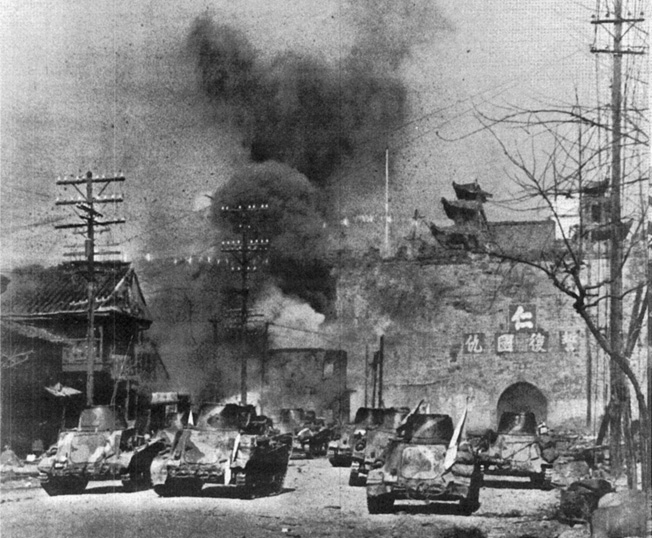
Japanese tanks approaching the Water Gate of Nanking, 1937
One can only imagine the thoughts of the humiliated Tang as his launch moved across the river. His last glimpse of Nanking was of a city in flames, its people frantically trying to save themselves, his own troops hanging onto driftwood to stay afloat in the dark cold waters of the Yangtze. He would later tell friends that while he had fought in hundreds of battles over twenty years, he had never experienced a day as dark as that one.
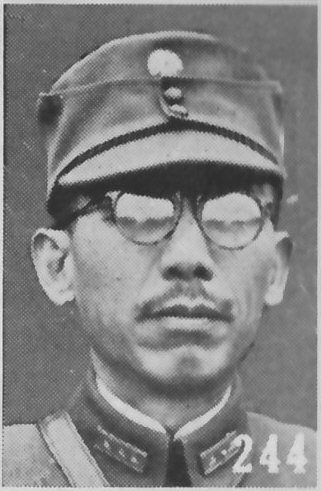
“Them was rotten days!” – Tang Sheng-chih
Culled from: The Rape of Nanking
Ghastly!!!
Whatever you do, kids, don’t try Krokodil!!!! This video, while tragically poor in quality, is very shocking.
(Thanks to Michael Marano for the link.)
In case you’re not familiar, desomorphine, known by the street name krokodil, is an opioid derivative of codeine. Like heroin and other opioids, it has a sedative and analgesic effect and is highly addictive. Those who inject these caustic agents into their veins can develop extreme skin ulcerations, infections, and gangrene — a discolored (green, grey, black) scale-like skin that resembles a crocodile, hence the street name “krokodil”.