Today’s Accelerated Yet Truly Morbid Fact!
In the eighteenth-century, most drowning victims succumbed in lakes, rivers, and the sea, while in the United States about half of today’s victims (and many in Australia) drown in swimming pools – especially toddlers who fall into private pools. Unlike a few centuries ago, drownings in the sea are comparatively rare except in cold-water fishing communities. Drownings among whitewater boaters – kayakers, canoeists, or rafters who are paddling in rapids – also make up only a small fraction of all drowning deaths, under fifty annually in the United States according to whitewater accident reports, the number having climbed as more paddlers pursue ever steeper and bigger descents.
Whatever the specific circumstances – a sinking ship, a swimming pool, a rock-laden fur coat, a kayak in Class V rapids – drowning in the archetype for all human deaths. At the very end almost everyone – heart patient, cancer victim, the very aged – perishes from the very cause so dramatically embodied in drowning: lack of oxygen to the brain. In the case of these illnesses, it can take days or weeks or years to reach that final moment. But drowning accelerates the process to a horrifying pace: the average person can hold his or her breath for about a minute and a half before inhaling or blacking out. In a victim on dry land whose breathing has stopped, brain damage starts to occur after about four minutes, and doctors consider the chances of brain recovery virtually nil after ten minutes. Underwater, however, especially cold water, these times can attenuate. One study of fitty-seven near drowning survivors showed they were totally immersed for an estimated average of eleven and a half minutes. This is still a very short time.
Culled from: Last Breath: Cautionary Tales from the Limits of Human Endurance
Ghastly!!!
Speaking of brains, how about some plastinated specimens from Gunther Von Hagens’ BodyWorlds?
The brain of an adult weighs approximately 2.8 lbs. It thus only accounts for about 2% of total body weight but requires 20% of the blood supply. We lose consciousness if the supply of blood to the brain is interrupted for only 10 seconds. Severe damage to brain tissue can be caused by prolonged disorders or disruptions of blood flow (e.g., resulting from an obstruction of a cerebral artery due to a blood clot or a massive hemorrhage.) This syndrome is referred to as a stroke. A stroke caused by hemorrhaging usually occurs because of a rupture in an artery damaged and distended by high blood pressure (aneurysm). Hemorrhaging can be restricted to the space between the soft membranes or pia mater (subarachnoid hemorrhage, first image below); with more severe hemorrhaging, it can seep into the brain matter (the bottom two images). Depending on what regions of the brain are afflicted by the stroke, certain dysfunctions may occur, such as loss of speech or paralysis on the side of the body opposite the hemisphere affected. Should vital centers be afflicted, a stroke may be fatal (approximately 15% of all deaths).
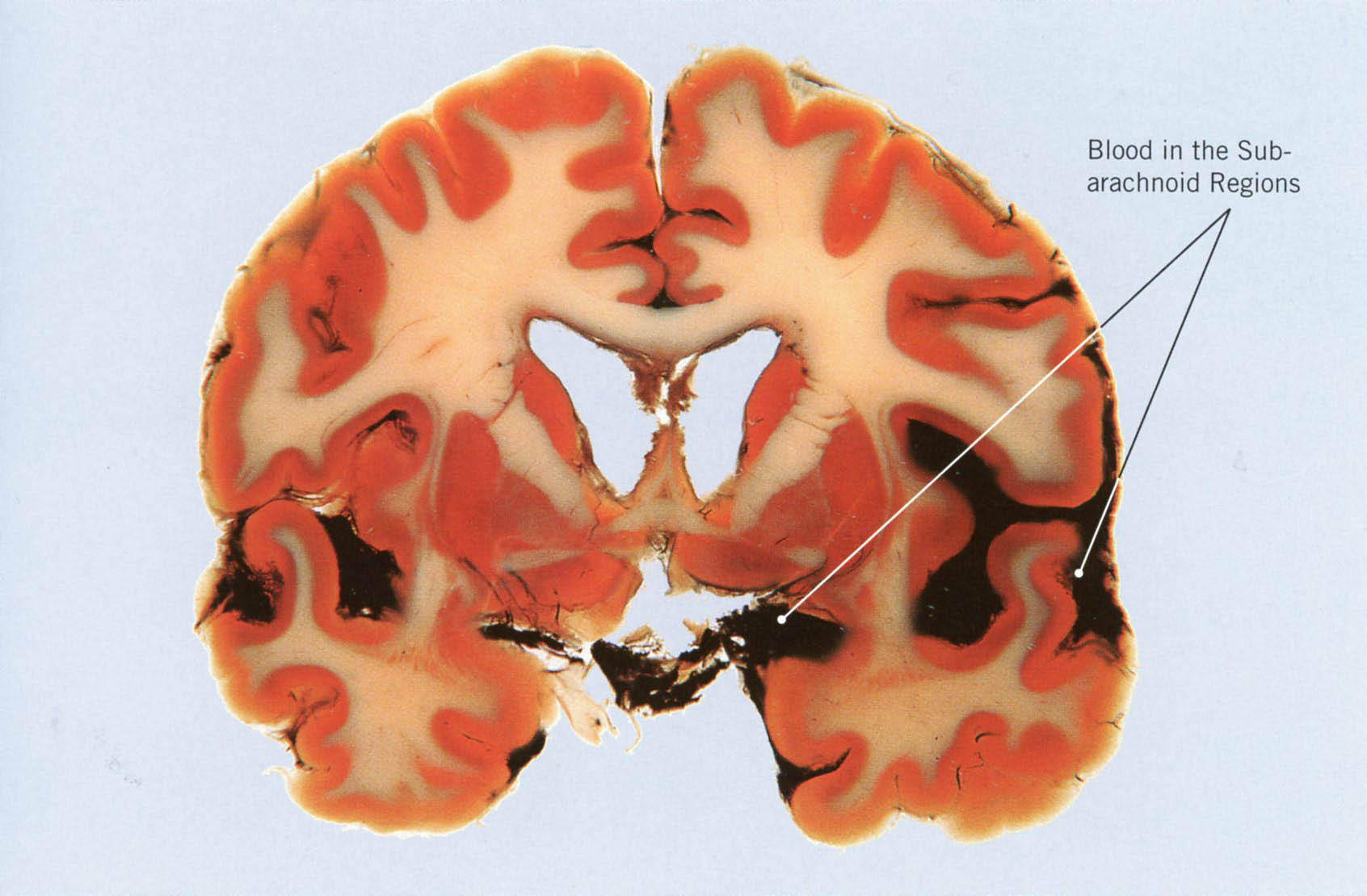
Brain slice with subarachnoidal hemorrhage following a stroke.
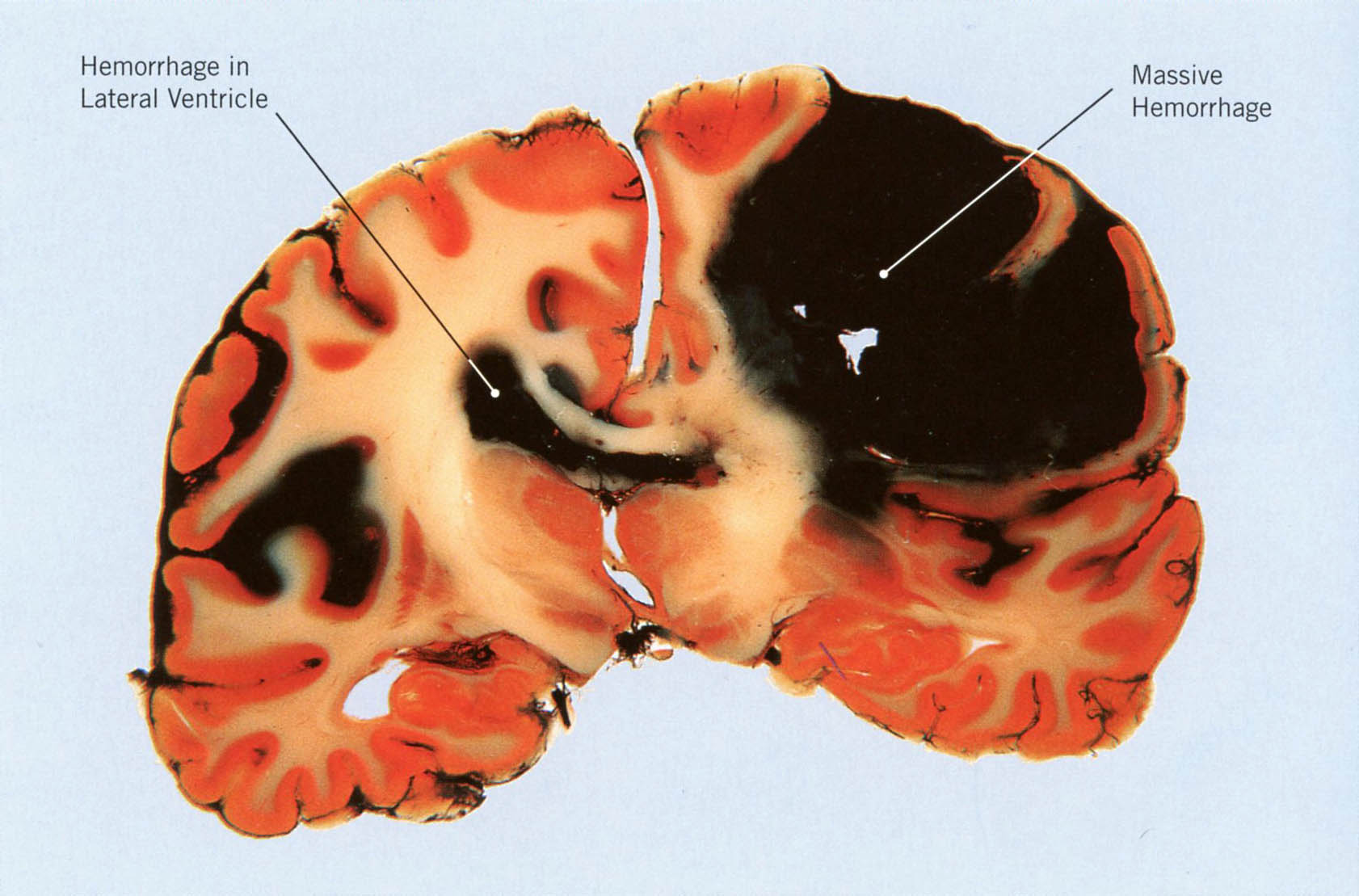
Brain slice with massive hemorrhage following a stroke.
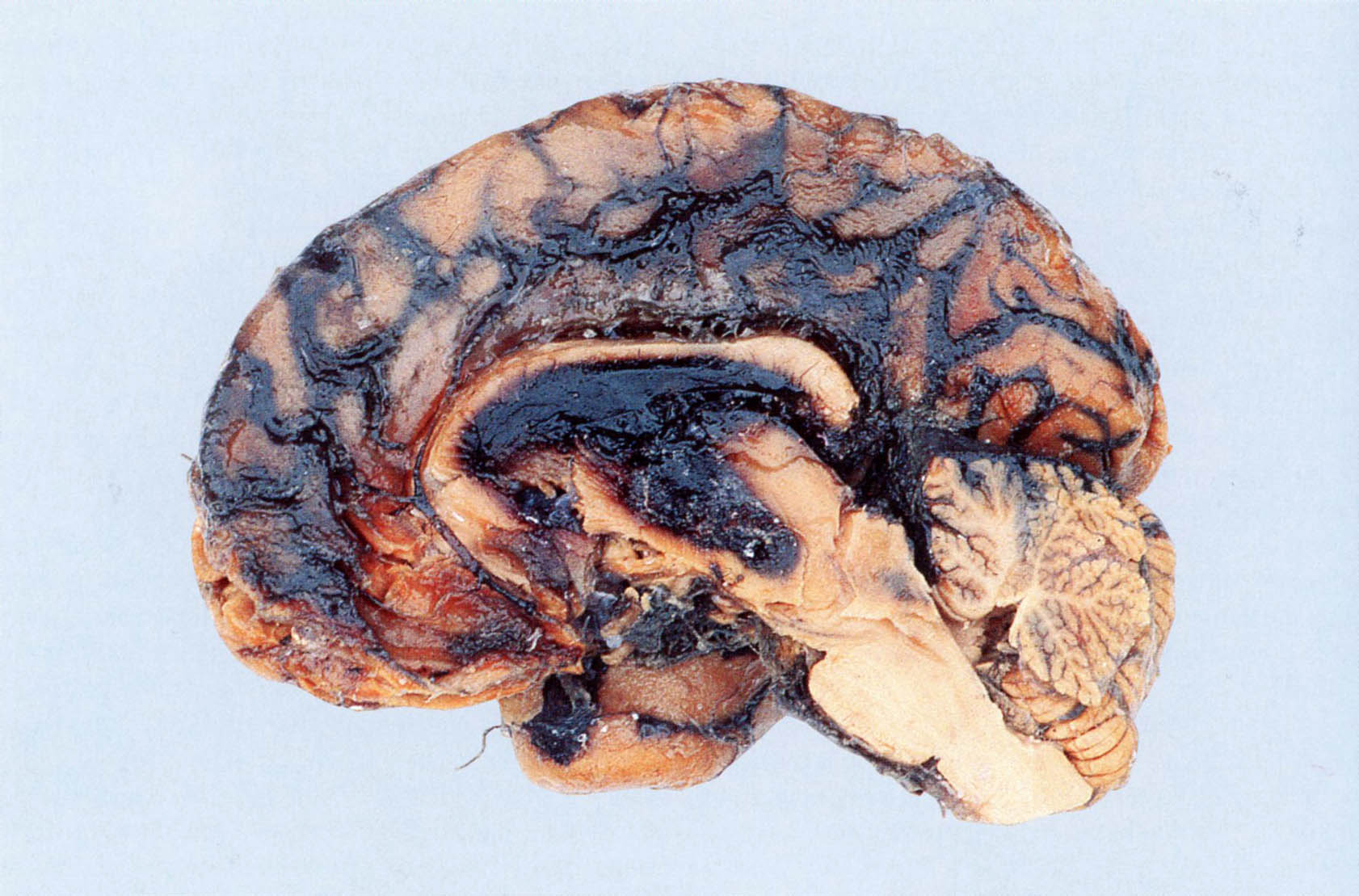
Brain hemisphere with subarachnoid hemorrhage and brain-stem hemorrhage following a stroke.
Culled from BodyWorlds: The Anatomical Exhibition of Real Human Bodies