Today’s Maniacal Yet Truly Morbid Fact!
McLean Hospital was founded in 1811 in a section of Charlestown, Massachusetts that is now a part of Somerville, Massachusetts. Originally named Asylum for the Insane, it was the first institution organized by a group of prominent Bostonians who were concerned about homeless mentally ill persons “abounding on the streets and by-ways in and about Boston”. The effort was organized by Rev. John Bartlett, chaplain of the Boston Almshouse. The hospital was built around a Charles Bulfinch mansion, which became the hospital’s administrative building; most of the other hospital buildings were completed by 1818. Here’s an excerpt from the book Gracefully Insane about the hospital:
The insane asylum seems to be the goal of every good and conscious Bostonian, babies and sanity the two leading topics. So and so has a baby. She becomes insane and goes to Somerville, baby grows up and promptly retires to Somerville. — Clover Adams, writing to her father in 1879
In modern times, McLean would become famous not only as a therapeutic locus but also as a literary and artistic landscape. Even in the increasingly grubby Charlestown, which was starting to attract unsavory factories and slaughterhouses, McLean had its share of what we might now call celebrity patients. Two of Ralph Waldo Emerson’s brothers lodged in Charlestown. Robert Bulkeley Emerson was retarded from birth and spent many years in and out of the hospital, as the family’s finances permitted. When not at McLean, he boarded in a rooming house and sometimes helped out on Israel Putnam’s farm in Chelmsford. More tragically, in 1828, another brother, Edward Bliss Emerson, suffered an unexpected nervous breakdown and was sent to McLean. Edward’s institutionalization weighed heavily on his older brother Ralph, who was somewhat in awe of Edward’s accomplishments. The boy who had finished second in his Harvard class, unlike Ralph Waldo, who finished thirtieth out of thirty-nine; Edward had just been accepted into law practice with Daniel Webster. It is from Ralph Waldo Emerson’s pen that we have one of the first descriptions of the shock a family member experiences when visiting a loved one in the mental hospital:
He has been now for one week thoroughly deranged & a great deal of the time violent so as to make it necessary to have two men in the room all the time… His frenzy took all forms; sometimes he was very gay & bantered every body… Afterward would come on a peevish or angry state & he would throw down every thing in the room & throw his clothes &c out of the window; then perhaps on being restrained wd. follow a paroxysm of perfect frenzy & he wd roll & twist on the floor with his eyes shut for half an hour. There he lay—Edward, the admired, learned, eloquent, thriving boy—a maniac.
Edward died of tuberculosis at age twenty-nine. Robert lived in the Boston area until he died at age fifty-two.
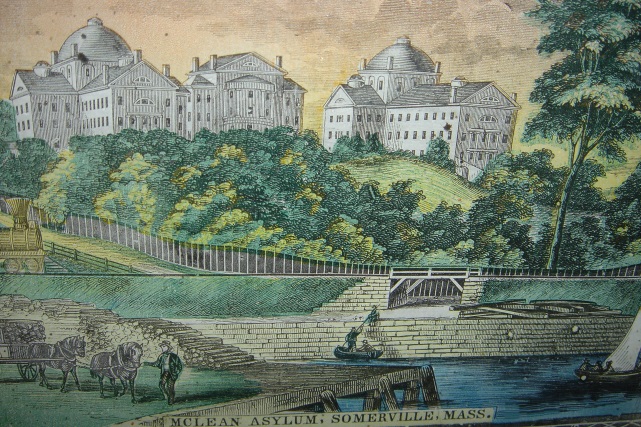
Culled from: Gracefully Insane
Malady Du Jour!
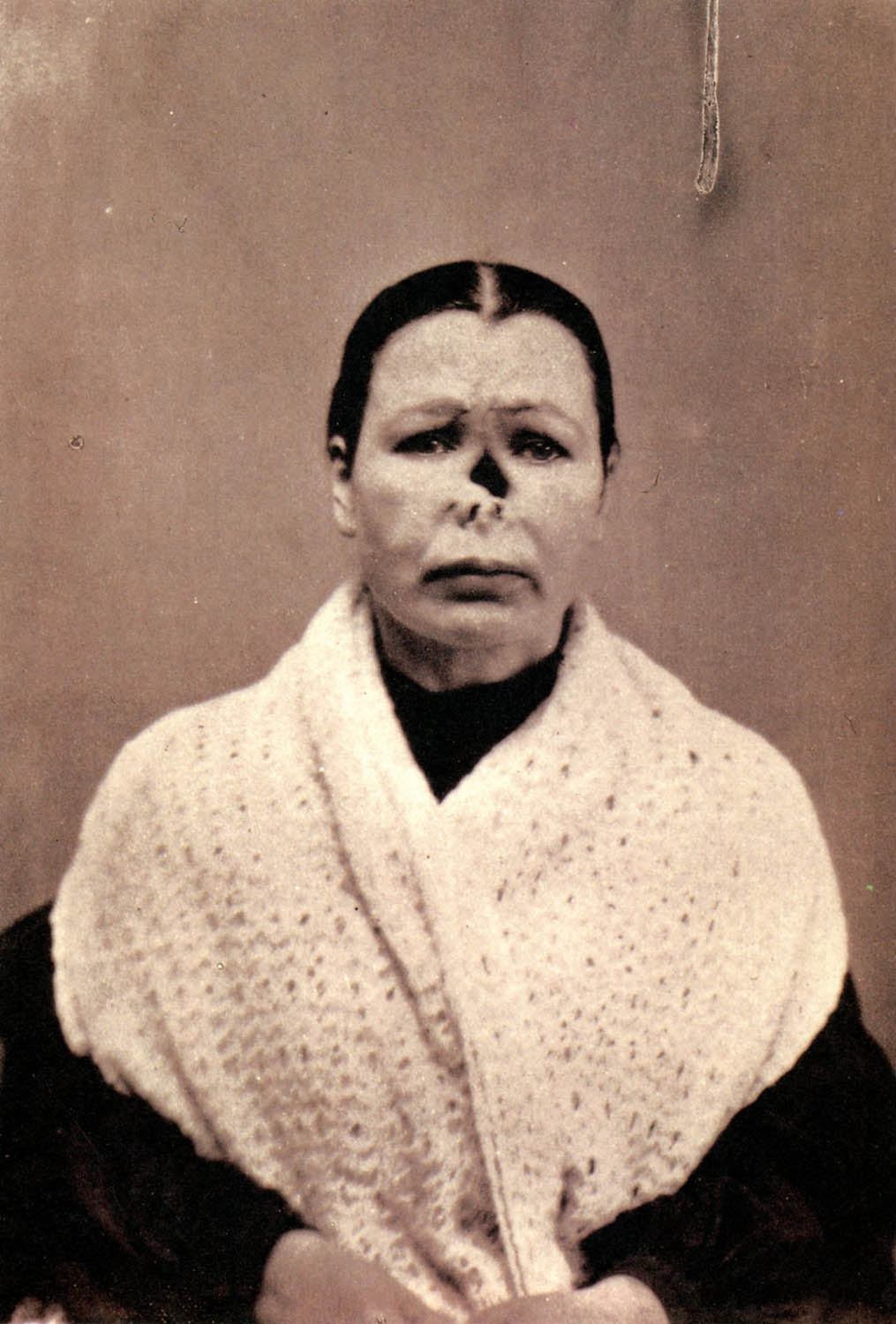
OZENA, HOLE IN NOSE FROM SYPHILIS
O.G. Mason, M.D., New York City; 5 x 7″, Artotype; 1881.
Destruction of the nose was a frequent result of tuberculosis and syphilis, two of the nineteenth century’s most common infectious diseases. Tuberculosis typically destroyed the cartilage, while syphilis eroded the bone. Because of its association with syphilis, nasal deformity carried an unfortunate social stigma. This was especially true when the infected nasal passages were attacked by other micro-organisms, resulting in “ozena.”
Ozena is derived from the Greek word “to stink.” The foul nasal discharge and putrid breath of those patients with nasal atrophy made their presence unbearable. The ozena associated with syphilis was the most offensive of all, and made public its sufferer’s disease. This woman has the classical deformity of syphilis. Treatment of ozena essentially involved burning out the infected areas with caustic agents. On occasion, pioneer plastic surgeons fashioned skin grafts to repair the defects. Many patients resorted to a nose prosthesis or mask. Today, antibiotic therapy has made the condition rare.
Culled from: Harms Way