Today’s Fissured Yet Truly Morbid Fact!
The earthquake that struck Dvin, at the time the capital city of Armenia, in March 893 is one of the first of which detailed accounts are available. It was recorded by two historians, Artsruni and Ovanes, and was clearly seen as an event of some significance even in this area, one of the world’s great earthquake centers.
The causes of earthquakes were not, of course, understood at the time, and all such natural disasters were thought to be the result of divine intervention, brought about by man’s sinful behavior offending God. Artsruni says: “In Armenia in the second year of the rule of Smbat I [this equates to AD 893] there was strong earthquake due to the wrath of God… there was underground shaking and movement of the earth, weakening the solid boundaries of hell itself, inhaling the wrath of the winds and dark waters.”
He goes on with more vivid prose to make the novel suggestion that the quake had “moved the solid and weightless gravity up to the surface so that hills were moved upwards” and quotes one mountain, Norabhur, as an example. He continues: “The city resembled an open-mouthed hell, attracting people to their doom… their homes became their graves.” This seems an excellent description of a city struck by major tremors in which large fissures opened.
According to the other historian, Ovanes, the earthquake happened at night “accompanied by shakings, howling and terror… the city of Dvin was destroyed down to its foundations.” He records that the palace of the rulers was shattered “along with the homes of warriors” and that everything was “instantly converted to a wasteland.”
Dvin was built on a hill, on loamy soil, so fissuring is very likely to have occurred. It is known that there were many aftershocks, causing further damage and loss of life. Accurate casualty figures are, not unnaturally, unavailable, but it is thought that as many as 20,0000 people may have perished. Ovanes says that “innumerable bodies lay buried in the ruins.” Working on such records as are available, Soviet seismologists have dated the quake to March 27, 893 and believe that, by equivelant modern standards, this earthquake would have had a Richter scale reading of at least 8.
Artsruni records that among the victims of the Dvin earthquake was the principle church leader of the area, Bishop Grigor Rshtunishki, who died, along with his retinue, while at prayer, probably trying to placate the same God who was thought to have caused the devastation.
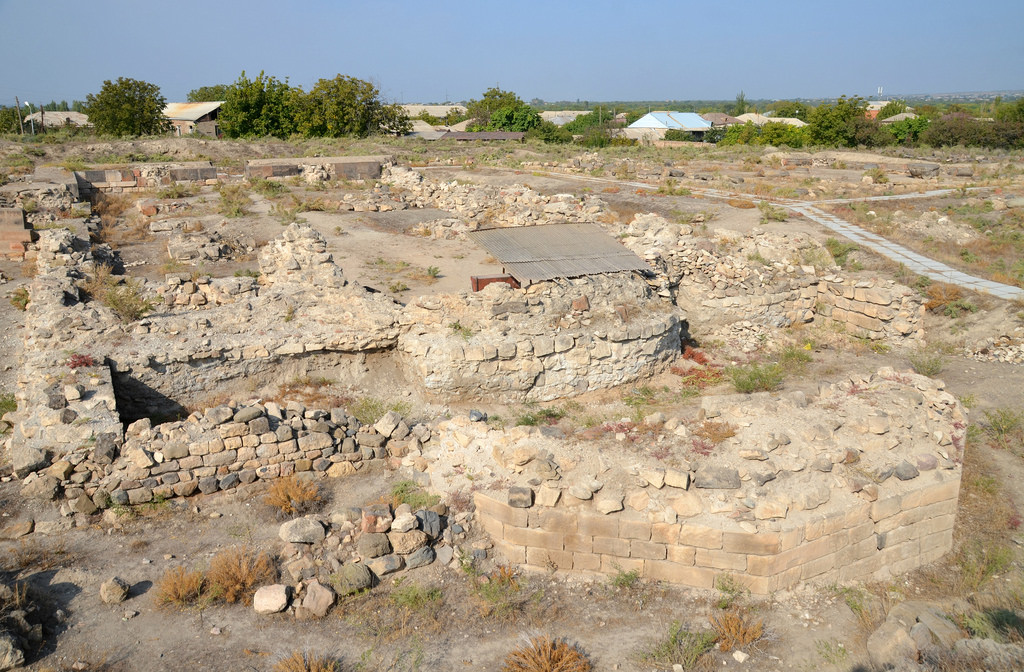
Ancient Dvin Excavation
Culled from: Catastrophes and Disasters
Legend Du Jour!
Song of the Sorrowing Harp
On the east coast of Scotland, in a castle hard by the North Sea, lived a lord who had two daughters, the elder one dark, the younger fair. As sometimes happens, the maidens were rivals – although the younger sister did not know it and the elder would not admit it – and something occurred between them that caused a ghost to speak.
A young lord came courting. Quite properly, he paid formal addresses to the elder sister, but his eyes always strayed to the younger. He rode by her at the hunt, he danced with her in the hall. And all the while, the dark gaze of the elder sister followed him. She made no complaint, biding her time.
Early one morning, the elder maiden asked her sister to walk by the seashore. As they strolled, the fair sister spoke guilelessly about the dashing visitor. The elder said little, but at a place where the waves beat against massive rocks, she acted. With a swift blow, she knocked her sister off balance and into the foaming sea.
The waves closed over the fair maiden’s head and clawed at her hair with icy fingers. She rose gasping to the surface and screamed to her sister, but there was no response. She heard only the roaring of the waters and the sharp cries of gulls as they wheeled in the sky above. The dark sister stood on the shore rocks, motionless as a carved statue. With a steady, unperturbed gaze, she watched her sister’s hopeless struggle. The young maiden sank, rose again for a moment and cried out pitifully, then sank again beneath the surging skirts of foam.
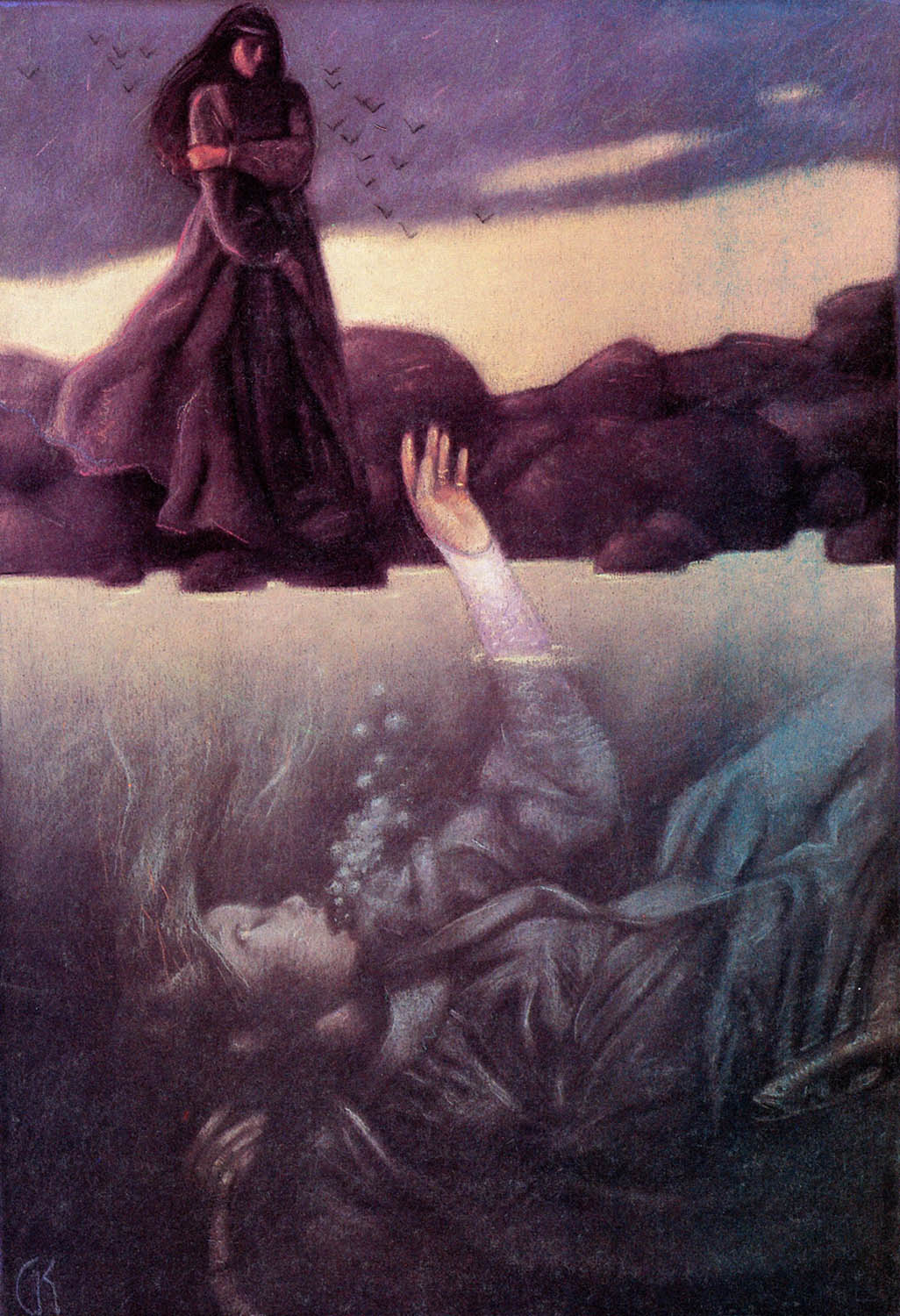
The dark one kept her vigil there for a time, observing the violence of the waves with satisfaction. Then she ran home to her father’s hall and, weeping, told a false tale, saying how her sister had slipped on the rocks and drowned. The people searched the shore for her, but they could not find her body. They made great mourning in the months that followed. Afterward, the young lord, bereft of the fair sister, sought consolation with the dark, and this was gladly given.
But the fair sister’s body, drawn by wind and tide and cradled in the killing waves, drifted along the Scottish shore and into a calm loch, far from her father’s lands. A miller at the loch’s edge spied the golden hair stirring beneath the surface and gently pulled the body from the water.
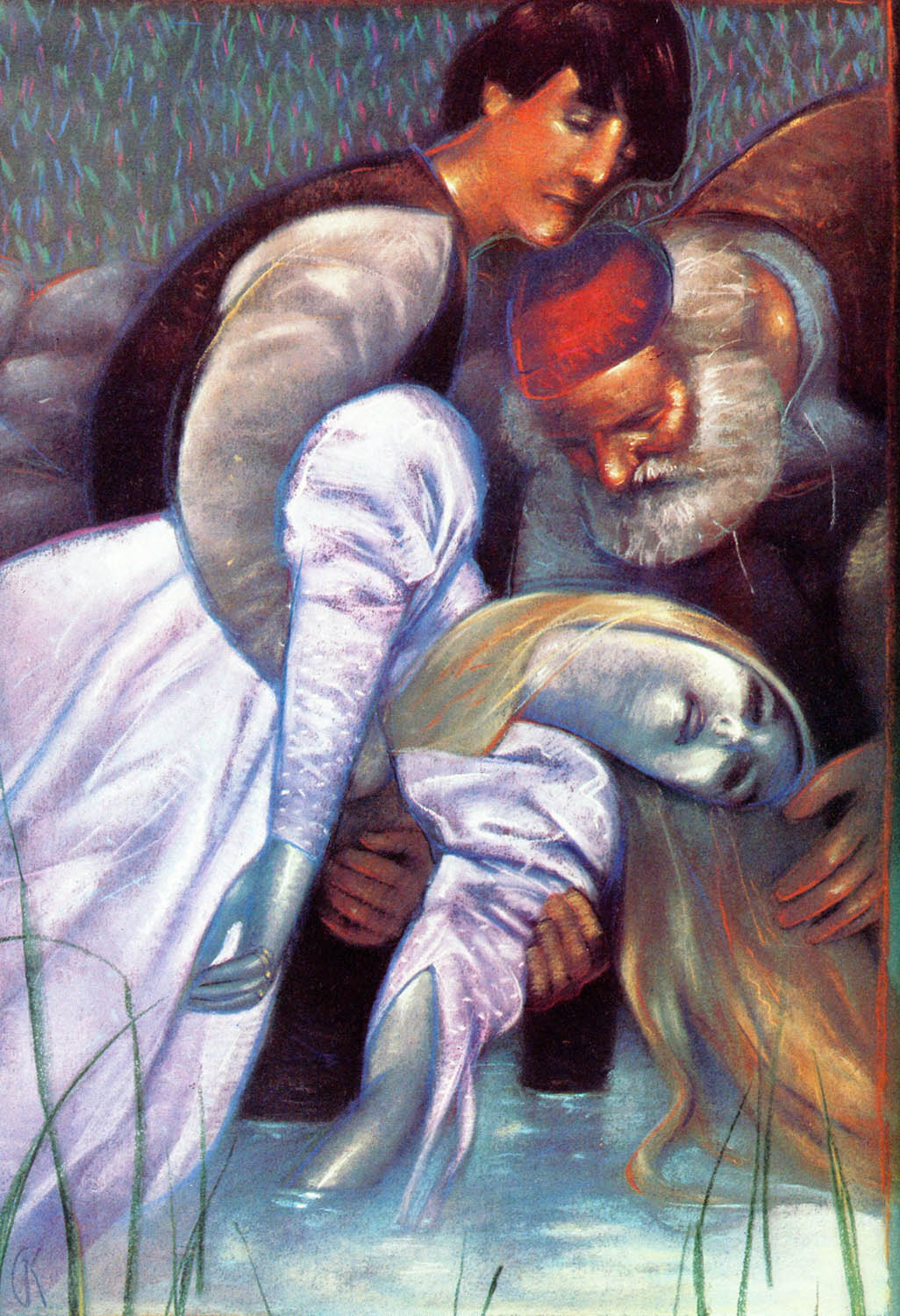
It happened that a wandering minstrel – a harper famed throughout Scotland – was staying with the miller. He helped the man to give her a burial, and moved by her beauty, he cut three strands of the golden hair ands strung them into his harp.
Eventually, the harper took leave of the miller and went on his way, traveling from castle to castle to sing before the lords of the land. In the months that followed, the harp played from the minstrel with a tenderness that brought tears to the eyes of its listeners, and the harper grew to cherish the golden strings.
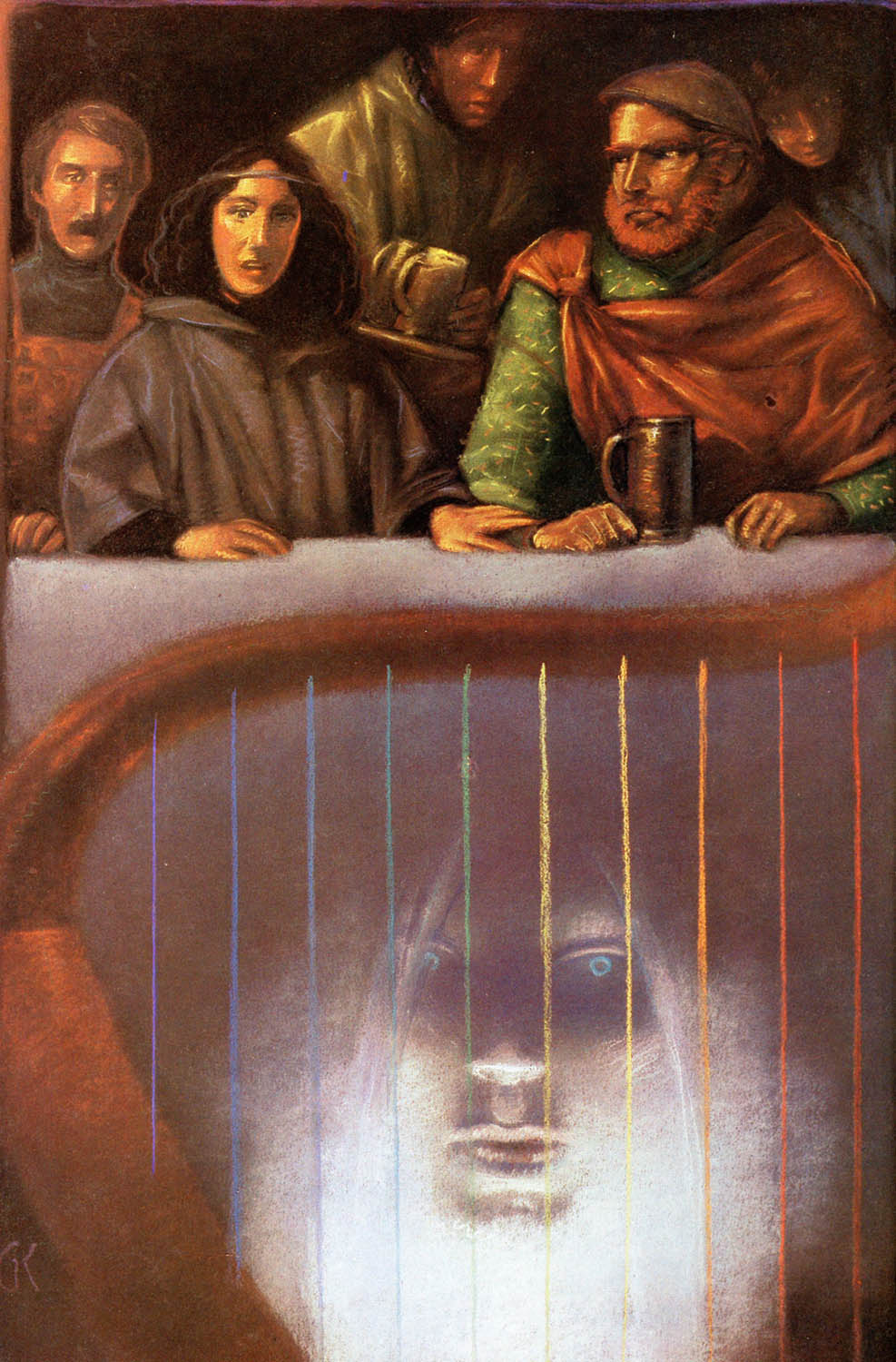
At length he came to the stronghold of the maiden’s father, although he did not know it for what it was. The minstrel was welcomed and feasted, as was the custom then. In the evening, when the fires were lit and the flames cast flickering shadows in the hall, the man drew out his harp and set it before him, making ready to sing. The dark sister settled on a bench to listen, flanked by her father and by the young lord she loved.
But before the harper could touch them, the golden strings shimmered in the firelight, they trembled of their own accord. A sweet familiar voice eddied around the company, and when the dark sister heard the words it sang, her face grew pale and tight. Her fate had come upon her, and well she knew it.
“Farewell to the lord my father,” sang the harp softly. “Farewell to my lady mother.”
The harp paused and the company watched it in horrified silence. Then the strings spoke once more, loud and wailing this time.
“And woe to my sister, who murdered me.”
Culled from: The Enchanted World: Ghosts