So with the last fact I was originally planning on sharing an interview of a “juvenile female sadist” from J. Paul De River’s 1949 opus, The Sexual Criminal. However, after reading through the interview, I realized I had more questions than answers about this case and decided to do some digging. I stumbled across an article that unpacks part of the fascinating story on the blog Unknown Gender History. I did some additional digging to fill in the gaps and now I present to you…
Today’s Curious Yet Truly Morbid Fact!
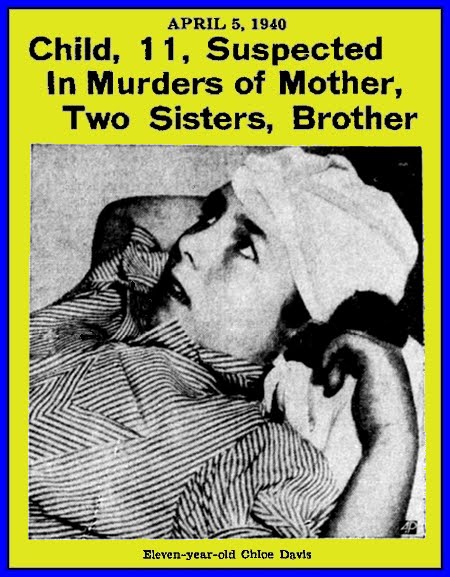
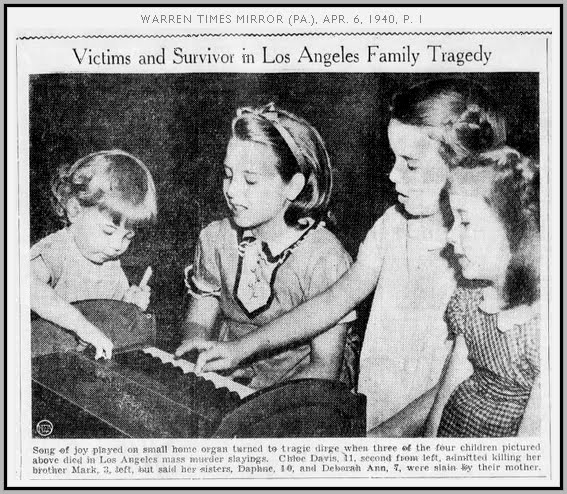
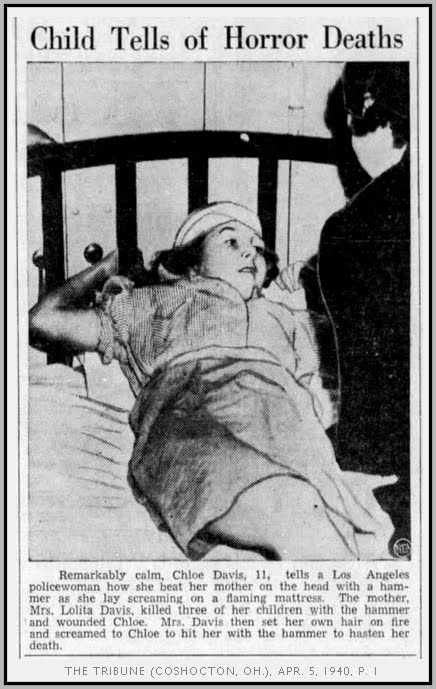
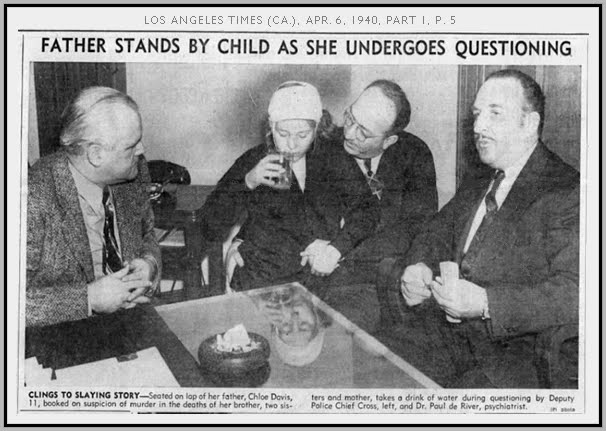
Later, the police captain related, the girl said to her father: “Daddy. Hi. you mustn’t get excited; let’s so for a walk.”

***
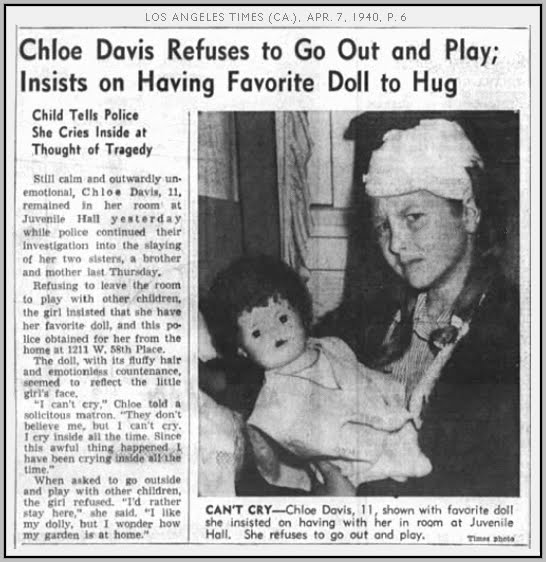
On April 7th, 1940, an article was published in the San Francisco Examiner by famous reporter Adela Rogers St. Johns that provided further insight into Chloe’s nature:
CHLOE DAVIS INCREDIBLE, UNREAL DECLARES ADELA ROGERS ST JOHNS
Secret Sought in Icy Stare of Eyes
by ADELA ROGERS ST. JOHNS
Stubby child hands with bitten fingernails clutched the handkerchief I offered, a bandaged head with unkempt pigtails went down on my shoulder and I held in my arms the most pitiful and terrible figure I have ever seen in my life.
Chloe Davis, 11 years old, is incredible—unreal—unbelievable, no matter how the facts of this crime in which her mother and her sisters and her brother met death may read in the end. When you talk to her, you talk to a stocky, plump little girl, feet in scuffed buckskin shoes not touching the floor, blue sweater over a yellow dress just like any one of a thousand kids you see going to school every day, nibbling chocolate bars and licking her fingers—fingers that only a few hours ago were red and dripping with—no, no, it can’t be real.
SHOCK WEARING OFF.
While I squeezed her, light sobs shook against me and I knew that this was a child, a child who has walked through a bloody hell that makes old police reporters shudder and that the shock that has frozen her for hours since she struck that last blow is wearing off.
To me, in our hour long talk, she said things fantastic, things sweeping from horror and tragedy to little girl jokes and ordinary kid talk, until I felt my heart beginning to hammer in an attempt to make this murder and her part in it real. It can’t be real. It can’t have happened.
Either way—whether she herself, this blonde little girl with the icy eyes, went mad in some twisted fashion and committed the whole deed herself or whether —even more unreal and horrible, her own story is true and she finished the dreadful deed her mother had begun—either way, there is about the story an unreality that smothers you in a nightmare and you sit paralyzed, bound, trying to scream for help the way you do in a nightmare and no sound comes.
WORLD IS WRONG.
There is something wrong—something wrong with Chloe Davis—with the monstrosity of whatever she did—something wrong with a world that has so much blood in it that it seeps through into the lives and minds of children.
There’s a hole in her white socks. Yes, that’s right. Ordinary hole. There’s a blister on her thumb—blister from a hammer she wielded—no, yes, that’s right, too.
Chloe Davis speaks always in the present tense. Not too far away lie the bodies of her mother, of the two sisters so close to her in age, of her baby brother. Two of those deaths at least by her own story she brought about. All of them she saw dead.
Yet she says in a high, ordinary little girl voice:
“My Mummy doesn’t read much. She never reads out loud to me.” She says, “Oh sure, I love my little brother, he’s a kinda cute kid—but he’s awful spoiled. I guess that’s natural when he’s the littlest and a boy. Daphne’s 10—she’s nearest my age—we could play together most.” She says, with a crooked smile — the smile comes easily enough, “Debby—Debby’s a nuisance. But my Mummy likes her best. She’s pretty.”
Always the present tense. Until at least I said, “But Chloe, you realize that — that it’s all over? That you and your Daddy will have to live alone now?”
“We won’t,” said Chloe, “We…” then the sudden twist of the mouth that, until she broke and began to cry, just as we drove up to Juvenile Hall, was her only sign of pain, “I won’t like that, I… no. I can’t think.”
“HOW COULD SHE.”
There was one thing—there had to be one thing—that must be asked. The one question that staggers Captain Edgar Edwards, the kindly gray haired detective who stands, too appalled by the unreality of this crime. The one fact that has driven many of the detectives with whom I talked today to utter bewilderment, that has made many people believe that Chloe herself did all these murders.
How could she have done the things she says she did? How could she have gone on—hitting her mother until the hammer broke? I saw that hammer—how could an 11 year old child use it as Chloe says she did? I mean, we’re human beings. How could she have struck the final blows — her little brother — her mother — why didn’t she run screaming out of that house when she says she came out and found them there and her mother attacked her?
I asked her.
I said, “Chloe, you must see why we’re so puzzled and bewildered. Why didn’t you run? Why didn’t you run and scream for help and maybe save Mark and your mother?”
She pushed her hand across her forehead—a gesture she uses often. Maybe the bandaged head aches. Maybe—maybe—she is trying to remember. I don’t think she remembers everything. She can’t. If she did, she would go mad.
“I can’t tell you why I didn’t run,” she said. “You see—I came out—all that squealing—and the room was full of blood and smoke—you never saw so much blood—it got all over me—”
“Didn’t it make you sick?” I said. “How did you know—didn’t it make you sick?”
The nausea began to creep up and get me by the throat then.
“Oh, I’ve seen lots of blood,” Chloe said.
ICY EYES.
Just then, for the first time she turned and looked full at me, her eyes came up to me. It isn’t imagination because I know about this child. It isn’t. Her eyes are set wide apart, they are set in enormous sockets, and they aren’t blue or gray, they are blue and gray shot with yellow, and they—they aren’t quite right. They are icy.
The rest of her face flushes, her mouth twists—the way a child’s mouth does in pain; you’ve seen it—but the eyes are wrong.
They stop. Whether or not that is shock, I don’t know. I don’t know what her eyes were like before she looked upon that shambles in the little home where she lived.
“I’ve seen lots of blood. I saw an awful automobile accident in Michigan. Two cars. There was blood all over everything. I saw lots of accidents. And I cut my own leg—see? There was a long white scar down the stocky little leg.”
The house was full of blood and smoke and squeals—Chloe’s words.
Then her mother hit her with a hammer and—
Something happened. The sights, the sounds, the smells—they went through some weak spot in that 11 year old brain. They sent her into some madness of unreality. That must be it, that must be the way it happened, because you see Chloe still talks about Mummy in the present tense. She still expects—she told me so—somehow in her imagination, she still expects to go back and find the clean little house, and find her spoiled little brother, and her sisters and “Mummy.”
That is the way I read it. Although when you see it all, that seems almost more abnormal than if Chloe herself in some childish insane anger had done it all herself. It seems more awful that she should have been able to go on —cold, blooded—conscious—you see, it’s unreal.
MUMMY DIDN’T LIKE ME.
“You — you and your mother—” you hesitate, you’re afraid to say the words, “you and your mother got along well? You loved her and after all you were the oldest and you must have helped her a lot around the house and all that.”
“Sure,” Chloe said, “I can cook. I don’t know if I can cook good, but I can cook. But — Mummy didn’t like me best, I can tell you that. Not much she didn’t.”
“Well, ” I said, stumbling on my own words, “maybe you just thought she liked her only son best—the littles—”
“Oh no,” said Chloe, “she didn’t like Mark best. She liked Debby best. Deborah was her pet. Then Mark and Daphne and then me.”
“Did that—were you hurt by that sometimes? Did it make you unhappy?”
Maybe here we might find something that had gone deep, driven a child into some peculiar savage world of jealousy and revenge.
“Yeah—it hurt. Sometimes it hurt plenty. But I never did anything about it—not for a while, I didn’t.”
Not for a while? Did that mean she had—at least, with a hammer?
“When you—did what your mother told you to do—with the matches and the hammer—you know what it is to be hypnotized? As though you were forced to do that and couldn’t do anything else? Was it that way or were you trying to help your mother out of her pain.”
“The house was full of blood and smoke,” Chloe said, taking another bite of her chocolate bar. But, you see, then there wasn’t any smoke in the house. Perhaps her memory is scrambled on that, runs in together. “I was like in a daze. I just did it. I just did it. I don’t know why. I wanted to get cleaned up. It was such a mess. Mummy —my Mummy was so pretty. Why, I had a girl friend named Bonnie and she though my mother was prettiest of anybody and she told her mother so and was her mother sore!” She laughed out loud.
“You can see, Chloe,” I said, “Why we can’t believe—why it seems strange to us that a little girl could go on and do—”
CRYING INSIDE.
Chloe looked at me. The untidy pigtails, the mouth smeared with chocolate, the icy eyes blank. “It seems strange to you?” she said. “I guess it seems strangest of all to me of anybody.” Those were her exact words.
“But you haven’t cried,” I said, “you’re such a little girl and you haven’t cried, they told me—”
“That’s what they think,” said Chloe. “I’m crying all the time. I haven’t ever stopped crying. I’m crying all the time inside. It don’t do you any good to cry where they can see you —it don’t get you anywhere. I’m crying all the time inside.”
Then she was crying in my arms and I was trying to fight my way back to reality—to what had happened to this 11 year old child.
There were so many other strange things she told me—about the Indians, and how she wanted to be born a little Indian girl—somewhere, we’ve got to find the truth of this story—for the sake of other children.

***

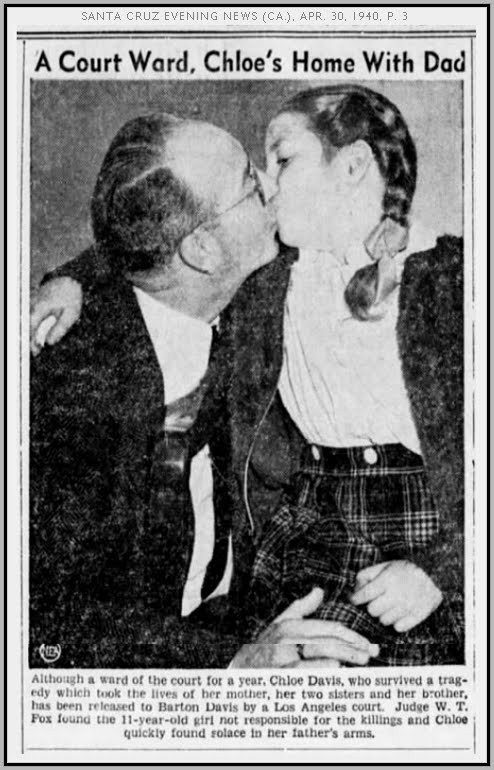
[“Chloe Davis Tearfully Tells How Her Mother Ran Amok – Frightened, Shocked Girl Becomes Ward of Juvenile Court, But Is Released In Father’s Care by Judge’s Order,” syndicated (AP), Washington Post (D.C.), Apr. 25, 1940, p. 5]
***

***

***

***

***

***

***
***
***

***

***

***
***

And here is an excellent video on the tragedy:
https://www.youtube.com/watch?v=V6tPrLbj3C0
Culled from: Unknown Gender History
Garretdom: Obstructed Edition
Today’s horrible olde news comes from the August 1, 1872 issue of the Mower County Transcript (Austin, Minnesota) as quoted in the excellent compilation book Coffee Made Her Insane.
A little boy named George Killian, aged six years, lost his life on Thursday last under most painful circumstances. In company with a younger brother he was playing upon a plank across the flume of Engle & Co.’s mill, from which it is supposed he fell into the water. The smaller boy missed him, and supposing he had stolen away, ran off in search of him. His inquiries excited alarm and Mr. Engle caused the gate to be closed, when it was found to be obstructed. The mill was stopped by choking the stones, and upon search, the body — except one leg, which had been severed and floated away — was found lying upon the top of the wheel, which is of the Turbine pattern, and has a lateral motion. It is supposed that the leg was forced into one of the buckets — they being too small to receive the whole body — and by contact with the case, in which the wheel revolved was crushed off. It was not found until after the body was interred. Coroner Barnes held an inquest which resulted in a verdict of “accidental death by drowning.”
More gruesome olde news can be perused at Garretdom.
What in the world?
It certainly sounds like Chloe did it, however …
Despite Adela Rogers St. Johns calling her stocky more than once, a sixty-pound eleven-year-old is tiny. I would expect there to have been more of a struggle with her mother, and for Chloe to be injured far worse than she was, if her mother had not been complicit in it. And why didn’t her mother run out screaming?
There is definitely something very odd about Chloe; it seems she can turn her tears on and off at will, which, I think, lots of kids can, but of course, in Chloe’s case, the stakes were much higher.
Do we know what eventually happened to Chloe? It’s a shame her name is so common or we could easily search.
I am pretty sure there was way more going on in that house than we’re told here.
I agree with Aimee, seems like there would have been more of a struggle with the mother—unless she was attacked while sleeping. Also, wouldn’t Chloe be covered in blood spatter and perhaps fragments of brains? Did she change clothes, burn them, and wash up before calling her dad? If so, that seems highly calculated for an 11-year-old.