Today’s Grievous Yet Truly Morbid Fact!
An account of the death of Private Theodore A. Weaver, Company C, 153rd Pennsylvania Infantry, 1st Brigade, 1st Division, 11th Corps at Gettysburg during the American Civil War.
In all likelihood, at least until late July, Samuel Weaver of Northampton County, Pennsylvania, still felt some hope for his wounded son. His boy, who had laid in a military hospital near the state capitol for nearly a month seemed to be holding his own against a grievous and painful injury. Then, sometime around July 26 or 27 Mr. Weaver received the following two letters, both written on the same day, the day Private Weaver took a severe turn for the worst.
Cotton Factory Hospital
Harrisburg Penn.
July 23, 1863Dear Sir
In the famous battle of Gettysburg, among the wounded was your son Theodore; the ball passed through the hip into the abdomen, inflicting a dangerous wound; he was admitted to this hospital where he still is, on July 16th. I feel it my duty to inform you that his condition is very dangerous, though he may yet recover; he behaves nobly now, as he did, I doubt not, in battle but if you desire to be sure of seeing him, it would be better to come to the hospital as soon as convenient.
Sincerely yours,
Carleton A. Shurtleff
Med. Cadet—U.S.A.Cotton Factory Hospital, Harrisburg
July 23, 1863Dear Sir,
I think it my duty as Chaplain of the above Hospital to inform you that your son is fast sinking and may not be alive in 48 hours—I am of opinion that under such circumstances you should be here with him in his dying moments at whatever cost or trouble—as you can so well afford to come and help to administer Christian comfort.
I expect you will therefore hasten here at once on receipt of this. Do not delay a moment. In case he dies before you arrive we won’t know what disposition to make of the body unless you telegraph to the surgeon (Dr. Woods, Factory Hospital, Harrisburg) in charge.
I rejoice to find that your son has been religiously brought up and is a professed Christian.
Yours respectfully,
W.H.D. Hatton
Chaplain, U.S. Army
Harrisburg, Pa.
Theodore did not survive that day, and by the time the father travelled to Harrisburg, young Weaver’s body was among so many who now were moldering into dust, in the loamy earth of their beloved Pennsylvania.
Culled from: Killed In Action: Eyewitness Accounts of the Last Moments of 100 Union Soldiers Who Died at Gettysburg
Malady Du Jour!
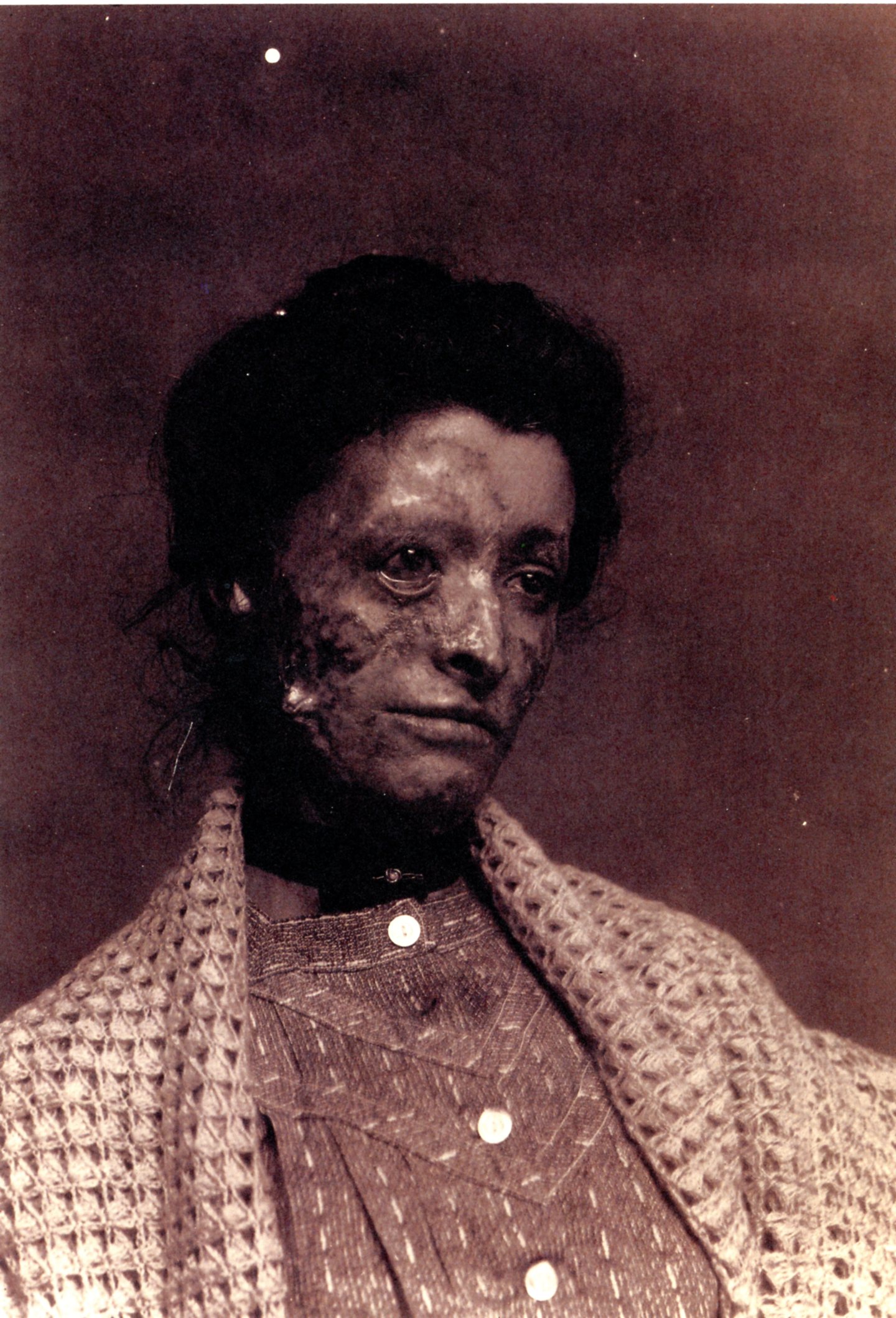
LUPUS OF THE FACE WITH CORNEAL INVOLVEMENT; Dr. Jean Alexander Lacassagne, Lyon, France; 5 x 7″ Silver Print; c. 1895.
For seven centuries, the term “lupus,” derived from the Latin for “wolf,” described a series of ulcerative diseases of the face, that appeared to bite and eat away at the face, until it was destroyed. This unfortunate patient’s skin disease and secondary infection destroys normal anatomy, distorting and deforming the face. In pre-antibiotic days, it was not uncommon for many facial skin diseases to cause the extreme scarring, mutilation and complications seen here. The scarring about her eye has resulted in the inability to close the eyelid. As the eye is left open and unprotected, lack of protective lubrication will result in the crystal-clear cornea becoming opaque, resulting in blindness. In the past, lupus, pemphigoid, congenital syphilis and many of the horrendous facially disfiguring skin diseases frequently caused blindness. Modern science has now distinguished many forms of lupus, each with its own clinical characteristics. Lupus erythematous is one of a group of diffuse systemic disorders that affects the connective tissue system. Lupus and several related diseases are considered to be auto-immune diseases, in which the body reacts to stimuli by destroying its own tissue.
Culled from: Harms Way