Today’s Ingenious Yet Truly Morbid Fact!
John Hunter (February 13, 1728 – October 16, 1793) was a Scottish surgeon, one of the most distinguished scientists and surgeons of his day. He was an early advocate of careful observation and scientific method in medicine. He was a teacher of, and collaborator with, Edward Jenner, pioneer of the smallpox vaccine.
Hunter’s early career, however, was much less glamorous. He learned anatomy by assisting his elder brother William with dissections in William’s anatomy school in Central London, starting in 1748, and quickly became an expert in anatomy. One of his most important early tasks was to procure the bodies needed for dissection.
In order to procure bodies for 18th century anatomy schools, ingenious methods were required. Anatomists took to loitering at Newgate Prison in the days before execution, bartering to buy the bodies of condemned prisoners in advance of their deaths. One desperate felon, William Signal, had been persuaded in 1752 to sell his body to a surgeon solely so that he could buy decent clothes for his day of execution. Another common ruse was to bribe unscrupulous undertakers to sell bodies prior to burial. Many a bereaved relatives followed a coffin packed with stones in a funeral procession through Georgian London. Some anatomists even took to dissecting the bodies of their own relatives. William Harvey conducted autopsies on his father and sister when they died—although he insisted that upon his own death, his body should be wrapped in lead to thwart any fellow enthusiasts. But for the serious anatomist determined to procure a regular and reliable supply of bodies in mid-eighteenth-century London there was really only one viable source: the grave.
Grave robbing had occurred on occasion in places throughout the British Isles since at least the seventeenth century; John Hunter would help transform it into an industry. When first he arrived in Covent Garden in 1748, a raw, fresh-faced youth, body snatching was in its infancy. During the span of his career, with his encouragement and support, the trade would grow exponentially, spawning warring gangs of professional grave robbers who stalked the city’s churchyards night after night. By the end of the eighteenth century, John and William Hunter’s disciples would have exported the practice to Ireland and the United States, stoking up mass protests in both countries. Eventually, the practice would reach such a scale—as London burial grounds had to be policed by armed vigilantes to thwart the thieves—that Parliament was forced in 1828 to investigate. Even then, it was only the discovery of murders committed by Burke and Hare in Scotland, and by similar but lesser-known assassins in London, which ultimately compelled the government to legislate and end more than a century of body snatching by introducing the Anatomy Act of 1832, which gave surgeons and their students legal access to bodies from workhouses, hospitals and prisons that were unclaimed 48 hours after death. It was also made possible for a person to donate a next of kin’s body for medical study.
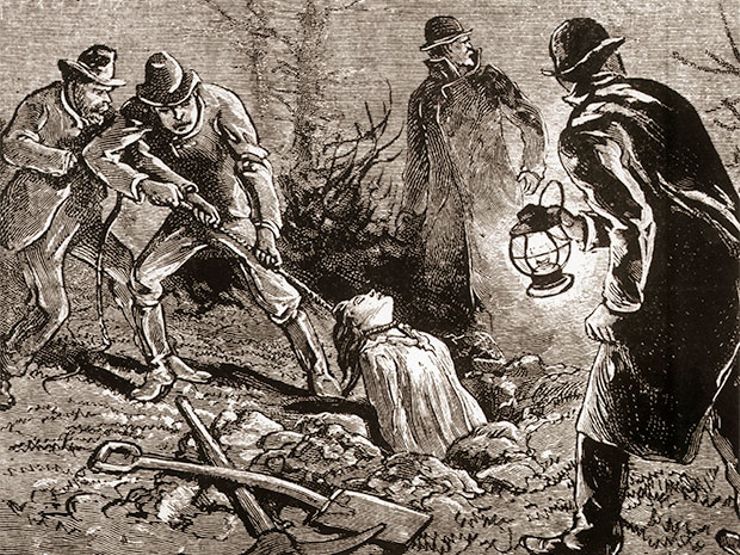
Bodysnatchers at work.
Culled from: The Knife Man
Legend Du Jour!
The venomous spirit of Lord Lonsdale was the bane of the Westmorland countryside in England two centuries ago.
It surprised no one that this rapacious aristocrat, given to quarreling with neighbors and flogging peasants who could not meet his criminal exactions of grain and livestock, did not submit quietly to the tomb. As the vicar knelt praying at the coffin, the body sat up abruptly. One massive shoulder caught the clergyman in the chest and sent him sprawling, gasping more in fright than in pain. The corpse’s eyes opened and bulged, as if it had startled itself, then its lids closed and it settled back onto the satin pillows. Once sealed in the coffin, though, the corpse was quiet, and its burial was seemly.
But that was by no means the last of the Bad Lord, as he had long been known. The unruly corpse spawned a rambunctious ghost whose heavy footsteps and destructive rage made a bedlam of the upper floors of Lowther Hall, the Bad Lord’s erstwhile residence. Those few of Lonsdale’s kinsmen who dared remain on the premises at the ghost’s hoarse bellows and the sound of splintering furniture. Occasionally the ghost strode into view at the head of the great stairway, its face an even more choleric red than it had been in life. It shook its fist at the fearful mortals gathered at the foot of the stairs, then continued its solitary rampage.
The Bad Lord did not confine his displays of spleen to Lowther Hall. On nights when the house fell ominously silent, servants scattered through the neighborhood to warn the farmfolk not to leave their cottages. For along the highroads, swift as the night wind, clattered a phantom—a black coach that terrorized wayfarers, panicking horses and running other carriages into the ditches. Torches blazed at its corners, shedding a lurid glare into the darkness, and on the driver’s bench, as menacing and highhanded as ever, sat the Bad Lord Lonsdale. This went on for months. Finally a wise neighbor, skilled in the art of stilling spirits, marshaled his powers against the apparition, and Lowther Hall and the surrounding district were fully in possession of the living once again.
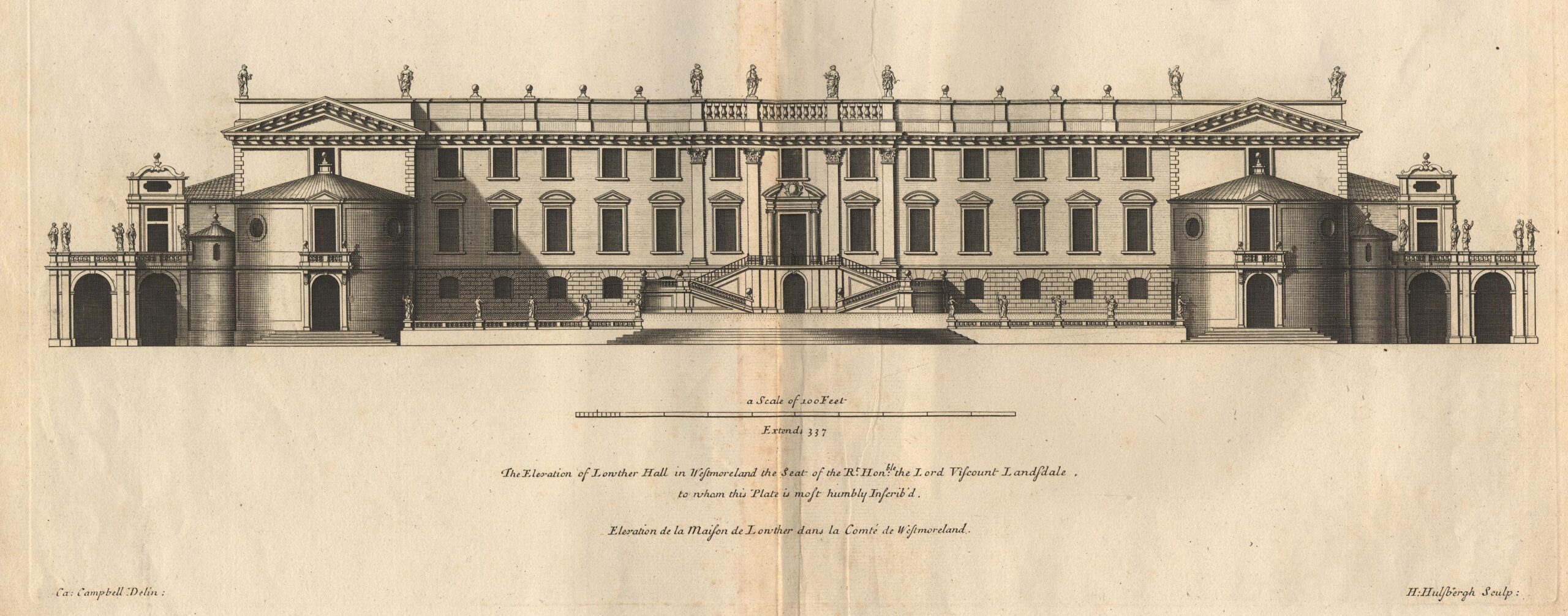
Lowther Hall, later Lowther Castle, now a picturesque ruin.
Culled from: The Enchanted World: Ghosts