Today’s Ferocious Yet Truly Morbid Fact!
Gregory Warren Allenby Trenor probably shared the characteristics of most six-year-old boys who visit Glacier National Park with their parents. We can guess that during his visit on June 27, 1963, the beauty of the scenery and foliage surrounding him were largely lost on the child, but that the search for small frogs and salamanders along McDonald Creek, the possible glimpse of a trout, and the antics of diving harlequin ducks and American dippers all fascinated him no end. When he, his father, Cameron, and his brothers, Douglas and Melvin, left their car at at a turn-off on Going-to-the-Sun Road at around six p.m. to get a close look at McDonald Falls, we can guess that Gregory hopped from rock to rock along the creek bank under the watchful eye of his father. “The party walked upstream to the trail bridge which crosses McDonald Creek,” the story in Kalispell’s newspaper, the Daily Inter Lake, read the next day. “Then they walked beneath the bridge and along the bank.”
In most areas of the country, a waterway the length, width, and depth of McDonald Creek would qualify as a river. Varying in width depending on the season, this so-called creek roars with frothy meltwater well into July, cascading mightily down drops of fifteen feet or more at Upper and Lower McDonald Falls. Many visitors pause along the creek to marvel at its ferocity—and when they are seized by the sense of daring that often grips tourists when they explore a national park as grand as Glacier, many pick their way along the rocks to points much too close for safety.
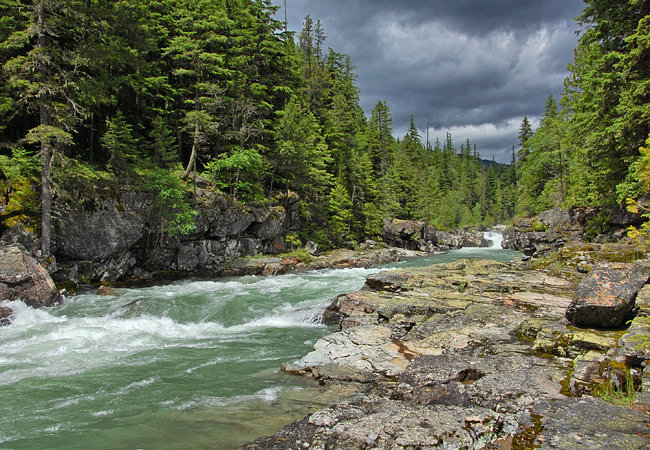
McDonald “Creek”
So when the stable surface below his feet suddenly became slippery, Gregory didn’t know how to recover or what to grab. Perhaps he shrieked for help, or maybe the fall took him so by surprise that he slid into the water without a sound. He could not have known that the swiftly flowing creek had swelled with snowmelt more recently than any creek at home—in fact, snow still clung to many peaks throughout Glacier National Park in these waning days of June. The only thing Gregory knew was that the water was icy cold, numbing his extremities in no time and carrying him away on the ceaseless current.
What went through Cameron’s mind as he saw his son disappear into the churning water? Instinct undoubtedly overrode the hard logic that would have told him that the boy’s fate was already sealed. Like any father would, Cameron plunged headlong into the water with nothing on his mind but a desperate attempt to save the boy. Just as Gregory went numb seconds after the creek claimed him, however, Cameron also realized with a start that his frigid mountain water —thirty-eight degrees Fahrenheit that day, according to the Montana Standard newspaper—would stiffen his joints and freeze his limbs. Worse, his son was nowhere in sight. He had no choice but to get back to shore and find help as fast as he possibly could.
Water temperature in Glacier’s two hundred-plus lakes and more than fifteen hundred miles of streams, creeks, and rivers never gets above about fifty degrees at the surface, and the water remains colder as it gets deeper. Some of the lakes, including Lake McDonald—at the mouth of McDonald Creek—are several hundred feet deep at their lowest points. As Gregory drifted along with the current toward Lake McDonald, he was headed for the deepest, coldest lake in the park.
When Cameron and his family reached a ranger and told him what had happened, park staff members went to work immediately. “Our crews got out on the search right away,” park public information officer Dan Nelson told the newspaper. “One of the rangers, Robert Sellers, was teaching a first aid class at headquarters. The 30 people in the class were divided into two groups and began searching for the body immediately. We also called immediately for members of the Flathead County Search and Rescue unit—the SCUBA divers.”
Among these experienced divers were Tom Dumay, a twenty-one-year-old lifesaving diver from nearby Columbia Falls, and a senior at Montana State University, and Ron Koppang, a diver of the same age who also lived in Columbia Falls. Working together, they began their search for Gregory by exploring a series of ledges in McDonald Creek, in hopes of recovering the boy’s body in shallower waters. The crews worked into the night, calling off the search at ten thirty p.m. when it became too dark, and beginning again at four a.m. on Friday, June 28. Dumay and Koppang then began searching in a deeper part of the lake.
Neither of the young men was prepared for the sudden force of a waterfall below the lake’s surface—a phenomenon created by a blast of current from the creek surging as it tumbled over McDonald Falls.
“Koppang said he and Dumay were about 60 feet below the surface when their aqualung tanks began running short of air,” the Montana Standard and the Butte Daily Post reported the following day. “He said they had started to surface when they were caught in a terrific current which officials described as an ‘underwater cascade’ below the delta where the creek flows into the lake.”
Fighting for his life, Koppang managed to grab Dumay and start for the surface, but the current broke his grasp, pushing both divers well below the sixty-foot level—down as far as one hundred forty feet. Koppang had no choice but to rush to the surface to save his own life, emerging near the mouth of the creek. The other members of the rescue team waited to see Dumay’s yellow oxygen tanks coming up from far below. Seconds passed, and then minutes, but Dumay did not rise.
The team could only come to one conclusion: Tom Dumay had drowned.
Koppang emerged in rough shape. His sudden return to the surface had triggered a case of the “bends,” the extremely painful, often fatal sickness caused by the pressure of nitrogen bubbles in his system that his body had not had time to expel. Accompanied by his father, he was rushed in a pressurized aircraft to a decompression chamber in Brownlee Dam in Idaho, where he would spend the next thirty-eight hours under close supervision as his body pressure returned to normal.
With the rescue and recovery team fractured and no sign of the six-year-old boy, Chief Ranger Lyle McDowell came to the inevitable conclusion that Gregory’s body was too far down in the lake for the divers to find safely. He called off the search for the child and turned the teams’ attention to finding the body of Tom Dumay. Now the divers used heavier tanks and lines to keep another tragedy from happening as their searched for their colleague. Two of the divers, Don Elgin and Jack Von Lindern, discovered Dumay about one hundred feet below the lake’s surface and brought him up with them late in the afternoon.
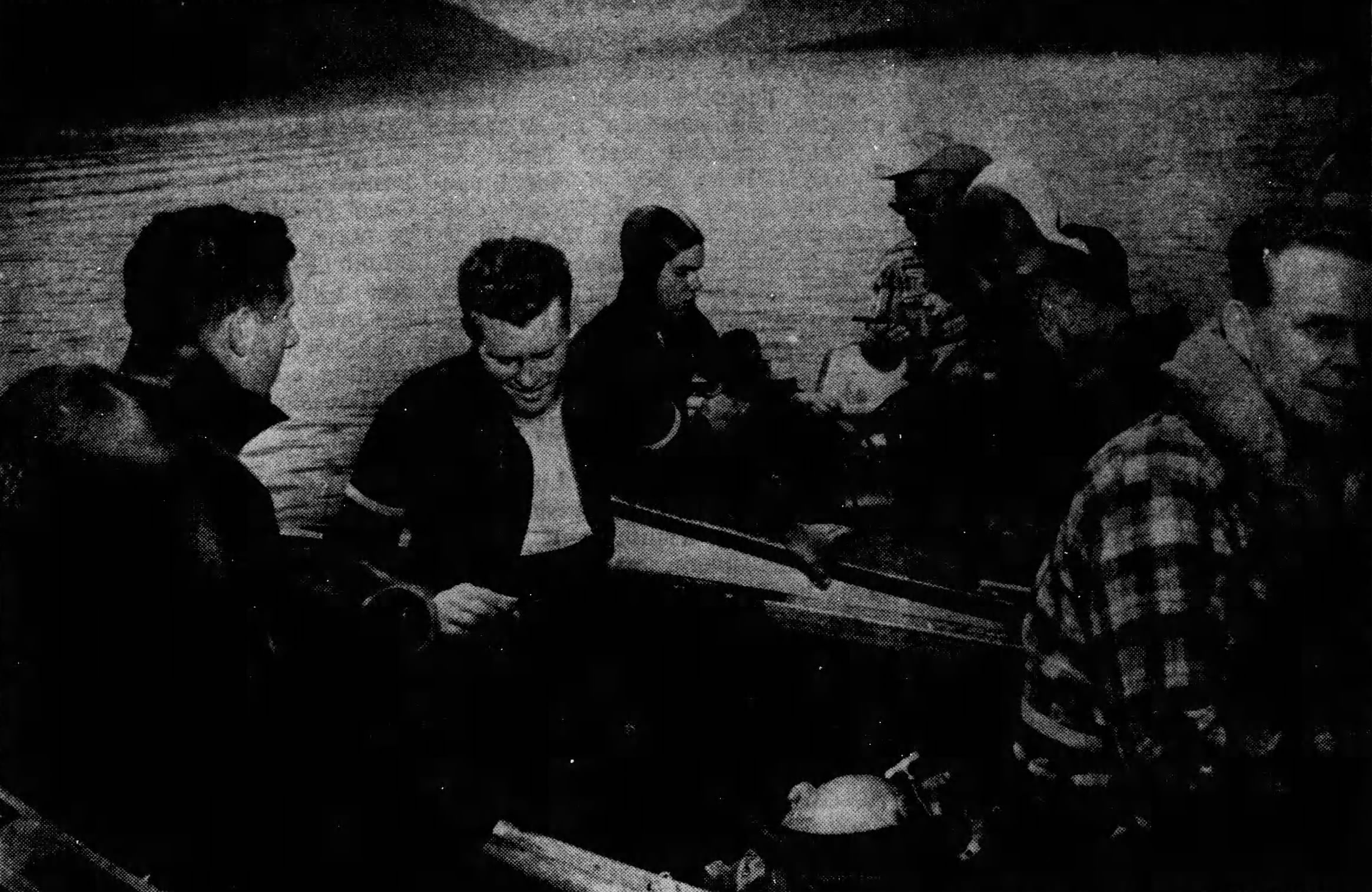
Searchers preparing to recover the body of Tom Dumay
While the underwater search for Gregory Trenor ended that day, no one had any intention on giving up on finding the body. “Officials report that visual observations will be made during the next few days in anticipation that the youth’s body will surface during that period,” the Daily Inter Lake reported on Sunday, June 30. “Officials indicate that it is possible, but not probably, that the body might still be in McDonald Creek.”
For the next several weeks, rangers made morning and afternoon checks of the area near the mouth of the creek, using a grappling hook to attempt to find the child’s remains. These twice-daily checks revealed nothing, however, and eventually the rangers lengthened the time between their attempts, checking every few days instead of daily. Park staff began to assume that this body, like others from previous drowning accidents, might not emerge at all.
Then on Wednesday, August 21, park resident Eugene Fox contacted Glacier park headquarters to report something unusual: a white tennis shoe wedged behind a boulder, about four feet below the surface of Lake McDonald and about a mile from the spot where Gregory had fallen into the creek.
Park staff moved quickly to investigate. Sure enough, the sneaker was still on Gregory’s foot, and the park had the opportunity to send the child’s body home to his family in Seattle and bring them some closure at the end of this tragedy.
Culled from: Death in Glacier National Park
Mütter Museum Specimen Du Jour!
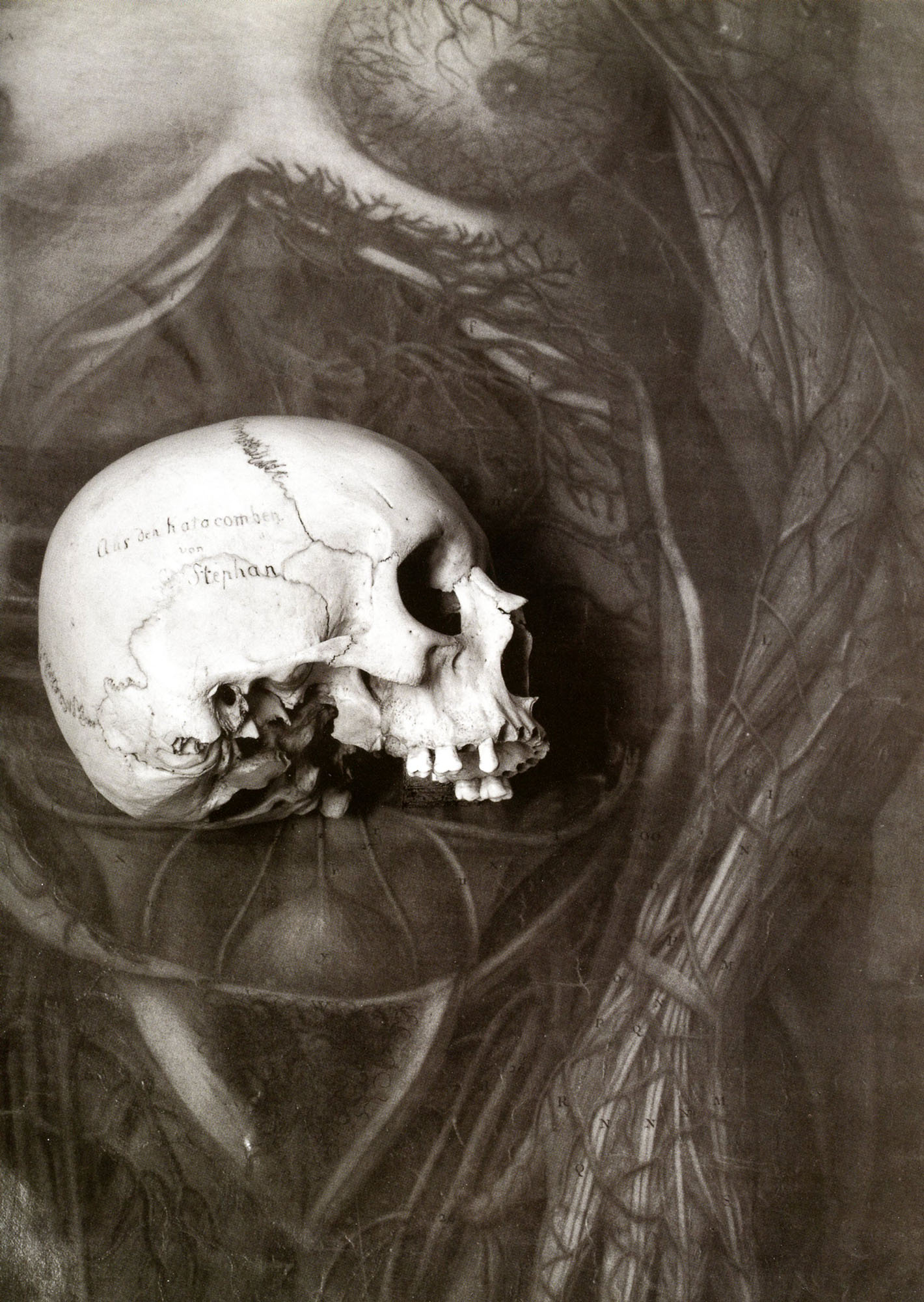
Skull ©1993 Rosamond Purcell
A skull from the Catacombs of St. Stephen (Hyrtl Skull Collection), with a print by Jacques-Fabien Gautier-Dagoty (1717-1785) from his series on the anatomy of the female.
Culled from: Mütter Museum
Andersonville Prisoner Diary Entry Du Jour!
This is the continuation of the 1864 diary of Andersonville prisoner Private George A. Hitchcock (see the archived version for all entries up until now).
Here’s today’s entry:
August 5th. Very hot. All the sick of the first eight detachments were taken out. Prisoners from Sherman came in. I was taken with a severe headache at night. We are continually tormented and tantalized with the sight of peaches, apples, chickens, and soda-water offered for sale at fabulous prices.
Culled from: Andersonville: Giving Up the Ghost