Today’s Philandering Yet Truly Morbid Fact!
Thirty-year-old blond-haired beauty Bernice Curtis was one of the thousands of women who went west during World War II. Recently divorced, Curtis moved from the Chicago area to San Francisco, where her married sister lived. She shared an apartment with Elsa Martin in the Mission District and worked as a clerk at a cigar store, where she came into contact with hundreds of people each day.
On the morning of November 23, 1942, Santa Clara sheriff’s deputies discovered the battered, fully clothed body of Bernice Curtis. Her fingers and jaw were broken, the back of her skull cracked, and her face shoved into the mud of the newly plowed field near the intersection of Alma Street and Diss Road, south of Palo Alto. Bernice had put up a struggle with her attacker and fought to her nightmarish death. Robbery was not the motive, as Bernice’s expensive rings were left on her shattered fingers.
The sheriff’s detectives re-created a scenario from the clues scattered about the crime scene. Bernice was attacked inside a green sedan and fought her way out of the car. Running down Diss Road, she tripped and fell, breaking her jaw in two places. Fearing for her life, the bloody and battered woman got up and climbed over a fence and ran into the freshly plowed field, where she was caught by her attacker, who shoved her face into the mud and then beat her head in with a nearby rock or clod of dirt. Diss Road is now known as East Meadow Drive, and is in a heavily-populated suburban area, but in 1942 the area was farmland and nobody heard Bernice’s terrified cries for help.
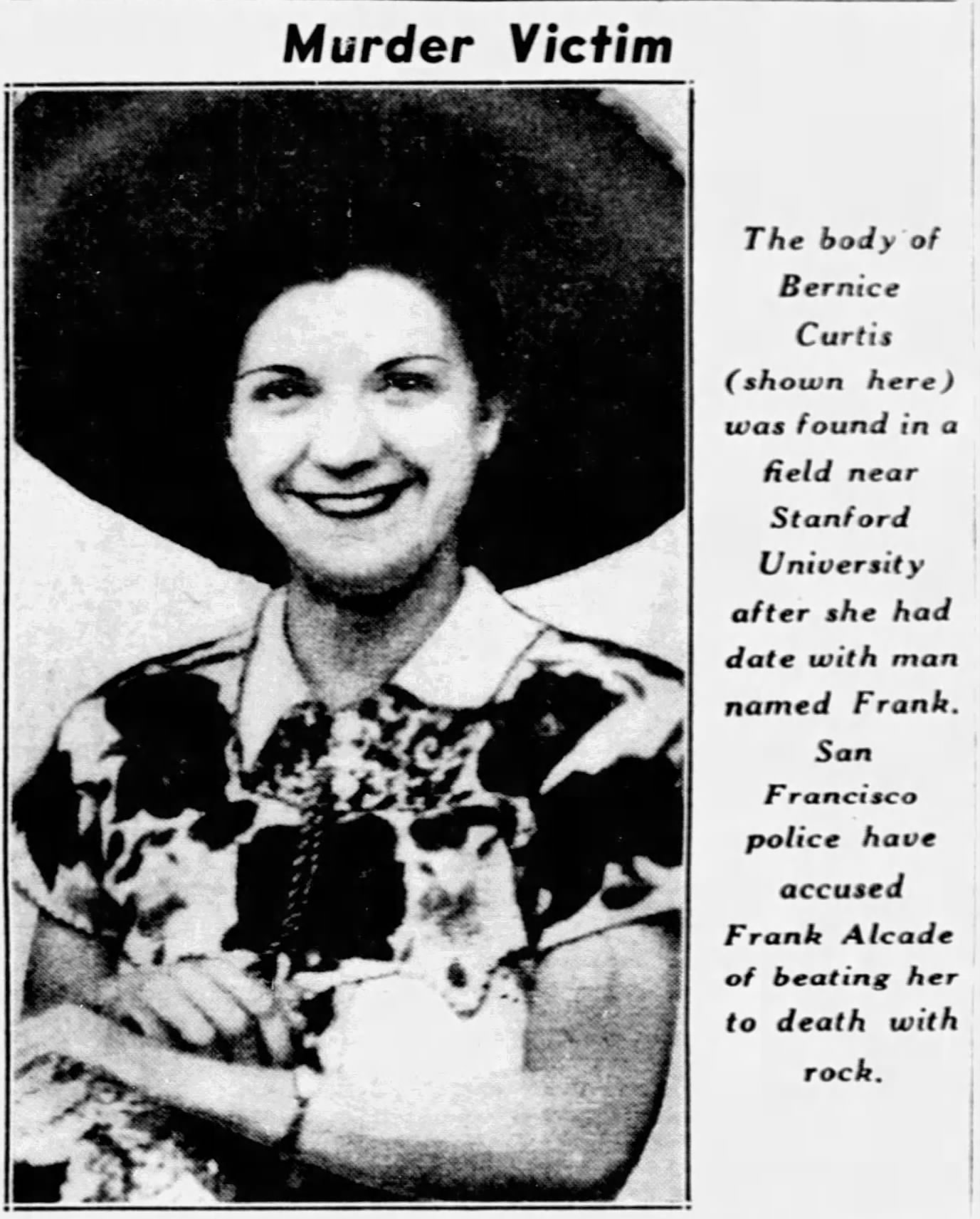
The police checked out Bernice Curtis’ background and it came back clean. She had moved to San Francisco just a few months earlier to be near her pregnant sister and to start a new life after her divorce. Her ex-husband was in the Army and stationed in the South Pacific. She was well liked by her co-workers and customers, but Curtis’ brother-in-law, Bernard Ash, told police that Bernice had been dating a tall, dark, and handsome Latin man named Frank.
More information was gathered concerning the mysterious boyfriend. According to roommate Elsa Martin, Bernice had been going steady with Frank for about three weeks. He was a charming man who bought a corsage of lavender, sweet peas, and gardenias for Bernice every Sunday. Bernice’s sister, Helen Ash, told the police that Frank worked at a shipyard in South San Francisco, was divorced, and had a daughter. Frank had a pencil mustache and drove a green Chevrolet. A hatcheck girl who worked at the Hawaiian Garden nightclub in San Jose saw Bernice’s photo in the newspaper and told the police that she had seen Curtis on Sunday night with a man whom she knew as Frank. They were with another couple, who were never identified.
The suspect was soon identified as twenty-nine-year-old Florencio Frank Alcalde, an American of Philippine ancestry from the South Bay city of San Bruno. After the florist identified him as the man who bought Miss Curtis a corsage every Sunday, he was arrested at Western Pipe and Steel Company, where he worked as shipfitter’s helper. Boxes from the florist shop were found in Curtis’ apartment.
Alcalde denied even knowing Bernice Curtis, but Santa Clara County Sheriff William Emig knew better. He had dealt with Alcalde back in 1935 when Alcalde was the main suspect in the death of twenty-six-year-old Kathleen Robinson of San Mateo. Robinson, a pretty, single woman who worked at a laundry and gave financial help to her parents, was found with a bullet behind her right ear on January 26, 1935. Sprawled under the Southern Pacific Railroad overpass on East Poplar Avenue in San Mateo, Robinson was at first thought to be the victim of a drive-by shooting.
The police put their clues together and brought Alcalde in for questioning, where he remained undaunted by the interrogation. When shown Robinson’s body, Alcalde broke down and wept.
Alcalde was released but was arrested again after the police discovered that the gun used to kill Robinson was of a German make and so rare that there were only six of them registered in California. One of the owners was Alcalde’s father, Frank Sr., who had reported the gun stolen two months earlier from his San Mateo tavern.
Alcalde hired hot-shot attorney Joseph Bullock, who pulled no punches to get his client off the hook. An alibi was provided for Alcalde’s whereabouts and he was released. San Mateo sheriff’s officers again arrested Alcalde when a search of his room turned up an ammunition clip made especially for the missing pistol. Again Bullock convinced the district attorney to dismiss the case due to insufficient evidence. The case lingered for seven long years without any new clues.
In the meantime, Frank Alcalde married and had a daughter, but the marriage was rocky because of Alcalde’s philandering lifestyle. He had left his wife and child and moved into a South San Francisco hotel during the two weeks that he was dating Bernice Curtis. Police found bloody clothing in his hotel room and at his home in San Bruno.
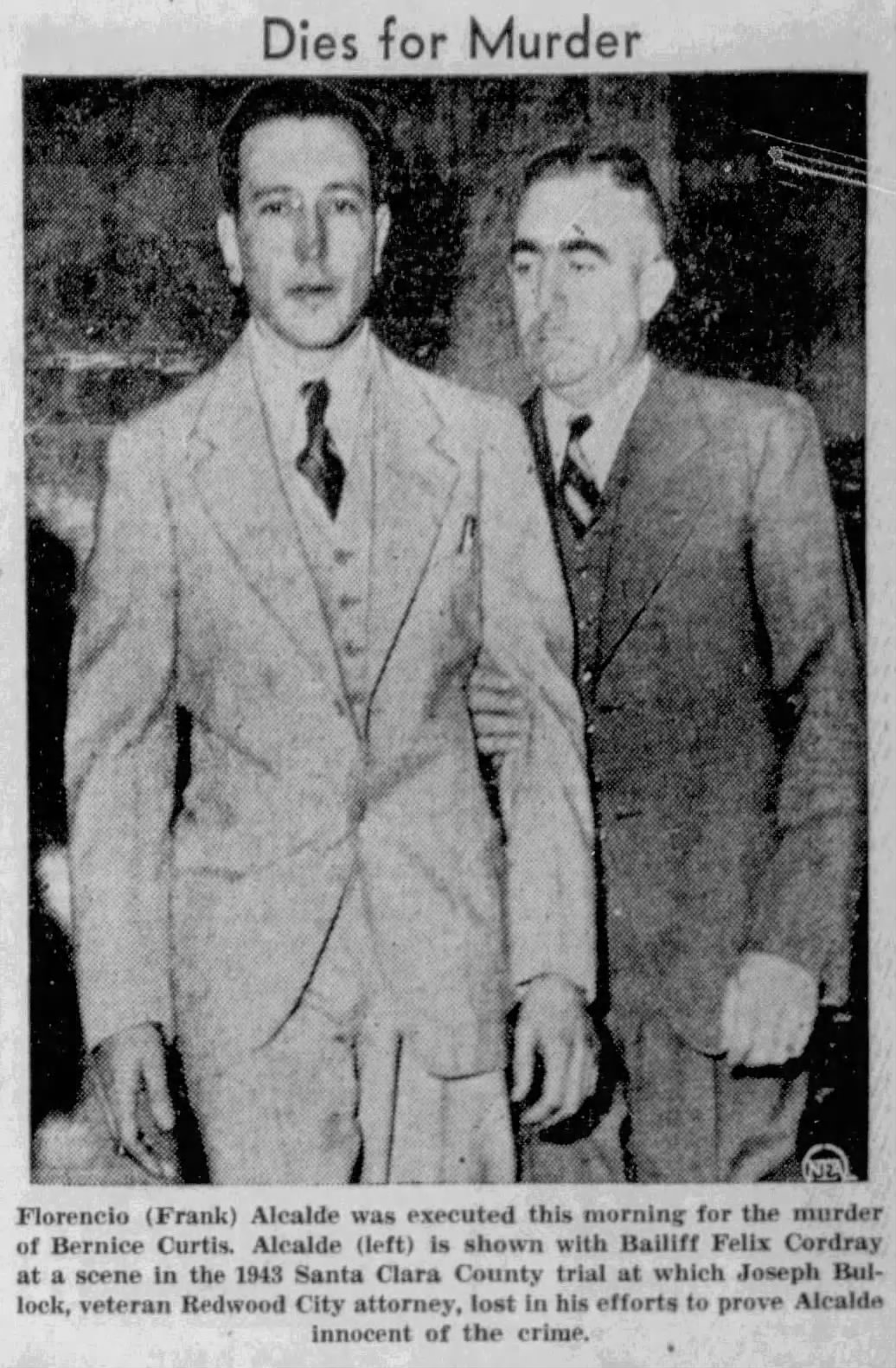
At Alcalde’s trial in San Jose, Joseph Bullock again represented the aloof Latin lover, but the evidence was more compelling than it had been in 1935. A green feather found at the crime scene matched perfectly a feather stub of a hat owned by Alcalde, as well as a broken inside light dome cover from a 1933 green Chevrolet sedan that was found on Diss Road near where the murder took place. Blood matching the slain woman was found on the floor mats of the green Chevrolet.
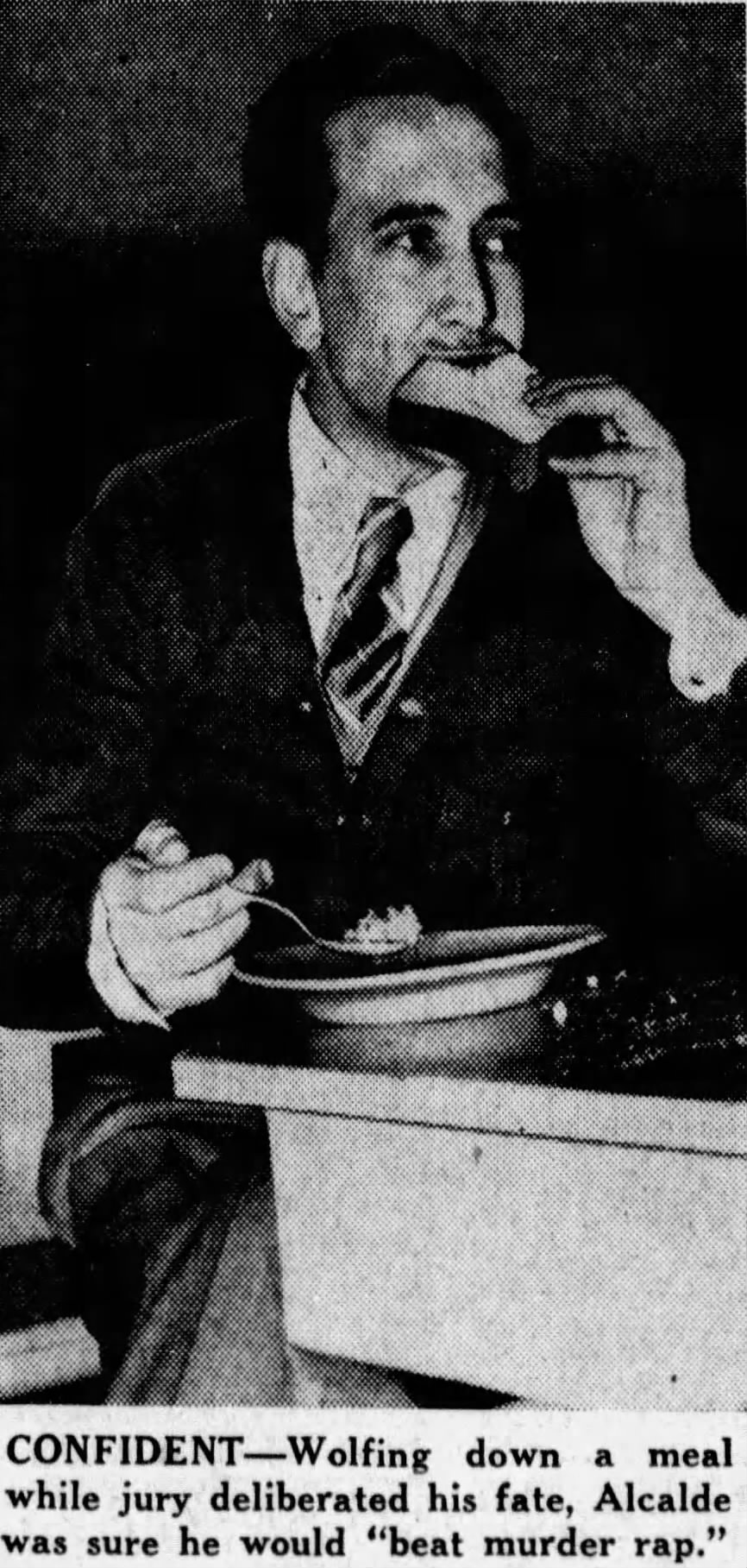
A bus driver reported that he had seen a coat that belonged to Curtis lying on Diss Road close to a parked green Chevrolet sedan with the right front door open in the early morning hours of January 25. The testimony of Curtis’ roommate, sister, brother-in-law, and the florist identified Alcalde as Bernice’s boyfriend. The hat-check girl from the Hawaiian Gardens put Alcalde in Santa Clara County with Bernice Curtis on that Sunday evening, November 22. A south San Francisco police officer told the court that he had caught the couple necking at a lovers’ lane, just a few weeks before the murder.
Alcalde’s co-workers at Western Pipe and Steel, John Lopez, Leonard Scott, George Manices, and Ben Pop Moore testified that not only had Alcalde shown them photos of Curtis, but he had bragged about their sex life in vivid detail. Alcalde had told them days before the murder that he wanted to go back to his wife but that Bernice Curtis was the marrying kind, adding that he would have to get rid of her.
Lopez and Moore put the nail in Alcalde’s coffin when they told the court that Frank Alcalde, Sr., had offered them money to be the younger Frank’s alibi. All they needed to do was say that they had been playing cards with the two Alcaldes at a San Bruno pool hall. They coldly turned down Alcalde’s offer and reported the conversation to Santa Clara County Prosecutor Amiglio Andrencetti.
The courtroom hushed when Alcalde’s wife, Della, walked into the courtroom during a recess, grabbed Bullock without even looking at her husband, and led him into an antechamber. Moments later, she walked out of the courtroom, without once glancing at her spouse.
Frank Alcalde took the stand in his defense and denied killing Bernice Curtis. He claimed that she told him that she had a date with another man the day that she died. Nobody believed him and Andrencetti tore his alibi to shreds. The trial lasted fifteen days.
On March 10, 1943, the jury of four men and eight women found Alcalde guilty of first degree murder after deliberating for only eight hours. He was sentenced to death on March 19, 1943, but the suave and confident lady killer shrugged off the conviction, saying that he was innocent and that he would get a new trial.
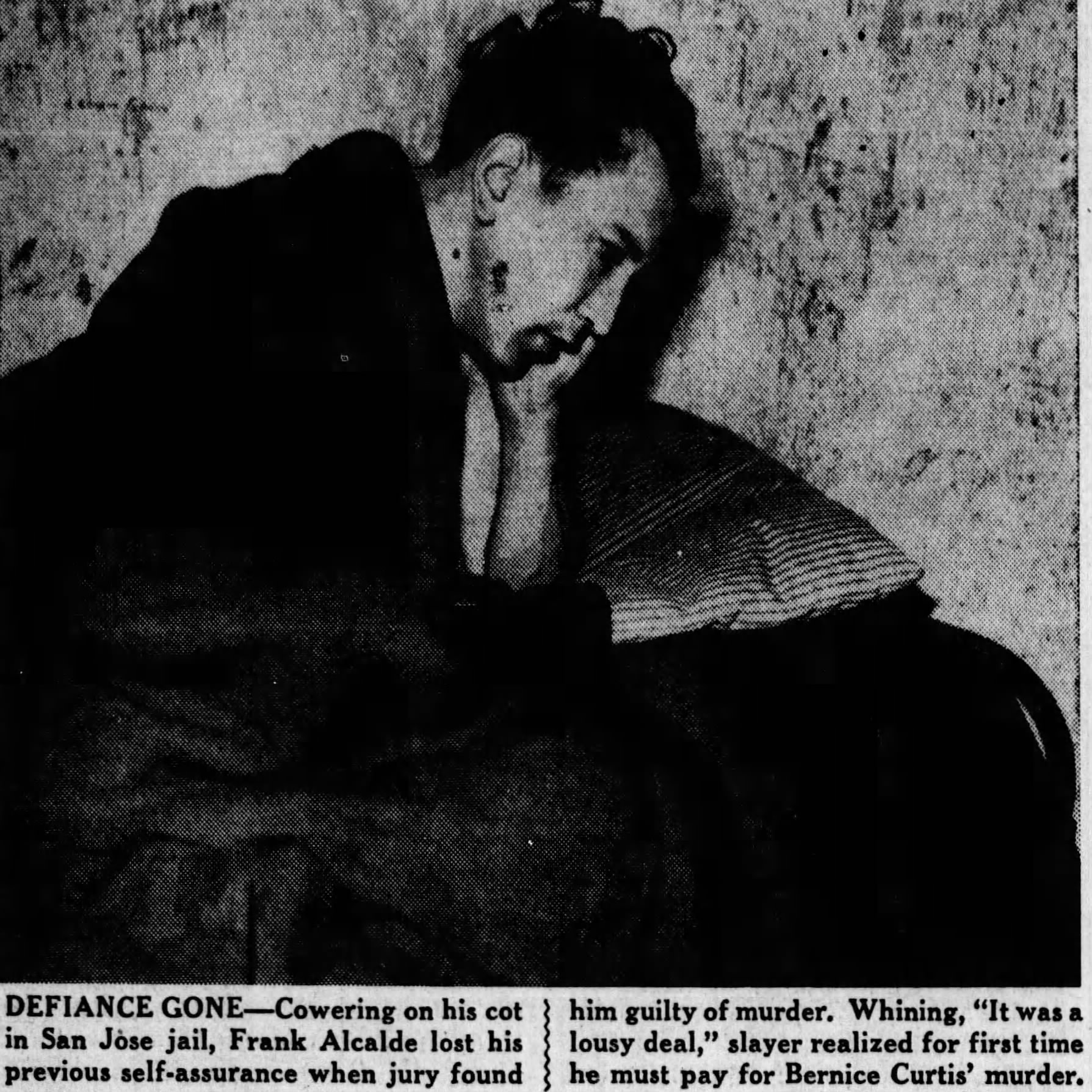
The new trial never came. Alcalde’s wife Della died of an illness that she caught from earning a living, leaving his young daughter an orphan on August 18, 1944, when an emaciated and ashen Florencio Frank Alcalde cursed as he entered San Quentin’s gas chamber. Alcalde was the 256th person to be legally executed in California and the 42nd to die in the gas chamber.
Culled from: Death In California by MFDJ-Patron David Kulczyk
Crime Scene Du Jour!
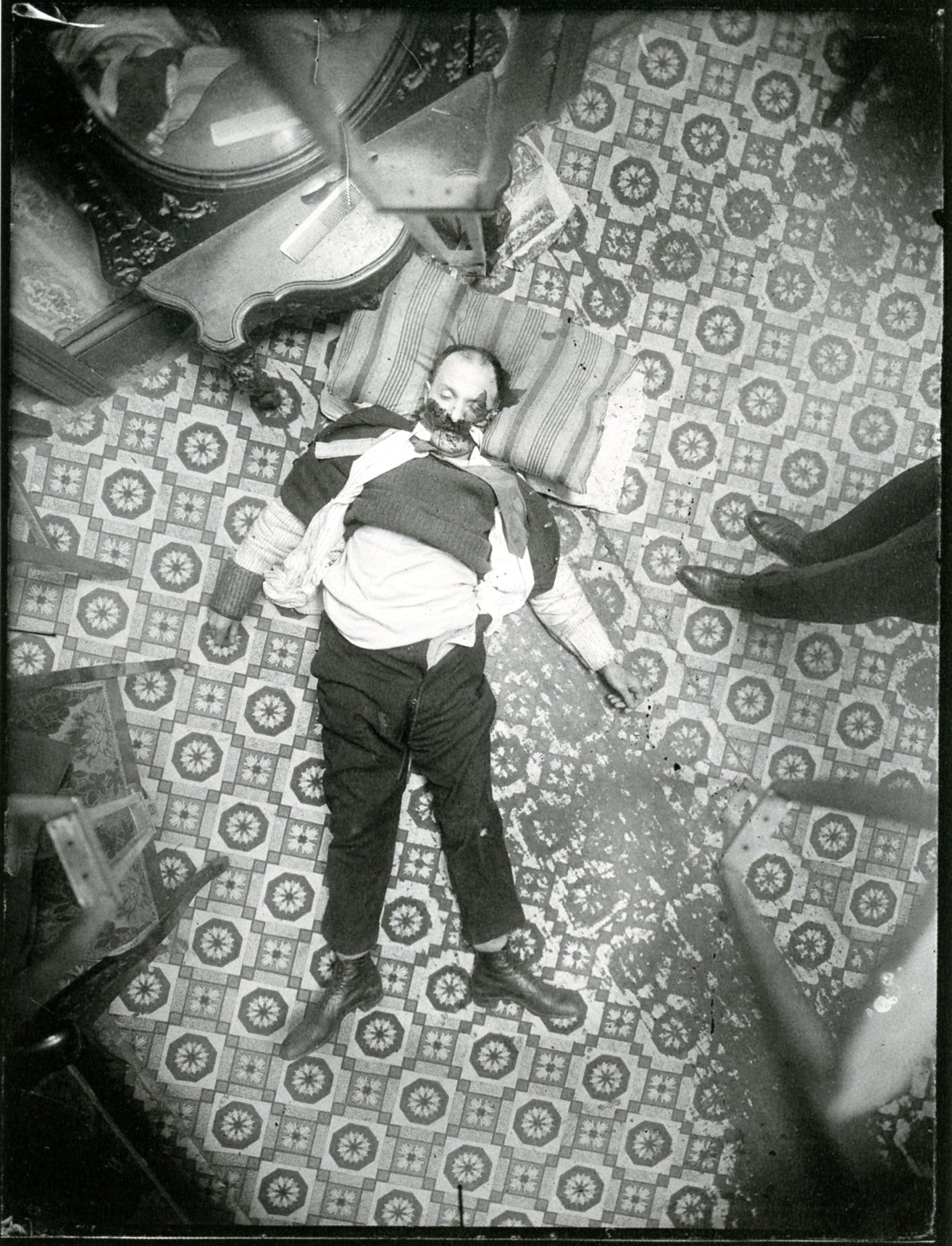
New York City homicide, 1916-1920
Format: 6.25″ x 8.25″ glass-plate negative
Culled from: Murder in the City
Andersonville Prisoner Diary Entry Du Jour!
This is the continuation of the 1864 diary of Andersonville prisoner Private George A. Hitchcock (see the archived version for all entries up until now).
Here’s today’s entry:
August 4th. Very hot. No sick were taken out; neither roll-call nor sick-call took place. One of our squad died near me this noon. Prayer-meeting was held near me in the evening.
Culled from: Andersonville: Giving Up the Ghost