Today’s Boiling Yet Truly Morbid Fact!
In the middle of the afternoon of June 28, 1970, Andy C. Hecht, 9, of Williamsville, New York, was walking with his vacationing family along a boardwalk near Crested Pool in the Old Faithful area of Yellowstone National Park. That awesomely beautiful hot spring had so captivated early visitors to the Park that it received a slough of romantic names, among them “Fire Basin,” “Circe’s Boudoir,” and the “Devil’s Well.” A puff of wind apparently blew the pool’s hot vapor into Andy’s eyes, momentarily blinding him at a turn in the walkway. Some accounts claim Andy tripped at the edge of the boardwalk, which had no guardrail. At any rate, he plunged into the pool where the temperature was over 200ºF. Andy tried vainly to swim a couple of strokes, then was scalded to death and sank. According to two national magazines, the last glimpse his mother had of him was seeing his rigid, stark-white face, the mark of his pain and apprehension of death, sinking into the boiling water. Andy’s father stated that they did not see him fall; he was behind them on the boardwalk when they heard a splash, turned around, and saw in horror that he had fallen into Crested Pool. Regardless, his body sank out of sight. Eight pounds of bone, flesh and clothing were recovered the following day.

The Ever-so-alluring Crested Pool
The accounts of other witnesses conflict with those of the parents. Several persons, including Andy’s sister, Margaret, were witnesses or near-witnesses to the tragedy, and two of them say he ran into the pool. Margaret stated, “I was walking behind Andy. We were going at a pretty slow pace, and I saw him coming close to the edge, and I go, ‘Andy, watch out!’ Then I heard this splash, and I grabbed his hand. I couldn’t hold on much longer. Then I couldn’t see him because of the steam; and the next thing I knew, I couldn’t see him again; and he was down.” Polly Eash, 15, of Greensboro, Maryland, was also a witness , and she said: “I saw him swing around and run into the pool. As he went into the pool his hands were up and his legs were in motion running. He just simply ran down the slope into the pool. Everyone was screaming and hollaring [sic].” Polly’s friend, Amy Myers, also 15, of Denton, Maryland, corroborated Polly’s account: “The boy did not trip that I noticed; he just ran right into the center of the pool… He just ran, actually running, right into the pool with both hands up over his head.” Ron Reader of Roseville, California, was another nearby stroller. He says, “I heard some screaming and ran to [the] edge of (the) pool to see a boy with (his) arm raised sink out of sight.”
Several witnesses remembered hearing the father yell “Andy!” several times. Walter Layfield of Parkersburg, West Virginia remembered that two or three persons physically restrained the father from going into the spring after his son. And a nurse at Lake Hospital, Carol Lake, remembers overhearing Andy’s father, James, saying something like, “He (Andy) was right behind us, and I heard him say, ‘I wonder if this water really is hot’.”
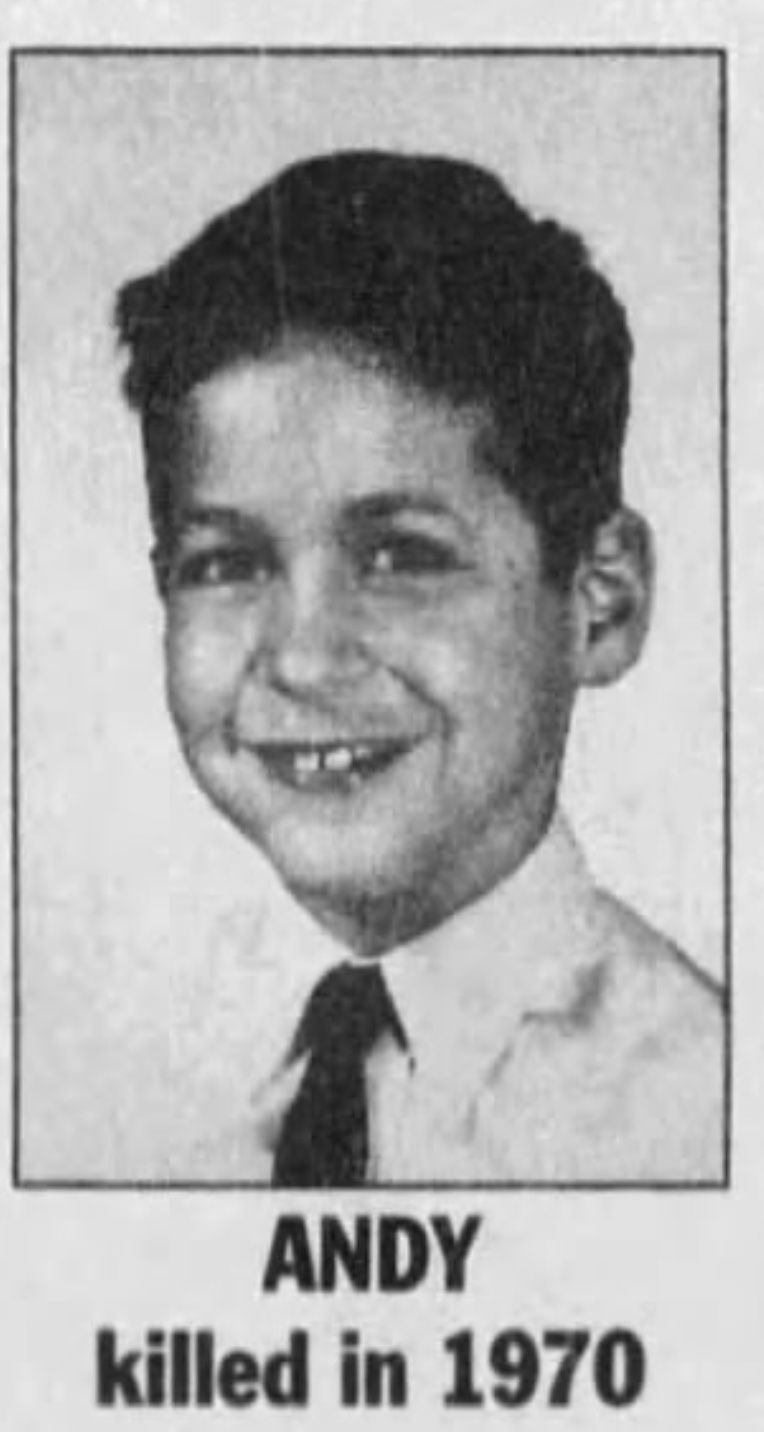
Fucked around and found out
Around four the next morning, James Hecht, unable to sleep in his motel room despite heavy sedation, arose to compose a letter to Secretary of the Interior, Walter Hickel, about what he thought were inadequate safety procedures on the part of the National Park Service. Dr. Hecht, a chemical engineer in Richmond, Virginia, urged Hickel to take “positive action” to prevent similar future accidents.
Dr. Hecht and his wife began a drive to force the National Park Service to commit to improved safety in the national parks. He testified before a senate subcommittee, accusing the NPS of failing to give adequate warnings in pamphlets and brochures about the dangers of thermal pools and of failing to erect guardrails. Dr. Hecht also filed a wrongful death lawsuit against the Park Service and another suit to force the government to give him information on fatalities in the then 258 nation park units. An initial tort claim asked for one million dollars. Hecht’s wrongful death lawsuit was eventually settled out of court for $20,000.
Culled from: Death In Yellowstone
Crime Scene Du Jour!
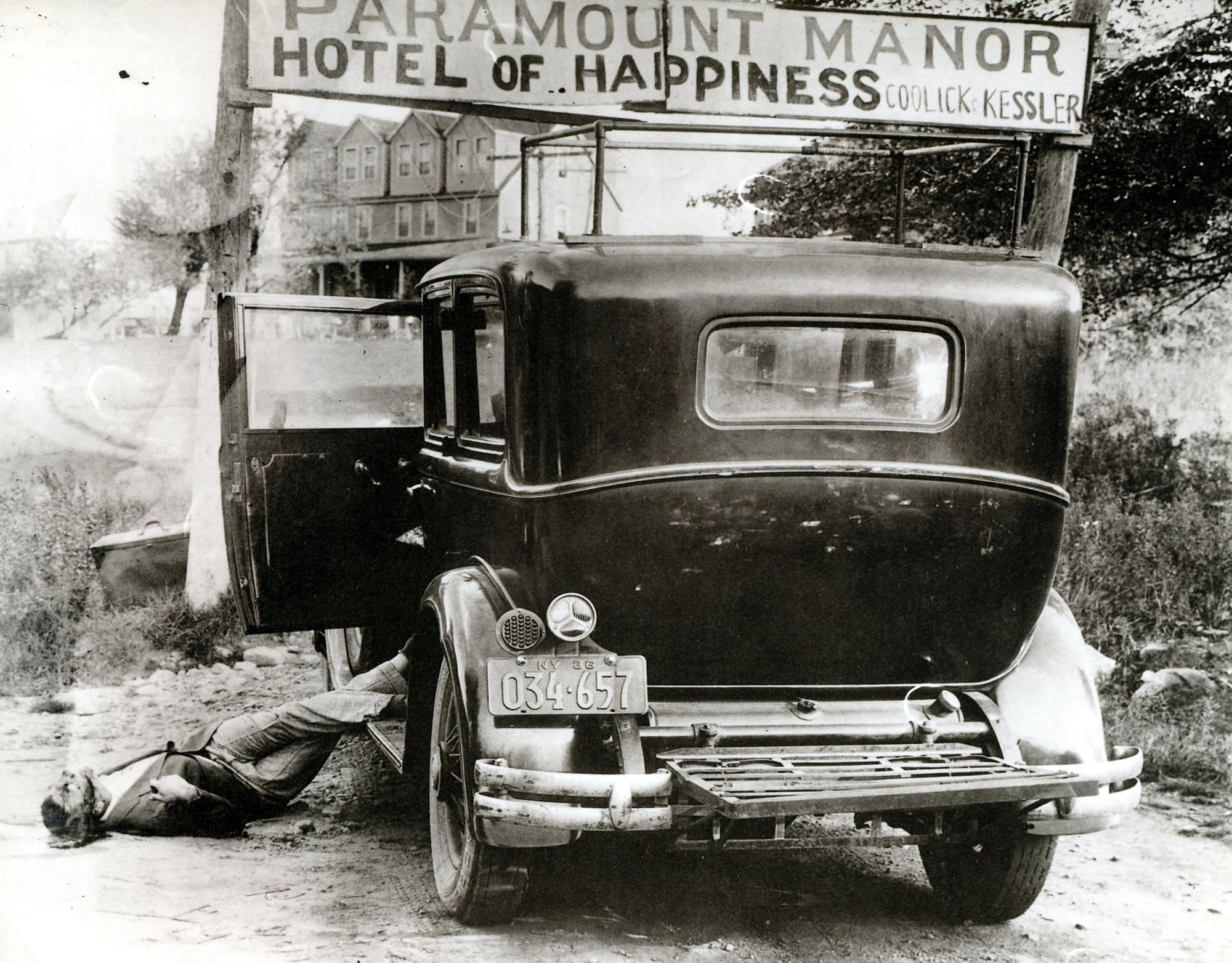
HOTEL OF HAPPINESS
September 5, 1936
Photographer: Wallace
Murder Ring. Pix shows scene near Hurleyville, N.Y. summer 1936. Underneath the “Hotel of Happiness” sign… Irving Ashkenas lies slain. Murder syndicate member Pretty Boy Levin admits complicity in the job.
– Photographer’s caption
Culled from: New York Noir: Crime Photos from the Daily News Archive
Here’s a newspaper article I uncovered about this murder from the September 5, 1936 issue of the Brooklyn Times Union:
5 SHOTS END LIFE OF MAN PAROLED IN STRIKE KILLING
Irving Ashkenas Killed After Carrying Passengers to Catskills in Taxicab.
The body of Irving Ashkenas, 34, of 279 South Fifth st., who in 1930 was convicted of manslaughter in connection with a garment strike killing, was found with five bullets in it early today behind an automobile at Loch Sheldrake, N. Y., according to word received here.
At his home here a neatly-furnished five-room apartment, his wife, Clara, 31, broke down when informed of the news and said she was certain her husband had no enemies in Williamsburgh or in the Catskills, and if he were murdered it must have been a repercussion of the garment disorders six years ago.
A Taxicab Driver
A small, trimly-dressed, attractive woman, Mrs. Ashkenas said her husband was sentenced to from 5 to 15 years in Sing Sing, but was paroled two years ago. He became a taxicab driver in midtown Manhattan, she reported, but later obtained a seven passenger Lincoln limousine and went into business for himself, carrying vacationists between Brooklyn and Catskills Mountain resorts, particularly Loch Sheldrake.
She and their two children, Selma, 10, and Paul, 6, were at Loch Sheldrake for a month, the wife said, but came back to Brooklyn last Wednesday because the weather was too cold. Her husband drove them home, according to Mrs. Ashkenas, and then returned with more passengers. When he left, he told her he expected to be very busy until after the holiday week-end, and might not be home for sleep or meals.
Sentenced to 5 to 15 Years
She had not heard from him since, she said, but did not worry because of his parting words.
At Manhattan Police Headquarters it was said no official word of Ashkenas’ murder that reached there. The police records tallied with Mrs. Ashkenas’ report. He was arrested on Feb. 10, 1930, on a charge of homicide in connection with the death of Jacob Rothberg, a dress manufacturer, of 1400 Broadway, Manhattan. On Dec. 19 of that year he was convicted of second degree manslaughter and sentenced to Sing Sing.
And here’s an article on the manslaughter that Ashkenas was convicted of, from the February 10, 1930 issue of the Brooklyn Times Union:
RIOTERS SLAY DRESS MAKER IN MANHATTAN
One man was fatally injured and a score of men and women were arrested today in the aftermath of an organized picketing demonstration, believed to herald the end of the dressmakers’ strike in Manhattan.
Jacob Rothenberg, 45, a dress manufacturer, suffered a fractured skull in a battle in front of 1412 Broadway, Manhattan. He died at Bellevue Hospital. Irving Ashkenas, 27, a chauffeur, of 173 Eldridge st., Manhattan, arrested as Rothenberg’s assailant, was charged with homicide.
Andersonville Prisoner Diary Entry Du Jour!
This is the continuation of the 1864 diary of Andersonville prisoner Private George A. Hitchcock (see the archived version for all entries up until now).
Here’s today’s entry:
August 7th. Very warm. Several convalescents came in from the hospitals, and report an awful condition of affairs there. I am feeling better, except an irritating cough. Prisoners from Sherman came in.
Culled from: Andersonville: Giving Up the Ghost