Today’s Improperly Loaded Yet Truly Morbid Fact!
The 178-foot (53m) twin-screw passenger steamer Manasoo left West Bay on Lake Huron’s Manitoulin Island with a rather unusual cargo—100 head of cattle destined for Owen Sound. At 8 p.m. on September 14, 1928, the ship passed Little Current and headed out into Georgian Bay with no indication of problems ahead.

The Manasoo
However, as so often happened on Lake Huron, by the time the Manasoo had reached Cape Croker, the southeast wind had turned into a full gale. Captain McKay headed towards Griffith Island to try and reach the shelter of Owen Sound Bay. The boat pitched, listing unnaturally as water streamed into the engine room. Only a short distance from Griffith Island, the Manasoo suddenly rolled over completely.
The purser, Arthur Middlebro, who had been thrown into the churning water, spotted something dark, which he reasoned to be two of the cattle. Maybe he could ride to the safety of Griffith Island on the back of one of them! Even more fortunately, it was a life raft. Six men, including Middlebro and Captain McKay, climbed aboard. Over the next three days the men suffered with scorching days and cold, windy nights. One of them died on the morning of the 17th, only hours before the Manitoba spotted them. Fifteen other crewmembers perished and were never found.
The unnatural list of the Manasoo led many to speculate that a steel plate had given way in the storm. Others contended that the cattle were improperly loaded and were loose on the deck, but McKay denied the accusations.
Culled from: Disaster Great Lakes
Incidentally, the ship was considered cursed because they had changed the name from Macassa and a sailor superstition holds that changing the name of a ship puts a curse on it. Indeed, it sank within a year of the name change so, how’s that for rock-solid evidence? Also, the wreckage was found in 2018 although, sadly, no skeletons of men or cows were found. But there was a cool car on the deck!



Crime Scene Du Jour!
It’s another of those fascinating Parisian crime photos!
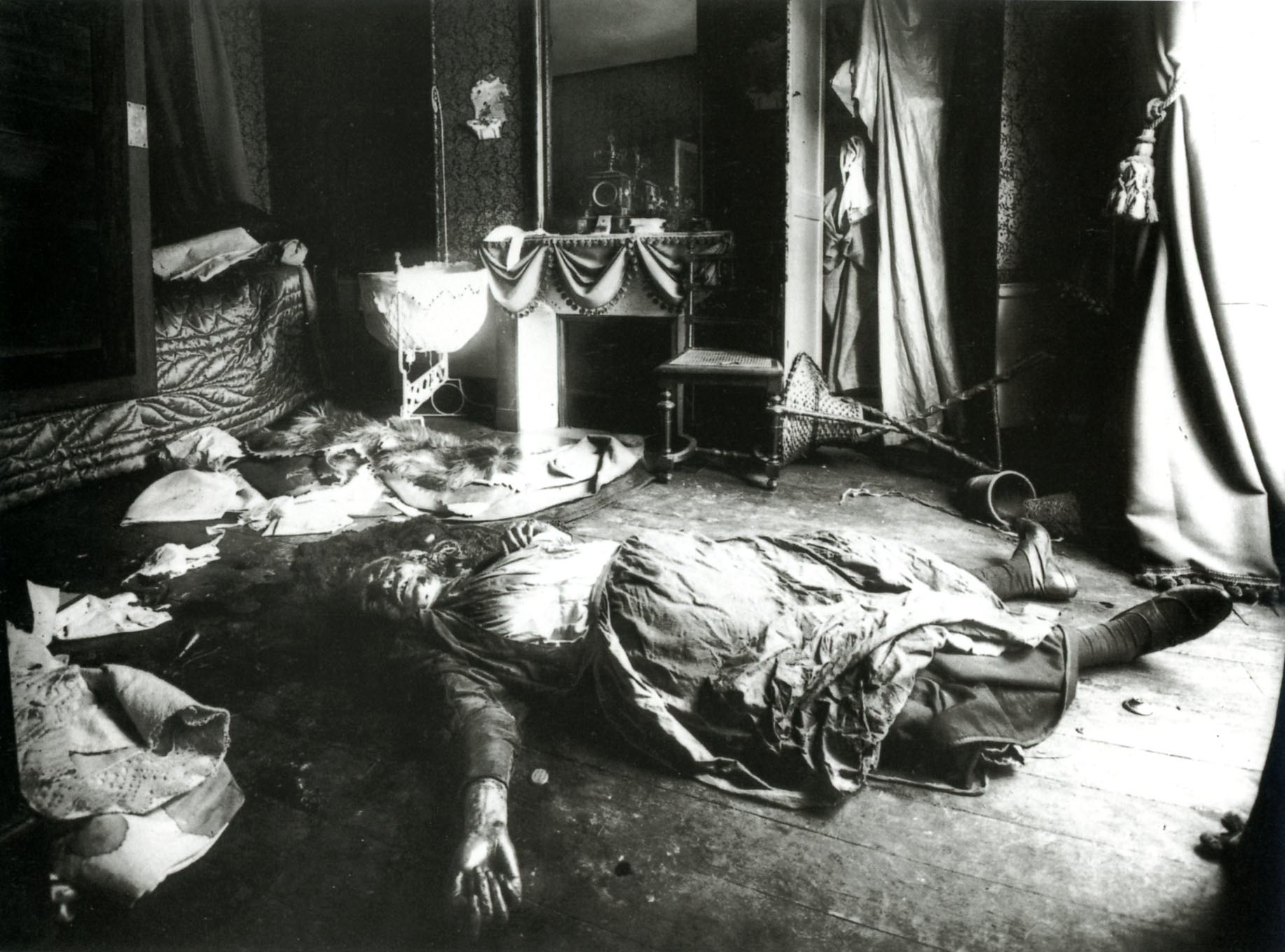
Crime de la rue Bouchardon (Madame Daly)
Culled from: Police Pictures
I was able to track down the sorry tale from the October 6, 1893 issue of the Newcastle upon Thyne Evening Chronicle:
THE TRAGEDY IN PARIS
“IT WAS YOU WHO MURDERED YOUR WIFE!”
KISSED THE BABY BEFORE KILLING THE MOTHER.
There is no longer any mystery about the murder of Madame Dally or Daly, as she is now called. The perpetrator of the deed in the Rue Bouchardon, near the Porte Saint-Martin, in Paris, has been discovered in the person of the woman’s husband, who was supposed to be so overcome with horror and grief when, on returning home from his work last Tuesday evening, he stumbled on the prostrate corpse of his wife. Daly—as stated—first told the Juge d’Instruction that on leaving the printing office in which he was foreman he went straight home, was surprised to see no light in his rooms, and found a key in the door. Entering his residence, he went to the kitchen, lighted a lamp, and was horrified to find his wife lying dead on the floor of the bed room. He then ran downstairs and gave the alarm to the concierge, who sent for the police. Later on the concierge and his wife were examined, the latter—Madame Oubriot—giving some startling evidence. She said that while nursing Madame Daly on one occasion lately the murdered woman complained that, despite appearances, her married life was not a happy one. Her husband was jealous to an extraordinary degree, and was sometimes in the habit of beating her. He was being constantly excited by his mother, who hated her daughter-in-law. Madame Oubriot further stated that Daly’s appearance and conduct on the evening of the crime appeared suspicious. He generally returned home from work in his printer’s blouse, but on Tuesday evening he came back in his Sunday clothes. She had, nevertheless, seen him go out in his blouse after his midday meal. The question was, had he, unseen by the concierge, gone back to his rooms at about 5 o’clock in the afternoon, and then dressed himself in his Sunday suit? Inspector Jaume, of the Detective Division, pondered over this evidence, and sent a policeman off to Daly’s employer, who said that his foreman left the workshop in an excited condition about half-past five on Tuesday evening. He was then in his blouse, but after a few hours returned to the shop in his best suit. Inspector Jaume was also impressed by the fact that Daly steadfastly refused to enter the room where his wife’s body was lying, covered with a cloth. Under the pretext that he wanted to note down in writing the number of a watch missing from among the murdered woman’s effects, the inspector took Daly with him to the police station in the Passage du Desir. There the printer was told to sit down, and hardly had he done so when M. Jaume, looking him straight in the face, said, “It was you who murdered your wife!” Daly grew pale, but protested his innocence, whereupon M. Jaume said that he would bring him face to face with his employer, who would speak as to his absence from the workshop on the evening of the crime. Policeman Boulet was then told to take charge of Daly, and eventually wrung a confession from the culprit, who, bursting into tears, said that he had murdered his wife because she had deceived him. M. Goran and the Juge d’Instructor—M. Espinas—were at once wired for, and on their arrival Daly again repeated his confession of guilt. He said that on Tuesday evening he received a letter informing him that his wife was waiting for a lover, whereupon he ran home, tried to make her admit that he had a rival, and in a sudden access of jealous fury, when she cried out, “Yes! I do love somebody else! I have had enough of you! I hate you!” he smote her with a heavy candlestick and literally battered the life out of her body. After she was dead he washed his hands, changed his clothes, and so arranged the wardrobe and chest of drawers to make people believe that the deed was the work of a burglar. Daly also said that before murdering his wife, he kissed his baby, which was crying in its cradle. The magistrates who conducted the investigation do not believe in the imputations of the man against his wife, who is said to have been a very hard-working, well-conducted woman. The murderer is a robust man of about 28, and is a Lieutenant in the Artillery of the Reserve. The employer of the man whom Daly accused of being his rival indignantly denies the accusation against his subordinate, who he says is a married man of excellent conduct, and was never alone with Madame Daly in his life.
And I have to share the description of Daly from the October 22, 1893 Pittsburgh Press:
“… he is no lunatic, but a cool, calculating, diabolic scoundrel; but, until this murder, a faultless character, adulterated with no politics, no isms.”
A “faultless character” with no isms, huh? M. Daly would beg to differ!
Andersonville Prisoner Diary Entry Du Jour!
This is the continuation of the 1864 diary of Andersonville prisoner Private George A. Hitchcock (see the archived version for all entries up until now).
Here’s today’s entry:
August 9th. Very warm. The heaviest thunder shower of the season occurred in the afternoon, which flooded camp and undermined the stockade in several places so that it fell over, causing wild excitement among the authorities outside. All the guard were called by the long roll, the batteries all manned and turned on us poor fellows, who were greatly amused by their alarm. Four hundred prisoners from Sherman came in. Poor old Boyer, a German from Ohio, died near me. All day yesterday and last night he lay, almost within arm’s-length of me, moaning and crying for water, while every draught seemed to throw him into spasms; and when he died we all felt relieved that rebel hate could do no more to him. In the evening I went over and had a good talk of old times with Walter Lamb.
Culled from: Andersonville: Giving Up the Ghost