Category Archives: Sightseer

Morbid Fact Du Jour for December 21, 2014

Today’s Icy Hot Yet Truly Morbid Fact!

In 1893, the city of Chicago hosted the World’s Columbian Exposition, a world’s fair belatedly commemorating the 400th anniversary of Christopher Columbus’s discovery of North America.  The fairgrounds were situated on the city’s south side six miles south of the Loop and spread over a 700-acre tract of land abutting Lake Michigan in Jackson Park. Frederick Law Olmsted, one of America’s foremost landscape architects, transformed the sandy, swampy land into a wonderful setting of lagoons and gardens that would host exhibits from 60 countries and more than 200 buildings. The fair cost the city $30 million and drew 27 million visitors during its six-month run. It turned a 10% profit. Two prominent Chicago architects, John Wellborn Root and Daniel Burnham, were selected to design the fair’s buildings. After Root died of pneumonia in 1891, Burnham decided to emulate classical Greek and Roman styles in his designs. Each building was built of wood and covered with “staff,” a fibrous plaster substance that gave the look and feel of white marble. Thus the “White City” as it became known, appeared to be built of stone. The grand effect was further heightened at night when electric lights were played against the building’s exteriors, illuminating the “marble”.

In addition to the stately show buildings, the White City housed restaurants, cafes, and sanitation and support facilities. One of the largest of the utility buildings was the fair’s cold-storage warehouse. Dubbed the “greatest refrigerator on earth” because of its mammoth size, the six-story white terra cotta building at 64th Street and Stony Island Avenue had its own ice-skating rink and measured 130 feet wide by 255 feet long. And though not officially a part of the fair itself, the warehouse had been built specifically to store all perishable food items used by the fair’s food vendors and to manufacture ice.

The cold storage warehouse appeared to be a sturdy, well-built structure, but it did have one fatal design flaw.  Its iron chimney, fitted at its base to a series of boilers, was 200 feet high, and because it was considered unsightly and clashed with the beauty of the surrounding buildings, a large wooden tower, topped with an ornate cupola, was built to enclose the chimney and hide it from view. Herein lay the problem. The cupola had been built several feet about the chimney opening creating a dangerous fire hazard. The chimney was insulated by firebrick for only the first 70 feet; the remaining 130 feet were left completely open and unprotected inside the tower. Though the architect’s plan had called for installation of a cast-iron thimble to extend the chimney above the cupola to protect it from the hot upward airflow, cost prevented it from being built.

This danger should have raised the concern of fire officials, especially after flames broke out inside the tower on June 17, although it was quickly put out by firefighters from the Columbian Exposition Fire Brigade.  On July 10, the firefighters were called back to the cold storage building when another fire broke out inside the wooden tower. This time, however, the flames would not be so easily tamed. Led by their captain, James Fitzpatrick, more than 20 men rushed to the top, climbing interior stairs that took them to platforms above the hot metal smokestack. Using ropes, the men hauled up their equipment, including hose and a portable ladder. A crowd began to gather. Just then hot coals started falling onto a lower platform below the firefighters, sparking a secondary fire that quickly burned upward. When it burst through the tower it cut off escape for the firefighters above.

The flames traveled quickly up the wooden tower, directly toward the firefighters trapped 200 feet above the street. To compound the situation, the water pressure in the hose line was severely inadequate, the pumps below unable to overcome the extreme height of the tower.

The stranded firefighters were left with just one option: they could tie off their hoseline and try sliding down it to safety. Though burned in the process, two managed to escape this way, to the cheers of the crowds below. When a third man followed their lead, he plunged to his death after the hose burned in half. A few others slid down a rope to the ground, but several more were trapped above when the rope burned as well. The remaining firefighters opted for jumping or falling off the ledge. The more than 40,000 spectators watched in shocked disbelief as the firefighters fell to their deaths. It took two hours for the 30 responding fire companies to put out the warehouse fire. Another three days would pass before rescuers recovered the last of the 12 dead firefighters, including Captain Fitzpatrick, whose body had broken through the roof and was buried in the debris. Fitzpatrick had survived the fall but died a short time afterward. Five other firefighters were severely injured, and one was crippled for life.  Of the dead, four were Chicago Fire Department members and eight were with the exposition’s fire brigade. Two cold storage employees and one electrician working in the building had also been killed.

The tragedy, of course, marred the world’s fair. Once again the Garden City was unable to protect itself from, or avoid being upstaged by, its greatest foe: fire.

Culled from: Great Chicago Fires: Historic Blazes That Shaped a City

Of course, I’m sure many of you know all about the Columbian Exposition by way of Erik Larson’s brilliant book The Devil in the White City.  I decided to take a trip to Oak Woods Cemetery the other day to see the monument to the cold storage firefighters and take some photos of the remnants of the White City.  Of course, as usual, I ended up getting quite sidetracked and I thought I’d share all the ways a Comtesse can get sidetracked whilst undertaking a simple task like photographing a couple of locations in Chicago.  Now, here’s my day on the South Side…


Wretched Recommendation!

When I saw that Joe had sent me a note about a book with the word ‘Müt­ter’ in the title, I lazily thought to myself, “Been there, read that, got it on my bookshelf”.  Luckily, I read his missive closer and realized that, no, this isn’t just another collection of photographs from the Müt­ter Museum (as glorious as those books always are); this is actually a book about the man behind the morbidly magnificent museum himself – Dr. Müt­ter!  And judging by the reviews on Amazon, it looks to be an excellent book – and it’s going on my ‘To Read’ list immediately! Thank you, Joe!

Dr. Mutter’s Marvels: A True Tale of Intrigue and Innovation at the Dawn of Modern Medicine

Here’s the Amazon blurb:

“A mesmerizing biography of the brilliant and eccentric medical innovator who revolutionized American surgery and founded the country’s most famous museum of medical oddities

“Imagine undergoing an operation without anesthesia performed by a surgeon who refuses to sterilize his tools—or even wash his hands. This was the world of medicine when Thomas Dent Mütter began his trailblazing career as a plastic surgeon in Philadelphia during the middle of the nineteenth century.

“Although he died at just forty-eight, Mütter was an audacious medical innovator who pioneered the use of ether as anesthesia, the sterilization of surgical tools, and a compassion-based vision for helping the severely deformed, which clashed spectacularly with the sentiments of his time.

“Brilliant, outspoken, and brazenly handsome, Mütter was flamboyant in every aspect of his life. He wore pink silk suits to perform surgery, added an umlaut to his last name just because he could, and amassed an immense collection of medical oddities that would later form the basis of Philadelphia’s Mütter Museum.

“Award-winning writer Cristin O’Keefe Aptowicz vividly chronicles how Mütter’s efforts helped establish Philadelphia as a global mecca for medical innovation—despite intense resistance from his numerous rivals. (Foremost among them: Charles D. Meigs, an influential obstetrician who loathed Mütter’s ‘overly’ modern medical opinions.) In the narrative spirit of The Devil in the White City, Dr. Mütter’s Marvels interweaves an eye-opening portrait of nineteenth-century medicine with the riveting biography of a man once described as the ‘P. T. Barnum of the surgery room.'”

More Monstrous Medical recommendations can be found at the Library Eclectica.


Fetus Du Jour!

Here’s another preserved 1930’s fetus that I photographed at the Museum of Science and Industry last week. You’ll note that as the fetuses get closer to birth, they start to look increasingly cynical. This one’s just picking its nose and watching its invisible watch. You think you’re bored NOW? Try staring at the same dark womb 24 hours a day – without a cell phone!

Morbid Fact Du Jour for November 29, 2014

Today’s Photographic Yet Truly Morbid Fact!

On September 7, 1993, Lori Newcomb, age 31, walked far out on a ledge of Kaibab Limestone at Cape Royal, Grand Canyon National Park, to capture the perfect photo.  The ledge itself crumbled under Newcomb’s weight. She slipped and fell 20 feet, rolled and slid down a terrace, then plunged 60 more feet to her death.  The activities of posing for and taking photographs account for 20%  (6 and 4 victims each) of the 50 total victims of accidental lethal falls from the rim of the Grand Canyon.

Culled from: Over the Edge: Death in Grand Canyon

In other words, when you’re at Grand Canyon, watch the people taking photographs along the ledge carefully, lest you miss the perfect photo op!

Plastination Vacation!

Okay, the next time I go to Germany, I am taking a Plastination Vacation in Guben to go to the Body Worlds headquarters. According to this documentary, you can actually help dissect some of the bodies that are in progress! Be still my morbid heart!  And there are fabulous examples of plastination on display in the gallery (like this doozy below!) And – may all towns be so lucky as to have an employer like this move in! (Thanks to The Dickeys for the link.)

(Sad to see that Gunther, the founder of Body Worlds, is suffering from Parkinson’s Disease though.)

Inside Body World’s Headquarters

Malformed Morbidity!

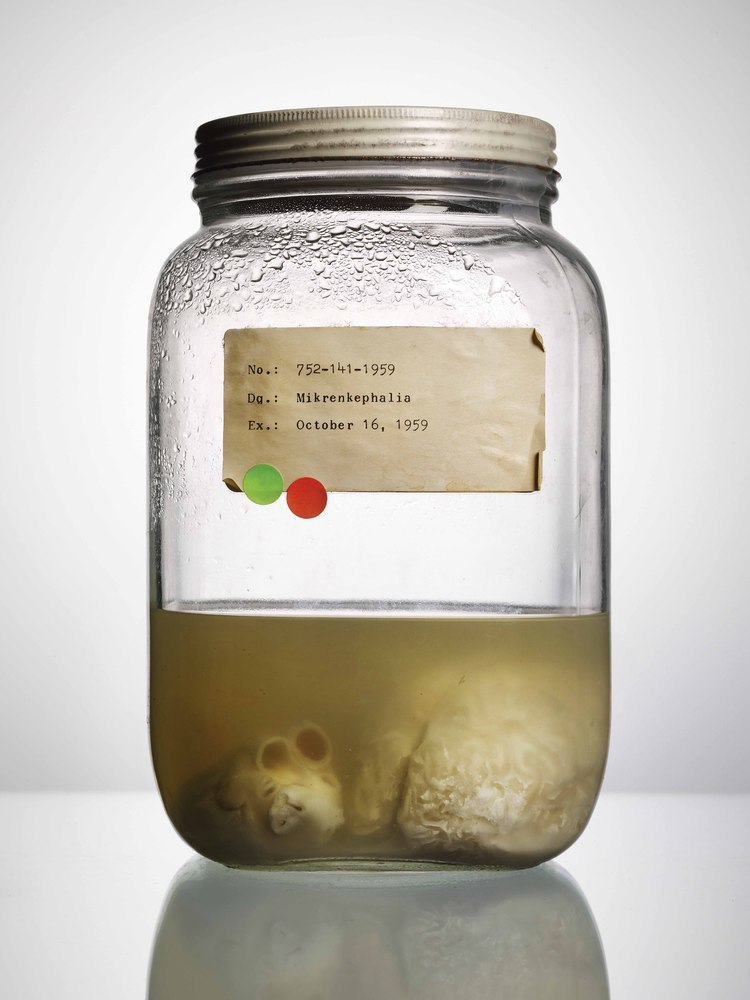
Steve Finn sent me a link to what looks to be an absolutely compelling collection of photographs of brains forgotten in a Texas asylum.  I’ve seen similar brains at the Central State Hospital forensic museum (Indiana Medical History Museum – go there if you can, it’s wonderful!), but who can’t use more brains in their lives?  And these are beautifully photographed.  Obviously, I’ve pre-ordered (it is released on Tuesday, Dec. 2nd).

There are nice excerpts here:
These Forgotten Brains From a Mental Hospital Are Oddly Fascinating

(Oddly?  Okay, Huffington Post hack – what is “odd” about finding brains fascinating?  Especially malformed brains. I think you’d be odd if you didn’t!)

And you can purchase the book from the conglomerate here to save a few bucks (or if you want to assist the Comtesse with her rewards program):
Malformed: Forgotten Brains of the Texas Mental Hospital

Morbid Fact Du Jour for November 27, 2014

Today’s Low Pressure Yet Truly Morbid Fact!

Sigmund Rascher (12 February 1909 – 26 April 1945) was a German SS doctor. His deadly experiments on humans, which were carried out in the Nazi concentration camp of Dachau, were judged inhumane and criminal during the Nuremberg Trials.In 1942, Sigmund Rascher and others conducted high-altitude experiments on prisoners at Dachau. Eager to find out how best to save German pilots forced to eject at high altitude, they placed inmates into low-pressure chambers that simulated altitudes as high as 68,000 feet and monitored their physiological response as they succumbed and died. Rascher was said to dissect victims’ brains while they were still alive to show that high-altitude sickness resulted from the formation of tiny air bubbles in the blood vessels of a certain part of the brain. Of 200 people subjected to these experiments, 80 died outright and the remainder were executed.In a typical experiment, detailed in a report by Rascher and his colleagues, a deli clerk was forced to endure an excruciating drop from 47,000 ft. without the aid of oxygen. Diligently, Rascher noted the subject’s behavior:2

  • “spasmodic convultions”
  • “gives the general impression of someone who is completely out of his mind”
  • “does not respond to speech”
  • “grimaces, bites his tongue”
  • “convulses arms and legs”
  • “yells aloud”
  • “clonic conclusions, groaning”
  • “agonal convulsive breathing”

The lurid Nuremberg testimony of Rascher’s prisoner assistant Antòn Pacholegg tells a similar story:3

“I personally saw, through the observation window of the chamber, how a prisoner inside was subjected to a vacuum until his lungs burst. Certain experiments produced such a pressure in the men’s heads that they went mad, tearing their hair out in an effort to relieve it. They lacerated their heads and faces with their nails, mutilating themselves in their frenzy.”

Culled from: Nova and Mad Scientist Blog

Here’s a photograph of Rascher.  Ain’t he sweet?  He wouldn’t even hurt a lil’ baby. Except, it turns out, that baby isn’t even his.  It was kidnapped.  What an evil scientist.

And here are some poor souls subjected to the altitude tests…

And here’s a post-mortem on one of the many victims.  After the war, the United States used Rascher’s data for the benefit of the Air Force. Isn’t it nice to know that it all went to something “useful”?

Morbid Sightseeing!

I’ve been told by someone who lives in Hays, Kansas that my Garden of Eden travelogue is a “hoot”. Perhaps you might concur?  It’s a weird place, that’s for sure…


The Garden of Eden

“My Brush With Morbidity” by Sleeper

“When I was very young I went to a school event where all the people who showed up for the activities crammed into the school’s cafeteria for some shitty pizza.  We were sitting at the cafeteria table, the typical humming of a hundred or so people talking and eating filling the air.”Sitting behind me was an older gentleman, his adult daughter, and I would assume her kids.  I didn’t notice them very well before the “event” partially because I was a very focused child.  Probably the opposite of ADHD, I was very focused on what I was doing or things I had in my hands, so to tear my attention away from something was a great feat indeed.

“The older gentleman moved my chair when he fell to the ground.  I remember looking at him as though he was rude but for the life of me I don’t remember any details of his face.  I was pulled from my chair but managed to grasp onto my bag of popcorn (how ironic) while my parents pulled my sister and I toward the wall of the cafeteria.  Hysteria reigned while his daughter, of about 40 years old, started screaming like a banshee, ‘SOMEBODY SAVE MY DAAAAADDDDYYYYYY!!!’

“Meanwhile I watched volunteer firemen perform CPR on this gentleman while calmly munching some popcorn.  Mommy and Daddy were ever so graceful enough to provide and explanation of what the firemen were doing, and while they were in shock from the experience and had to drive around for a while afterward to forget the events of ‘Fun Day’ I was excessively interested in what had happened and mulled over it.  I’m still mulling over it, years later.”

Do you have a morbid experience to share? Then send it to the Comtesse!

Past Brushes can be viewed at The Asylum Eclectica:
My Brush With Morbidity

Morbid Fact Du Jour for November 26, 2014

Today’s Dyn-O-Mite Yet Truly Morbid Fact!

For more than 100 years, the Nobel Prizes have recognized the finest in human achievements, from literature and science to the Nobel Peace Prize, which is given “to the person who shall have done the most or the best work for fraternity between nations, the abolition or reduction of standing armies and for the holding and promotion of peace congresses,” according to the last will and testament of founder Alfred Nobel.  But the origins of the Nobel Prizes, and the life of Alfred Nobel, tell a very different story, one tainted by the deaths of untold thousands of people.

Alfred Bernhard Nobel was born in 1833 in Stockholm, Sweden. His father, Immanuel Nobel, was an inventor and engineer who struggled financially for much of his life. Forced to declare bankruptcy, Immanuel left Sweden and began working in St. Petersburg, Russia, where he impressed the czar with one of his inventions — submerged explosive mines that could thwart a naval invasion. Finally achieving a measure of success, Immanuel brought his wife and eight children to St. Petersburg. His sons were given a formal education, and Alfred shined under strict Russian tutelage, mastering several languages as well as chemistry, physics, poetry and natural sciences.

Because the elder Nobel disapproved of Alfred’s interest in poetry, he sent his son abroad to further his training in chemistry and engineering. While studying in Paris, Nobel met Italian chemist Ascanio Sobrero, who in 1847 invented nitroglycerin, the oily, liquid explosive made by combining glycerin with nitric acid and sulfuric acid. Though nitroglycerine was considered too unsafe to have any practical use, the Nobel family — which now had several profitable enterprises in Russia and Sweden — continued to investigate its potential for commercial and industrial uses.

But their inquiries had tragic results: In 1864, Alfred’s younger brother Emil and several other people were killed in an explosion at one of their factories in Sweden. The disaster encouraged Alfred to try to find a way to make nitroglycerin safe. Success didn’t come easily: Early experiments included the creation of “blasting oil,” a mixture of nitro and gunpowder, which resulted in several deadly explosions and once killed 15 people when it exploded in a storeroom in San Francisco.

Finally, in 1867, Alfred Nobel found that by mixing nitroglycerin with diatomaceous earth (known as kieselguhr in German), the resulting compound was a stable paste that could be shaped into short sticks that mining companies might use to blast through rock. Nobel patented this invention as “dynamite,” from the Greek word dunamis, or “power.”

The invention of dynamite revolutionized the mining, construction and demolition industries. Railroad companies could now safety blast through mountains, opening up vast stretches of the Earth’s surface to exploration and commerce. As a result, Nobel — who eventually garnered 355 patents on his many inventions — grew fantastically wealthy.

Dynamite, of course, had other uses, and it wasn’t long before military authorities began using it in warfare, including dynamite cannons used during the Spanish-American War. Though he’s widely credited with being a pacifist, it’s not known whether Nobel approved of dynamite’s military use or not.

Nonetheless, he found out what others thought of his invention when, in 1888, his brother Ludvig died. Though some journalistic error, Alfred’s obituary was widely printed instead, and he was scorned for being the man who made millions through the deaths of others. Once French newspaper wrote “Le marchand de la mort est mort,” or “the merchant of death is dead.” The obituary went on to describe Nobel as a man “who became rich by finding ways to kill more people faster than ever before.”

Nobel was reportedly stunned by what he read, and as a result became determined to do something to improve his legacy. One year before he died in 1896, Nobel signed his last will and testament, which set aside the majority of his vast estate to establish the five Nobel Prizes, including one awarded for the pursuit of peace.

Culled from: LiveScience

I wonder how many of you are old enough to get the Dyn-O-Mite reference?

Morbid Trinket Du Jour!

I know you’re jealous of my Edgar Allan Poe bandages, but don’t hate.  You can get your own at Archie McPhee!

(I received mine as a reward based upon my Indiegogo donation to the nEvermore Horror Anthology project… which obviously made its goal!  Yay!)

Taphophilia!

Martina has sent me a lovely collection of photographs she has taken in Scottish burial grounds.  It makes me want to hop on a plane and head over the ocean immediately!

OLYMPUS DIGITAL CAMERA

Scottish Burial Grounds

Morbid Fact Du Jour for November 25, 2014

Today’s Deceptive Yet Truly Morbid Fact!

Amanita phalloides, commonly known as the death cap, is a deadly poisonous basidiomycete fungus, one of many in the genus Amanita. Widely distributed across Europe, A. phalloides forms ectomycorrhizas [a symbiotic association between the roots of a fungus and a vascular plant – Botanist DeSpair] with various broadleaved trees. In some cases, the death cap has been introduced to new regions with the cultivation of non-native species of oak, chestnut, and pine. The large fruiting bodies (mushrooms) appear in summer and autumn; the caps are generally greenish in color, with a white stipe and gills.

These toxic mushrooms resemble several edible species (most notably caesar’s mushroom and the straw mushroom) commonly consumed by humans, increasing the risk of accidental poisoning. A. phalloides is one of the most poisonous of all known toadstools. It has been involved in the majority of human deaths from mushroom poisoning, possibly including the deaths of Roman Emperor Claudius in AD 54 and Holy Roman Emperor Charles VI in 1740. Pope Clement VII died in 1534 after eating this mushroom. It has been the subject of much research, and many of its biologically active agents have been isolated. The principal toxic constituent is α-amanitin, which damages the liver and kidneys, often fatally.

Culled from: Wikipedia
Generously submitted by: Robert Scott

And it looks so innocent, doesn’t it?

Daddy’s Speeding

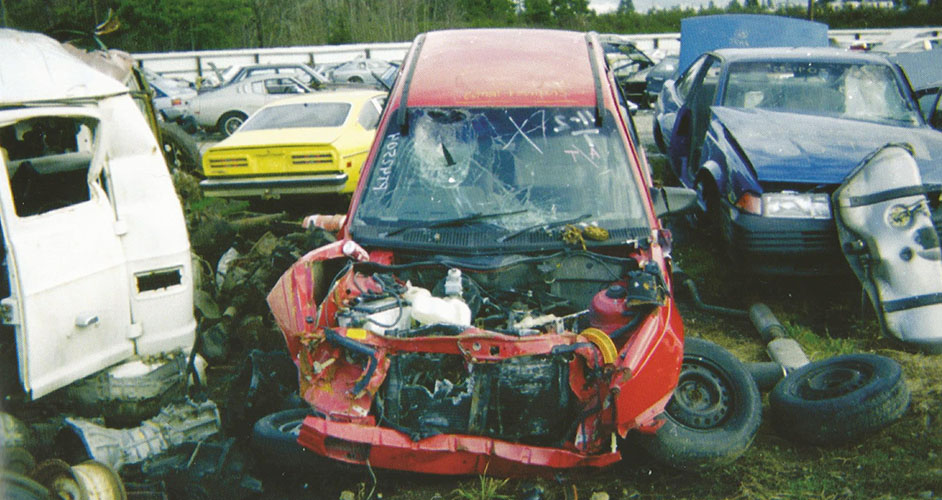
Deathsentences of the Polished and Structurally Weak is an album and booklet by Negativland. The band describes the project as “a 6 by 12 inch 64-page full-color book which comes with a 45-minute CD soundtrack.”  I’m not interested in the band Negativland, but I own a copy of this objet d’art macabre because car crashes are fascinating… and this is very similar to a project I wanted to do years ago but never got around to completing (nothing new there).  What they did was go to junkyards and look for notes left behind in the smashed cars and display them together.  Of course. you’re left wondering – did the person who wrote the note or for whom the note was intended live or die? I have no answers…  but speculating can be its own entertainment, and so I present to you the first entry.  What do you think?  Did Daddy survive this one?

Did Daddy survive?
No
Yes

Morbid Sightseeing Update!

I love it when patrons of The Morbid Sightseer write me with additional information concerning the sites. One Chris Reinhold wrote me about my Hinckley Fire Museumtravelogue. Thank you, Chris!
Hi, I saw your page devoted to the Great Hinckley Fire.I’m the step grandson of Frank Patrick, a renowned survivor of the fire. My family has very strong ties to that town  My grandfather Frank Reinhold was a lawyer and ran the Lamson and Reinhold law firm there. My grandmother Arloine Patrick was an elementary school teacher there, after my grandfather passed away she re-married to Frank Patrick the Hinckley Fire survivor and they spent the rest of their lives together. My father, Frank Reinhold (Jr.) grew up in Hinckley and was a sports star at Hinckley High School before joining the service.

“Pat” was the only grandfather I ever knew.

I found the annonymous contribution in the replies interesting because my grandparent’s house was on the [lot] near where “The Pit” is.

Hinckley is a quiet and peaceful town with great people, I wouldn’t mind moving back there one day.

My step-brothers were adopted by Harold and Margaret Underhill who lived on on Grindstone Lake in Sandstone. Grindstone Lake is where my grandfather and his family were rescued by a Native American woman. The blanket he was rescued in is on display at the Hinckley Fire museum. I guess an artist made a mural of the rescue that hangs on the Hinckley Town Hall. He gave lectures about the fire at the museum and in front of the Hinckley Fire Monument in the cemetery for years. Pat was a great guy, a real character. = )

Morbid Fact Du Jour for November 24, 2014

Today’s Undiagnosed Yet Truly Morbid Fact!

Born on a farm in Ohio, President Warren G. Harding purchased a struggling local newspaper soon after graduating from college and turned it around financially. He then steadily moved up the political ranks, serving as an Ohio state senator for four years, as lieutenant governor for two years and as a U.S. senator for six years. Only a failed campaign for governor in 1910 marred his resume. As luck would have it, the delegates to the 1920 Republican National Convention deadlocked during the presidential nominee balloting and therefore turned to Harding as a compromise candidate. Promising a “return to normalcy,” he went on to win the general election against Democratic opponent James M. Cox in a landslide, garnering about 60 percent of the popular vote and 404 of 531 electoral votes.

As president, Harding signed bills that reduced taxes for both individuals and corporations, set high protective tariffs, created a federal budget system and limited immigration, particularly from southern and eastern Europe. He also hosted a disarmament conference, at which the world’s largest naval powers agreed to reduce their arsenal of warships. It is for wrongdoing, however, that Harding’s administration is best remembered. During his time in office, several prominent officials took bribes, including his interior secretary, who granted favorable leases to oil companies in what became known as the Teapot Dome scandal, and his Veterans Bureau director, who, among other things, sold government hospital supplies at artificially low prices. “I can take care of my enemies all right. But my damn friends … they’re the ones that keep me walking the floor nights,” Harding reportedly complained to a journalist. Harding himself was never personally implicated in these affairs, but he faced his own allegations of drinking alcohol in the White House during Prohibition and of extramarital affairs. A woman 31 years younger even claimed to be the mother of his only biological child.

In early 1923, just before the first whiff of scandal began hovering, Harding came down with the flu. He also apparently had trouble sleeping. Nonetheless, he decided to go ahead with his so-called Voyage of Understanding, aimed, perhaps with a second term in mind, at explaining his policies and getting a feel for the pulse of the nation. Some observers along the route later claimed that Harding looked tired, and a journalist described him as having swollen lips and puffed eyes. But his personal physician, Dr. Charles E. Sawyer, a close friend of the Hardings who practiced homeopathy, remarked that the president was “feeling fit and in splendid physical trim.”

While in Alaska, Harding toured a number of coastal towns and traveled by train as far north as Fairbanks. He then sailed back down to Vancouver, Canada, where he gave a speech to some 40,000 people at Stanley Park. He also tried to play a round of golf but only had the strength for a few holes. The next day, July 27, the Henderson collided with another ship in a heavy fog. More ominous signs came later that day, when, as he delivered a speech to over 60,000 people at the University of Washington, Harding referred to Alaska as “Nebraska,” dropped his manuscript and grasped the podium to keep his balance. Following an appearance at the Seattle Press Club, he went to bed early complaining of upper abdominal pain.

Dr. Sawyer attributed the illness to bad seafood and began administrating laxatives. But another White House physician, Dr. Joel T. Boone, believed that Harding had an enlarged heart. As a result, Boone helped arrange to have Dr. Ray Lyman Wilbur, the president of both Stanford University and the American Medical Association, and Dr. Charles Cooper, a leading cardiologist, meet them in San Francisco. When the train arrived there on July 29, Harding declined the offer of a wheelchair and walked to a waiting limo, which whisked him to the Palace Hotel in the city’s Financial District. The next day he had a fever of 102 and was diagnosed with pneumonia, prompting the remainder of his California appearances to be canceled. This was followed, however, by a slight recovery. On August 1, his temperature was back to normal, his lungs were clearing up and he was capable of sitting up in bed, reading and eating solid food.

At around 7:30 p.m. a day later, Harding abruptly died in bed, supposedly as his wife read to him a flattering article about himself. Accounts differ as to who was in the room at the time and the exact sequence of events. Sawyer, still discounting his colleagues’ theories about heart problems, believed the cause of death to be a cerebral hemorrhage. Though the other four doctors on hand signed a joint bulletin with Sawyer, which said the “death was apparently due to some brain evolvement, probably an apoplexy,” they later backed away somewhat from this assessment. Today, nearly all experts place the blame on congestive heart failure. Harding may, in fact, have suffered a series of undiagnosed heart attacks going back months.

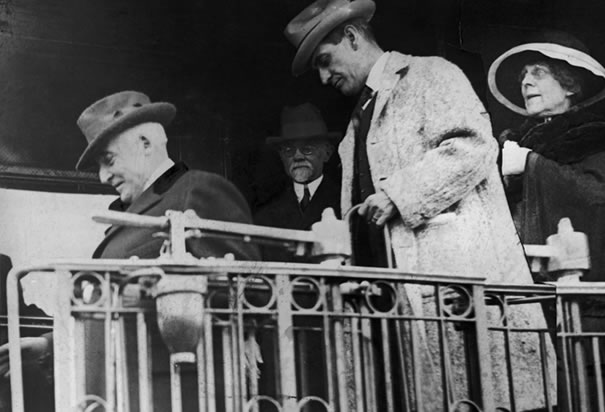
The last known photography of Warren G. Harding:

Culled from: History.Com

Taphophilia!

Sunny recommends you stop and visit Laurel Grove Cemetery the next time you’re in Savannah.  I can’t believe I haven’t been to this one before?

“I highly recommend going to Laurel Grove. It’s awesome, and it’s huge! It would take all day to see the whole thing, but sadly I was only there about an hour before I had to leave.”

Laurel Grove Cemetery

Morbid Sightseeing!


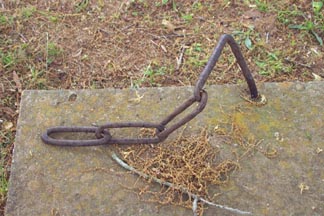
Way back in 2003, I drove to Memory Hill Cemetery in Milledgeville, Georgia to see some slave graves I had read about.  The grave markers consisted of chains which supposedly represented the life of the slave (one link = born in slavery, lived and died free; two links = born and lived for a time as a slave, but died free; three links = born a slave and died a slave).Diane wrote me about the travelogue and added her own insights:
“I just spent a short amount of time at the cemetery.  I am particularly interested in the black area of the cemetery.  It was in very poor condition, unlike the lovely white area.  I Noticed that when the grass is cut in the black area, large clumps of dead grass are laying everywhere.  Many of the graves are overgrown with weeds there and the concrete slabs look like they have been run over with lawnmowers, crushing them.  They will not be lasting long with that type of treatment.”It was very disheartening that the white politicians are still being celebrated.  And all of the slave that broke their backs doing free labor under horrible conditions are still being dismissed.  I am white and I am doing some genealogical research for several black families, many of whom, especially from the South, are ashamed and still  devastated from the aftermath of pain their ancestors had to endure.

“I think these slaves should be acknowledged and celebrated for the heros that they really are.  I plan to do some writing about this to raise awareness in both the white and black communities about this issue.  I know that the older white establishment would be resistant to it.  But the younger people need to be educated.”

If you’d like to read my full travelogue again, here it is at The Morbid Sightseer:
Trudging Up Memory Hill

Morbid Fact Du Jour for November 18, 2014

Today’s Chilling Yet Truly Morbid Fact!

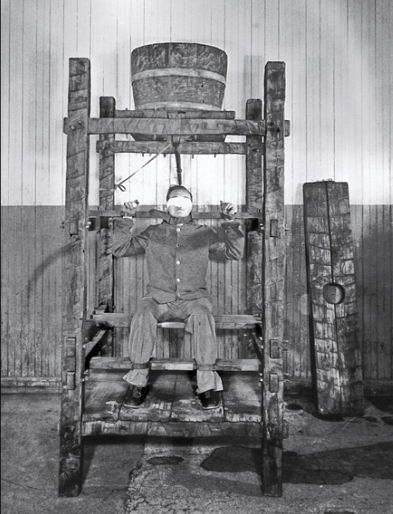
Built on the banks of the Hudson River in Westchester County, New York in 1825, Sing Sing Prison already had become internationally famous by the time Alexis de Tocqueville visited it in 1831.  Much of the institution’s early success was due to brutal slavery, which helped make it profitable for a short time. By the late nineteenth century hundreds of convicts had perished, with causes of death ranging from consumption to starvation, suicide, and physical abuse, including water torture in the infamous shower bath, a non-electric and, usually, nonfatal precursor of the electric chair (and waterboarding) in which chilled water was released over the prisoner, who was strapped into a semi-seated position.  Legal executions at Sing Sing did not begin until 1891, using the new method of electrocution that recently had been tested at Sing Sing and first was used at another New York prison, Auburn, in 1890. During the first four decades of executions at Sing Sing, the death house consisted of a section of the prison that was appropriated as the Condemned Cells. But a rash of daring escapes, including the violent breakout of condemned murderer Oreste Shillitoni, who killed a prison guard and seriously wounded another before he was quickly recaptured and executed in 1916, prompted the construction of a special state-of-the-art prison within a prison: the Sing Sing “Death House”.Culled from: Condemned: Inside the Sing Sing Death House

Here’s a photo of the infamous “shower bath”.


Water torture: an American tradition since 1825! 

Morbid Sightseeing!

It may not surprise you that back in 2003 when I went to New York for the first (and so far only) time, I had to stop by Sing Sing.  I was hoping I’d get a view of the original cell block but it’s hidden behind the walls.  I did get a few photos in before I got yelled at and turned my attention to the little Sing Sing Museum instead.  If you’re interested, here’s my cheap holiday in other people’s misery!

Sing Sing Your Life!

Ghastly!

Another slice of gruesomeness guaranteed to ruin your day!  This time a poor fellow I believe in Malaysia has a most unfortunate meeting with a train while attempting (and failing) at suicide. And judging by the reaction of the onlookers, remind me to never injure myself in Malaysia.  (Thanks to Katchaya for the link.)Oh Gawd, The Humanity!!!!!!!!!

Morbid Fact Du Jour for November 16, 2014

Today’s Dislodged Yet Truly Morbid Fact!

A man delivering drywall to a construction site in Jersey City was killed when a one-pound tape measure fell 50 stories and struck him. The tape measure had become dislodged from construction worker’s belt, Carly Baldwin, a spokeswoman for Jersey City Public Safety said. The victim, Gary Anderson of Somerdale, N.J., was an independent contractor for a New York trucking company, George Hildebrandt Inc. He was at the site, where two 50-story residential towers are under construction in downtown Jersey City, to make a delivery of National Gypsum drywall. The tape measure bounced off construction equipment before hitting Anderson in the head. Police said he was not wearing a hard hat at the time. Upon preliminary investigation, it appears to be a very tragic accident, Jersey City Public Safety Director James Shea said. Work at the site was halted after the accident. Anderson was pronounced dead at Jersey City Medical Center at 10 a.m. on November 3, 2014.

Culled From: UPI
Submitted by: Aimee

Supposedly it isn’t true that a penny dropped from the Empire State Building will kill you if it hits you on the head, but after this story, does anybody really want to test it? – Aimee

Morbid Must-Have!

The ever-marvelous Jack Mord of the Thanatos Archive of post-mortem and mourning photography has the best news I’ve heard in a long time:  they’re releasing a book!  And it’s cheap too!!!  Get out there and pre-order you copy before it’s gone!!!  I’ve already ordered mine.  Supplies are limited!  (In the interest of full disclosure: the Amazon links that I share with you are tied to my associates ID and the funds that I earn go towards purchasing books used for the newsletter.)


Beyond the Dark Veil: Post Mortem & Mourning Photography from The Thanatos Archive

My Phone: 100% More Evil!

This is my cat.  His name is Evil.  Can you see why?  The irony is that, appearances aside, he is the sweetest cat I have ever known.

Morbid Sightseeing!

In addition to the aforementioned Victorian mourning exhibit Death Becomes Her in New York (which runs through February 1, 2015), there’s another exhibit currently underway at the Bata Shoe Museum in Toronto (running through June 30, 2016) that sounds most enticing!  Hyperallergic has a great preview of the exhibit.

Fatal Victorian Fashion and the Allure of the Poison Garment

Morbid Fact Du Jour for November 11, 2014

Today’s Heated Yet Truly Morbid Fact!

A father is facing murder charges after he invited his 14-year-old daughter’s alleged rapist over for dinner, and then burned his genitals with heated tongs before strangling him to death.

According to The Indian Express, the 36-year-old father in India was getting revenge on his underage daughter’s 45-year-old alleged rapist.

“He served him dinner,” an officer told the Indian Express. “After the meal, the father overpowered the man and tied him to a chair. He got heated tongs and burned the supplier’s genitals before strangling him to death. He came to the police station and surrendered himself.”

According to police, the 45-year-old alleged rapist is suspected as being one of two people that raped the young victim a few months ago when she was home alone. The rapist allegedly told his victim to stay quiet about the assault, but the daughter reportedly told her father the same day.The father said he had been planning it since he learned about the rape.

Culled from: Fox40
Generously submitted by: Katchaya

See, this is how the movie Hard Candy should have ended!

Spam Du Jour!

Sometimes the ridiculous SPAM comments I get on my blogs are just too good not to share.  Like this piece of utter magnificence!

“You know for that reason noticeably in connection with this kind of theme, generated me personally professionally ponder over it by so many a lot of perspectives. It’s just like men and women aren’t interested except it truly is something to use Woman coo! Your very own items exceptional.  At all times maintain it down!”

My new personal motto?  “At all times maintain it down!”

Morbid Sightseeing!

I’d heard that the Pinal County Historical Society Museum in Florence, Arizona was well worth a visit, and based upon the summary that Chris sent me, I’m convinced!  This sounds like a great undiscovered gem of morbidity!

Nooses galore, and a two-person gas chamber chair that executed twins!

“This is a great museum in  a very historic town founded in 1866. Florence was a silver mining boom town in the 1870’s and the county seat since 1875. It was a wild and woolly place with a shoot out between the sheriff and the deputy in 1888. The museum has the window with the bullet holes from the Tunnel Saloon where the fight started. Other things you might be interested in is the famous trunk murderess’s doll she made while in the prison in Florence. Winnie Ruth Judd-the one who shot her Phoenix roommates and put them in trunks. One fit. One didn’t, so she cut the corpse into pieces to make it fit. Go to the museum to get the full story. Yes, there is also the noose display as well which includes the one of the lady who lost her head and the double execution chair from the first gas execution in Arizona.

“Although the prison displays are the most unique, there are other items of interest like the furniture made out of saguaro cactus, the wooden bullets, the Apache playing cards made out of deerskin, info on Camp Florence, the WWII prisoner of war camp, info on Tom Mix, the movie star killed south of Florence in  a freak accident. His suitcases killed him. Amongst the stories of some of the people who lived in Florence is the tale of a young Florence sailor who was on the USS Indianapolis and was one of the few who survived the sinking and the sharks during WWII. There are also Hohokam exhibits, info on movies filmed in Florence (Murphy’s Romans, Stir Crazy to name two) and lots of rodeo info relating to Gene Autry who visited Florence often.
“If you haven’t been to this museum, it deserves a trip. While in town check out the over 100 buildings on the National Register and the prison outlet store with prisoner made goods. It’s a great Arizona destination if you like Arizona history and getting off the beaten path.”

For more Morbid Sightseeing suggestions see The Morbid Sightseer.

Morbid Fact Du Jour for November 10, 2014

Today’s Mobbed Yet Truly Morbid Fact!

Henry de Forrest was excited about his new life in California.  The sixty-two-year-old carpenter had left his wife and young children in Maine while he looked for opportunities in the Golden State.  He quickly found employment in his trade at the Powder Mill wharf operation in Santa Cruz, and he was excited about sending for his family.

On April 29, 1877 de Forrest was walking along River Street near the present Farmers Exchange when he was accosted by ex-cons Francisco Arias and Jose Chamales.  Arias shot de Forrest in the chest with a large-caliber revolver, and the two men dragged him fifty feet off the street into the brush, where they went through his pockets for money.  They then went to a saloon and spent the dead man’s money.

In the morning, a passerby discovered de Forrest’s lifeless body and ran for the police.  The sheriff had barely started his investigation when a Californio came forward and told him about a frightening encounter that he had the night before.  Before Arias and Chamales attacked de Forrest, the bandits stopped the Californio at the same spot where De Forrest was murdered and robbed.  The man was from a Native American village located a mile north of Santa Cruz and the bandits recognized him and decided not to rob him.

Francisco Arias had murdered before.  He had killed a sheepherder and was sent to San Quentin.  Most sheepherders in the early history of California were either Mexican or Native American, which is probably why Arias didn’t get the death penalty.  At twenty-one years of age, Jose Chamales was already a veteran of the San Quentin prison.  Robbery was second nature to the Santa Cruz native.

Armed with the information provided by the Californio, the sheriff’s deputies tracked down Chamales in Watsonville and Arias camped out near San Juan Bautista. They were taken to the Santa Cruz jail.

The next night, May 3, 1877, somewhere between forty and three hundred masked men descended on the jail and easily convinced the two guards to release the bandits into their care.  The frightened criminals were marched to the Water Street bridge over the San Lorenzo River and nooses were placed around their necks.  They were given a shot of whiskey and were allowed to say a few last words.  What they said was never written down, except it was noted that they spoke in Spanish.  They were then hoisted up and left hanging until they were discovered the next morning.  When they were cut down in mid-morning, the ropes were divided into foot-long sections and given away as souvenirs.

Culled from: California Justice: Shootouts, Lynchings and Assassinations in the Golden State by David Kulczyk

Somewhere between 40 and 300?  That’s quite a range!  I’m gonna guess it was more like 40 than 300 because how many people can be bothered to put on a mask and go out on a work night?

Morbid Sightseeing!

So a few years back – okay, more than few now – I went to the Hinckley Fire Museum in Hinckley, Minnesota. Here’s a summary of the tragedy at Hinckley from my travelogue:

“On September 1, 1894 a fire raged through the town of Hinckley, Minnesota. A combination of intense drought, high winds, and dry kindling left behind by sloppy loggers resulted in an enormous firestorm that literally engulfed the town. The cyclone shot flames miles into the air and temperatures reached 1000 degrees (F). Survival was haphazard: over 100 people safely rode out the storm in a soggy gravel pit in the middle of town, while 127 people died seeking refuge in a swamp. In four hours the fire burned out 400 square miles and killed more than 400 people.”

Recently Debbers sent me the following update:
“Hello, I found out that my great-great-grandparents were one of the Russian families living in Hinckley. My great-great-grandma took her two boys to that gravel pit. But, my family states the two year old died there. He drowned. My great-grandpa was four; he lived, but his legs were badly burned.”

If you’d like to read my travelogue, here it is in all its 2002 glory!

Great Fire!

European DeSpair, Part 3!

I finished another episode of the travelogue of my trip to Europe this summer. Hope you enjoy Part 3 of European DeSpair.

European DeSpair, Part 3: Berlin Bust!