Today’s Foul Yet Truly Morbid Fact!
For most medieval and early modern Europeans, rich or poor, tooth loss was a part of life. An ordinary laborer or peasant could expect to lose one or two teeth before their fortieth birthday, and (if they lived long enough) this process would end with a toothless mouth. The most exalted figures on the continent were not exempt: Louis XIV of France, the Sun King, had lost all but a handful of his teeth by his early forties, and a German visitor to the court of Elizabeth I reported in 1578 that ‘her lips are narrow and her teeth black, a defect that the English seem subject to, from their great use of sugar’. This points towards one of the great transitions in European eating habits and dental disease, from long-term attrition and wear to the black teeth, cavities and abscesses associated with a diet rich in refined sugar.
Wealthy, powerful monarchs such as Louis XIV and Elizabeth I were particularly vulnerable to the hazards of a sweet tooth. Although Europeans had been eating sugar from North Africa since the fourteenth century, it was not until the sixteenth century, when merchants established direct trade with Morocco, that large quantities came onto the market. By 1593 the English were consuming in the region of two thousand tons of sugar a year, almost all of which went straight into the mouths of the prosperous. At around nineteen pence a pound – roughly a day’s wages for a skilled artisan – sugar was no mass-market commodity but an abject of conspicuous consumption for the very richest. This began to change when English slave traders established plantations in the West Indies, and after the Restoration (begun in 1660) the price of this slave sugar fell dramatically. Around this time another product of the slave plantations – tobacco- also became a European vice, adding a smoky note to the foul breath of the rich.

Queen Elizabeth: Absolutely Foul
Culled from: The Smile Stealers: The Fine and Foul Art Of Dentistry
Vintage Medical Illustration Du Jour!
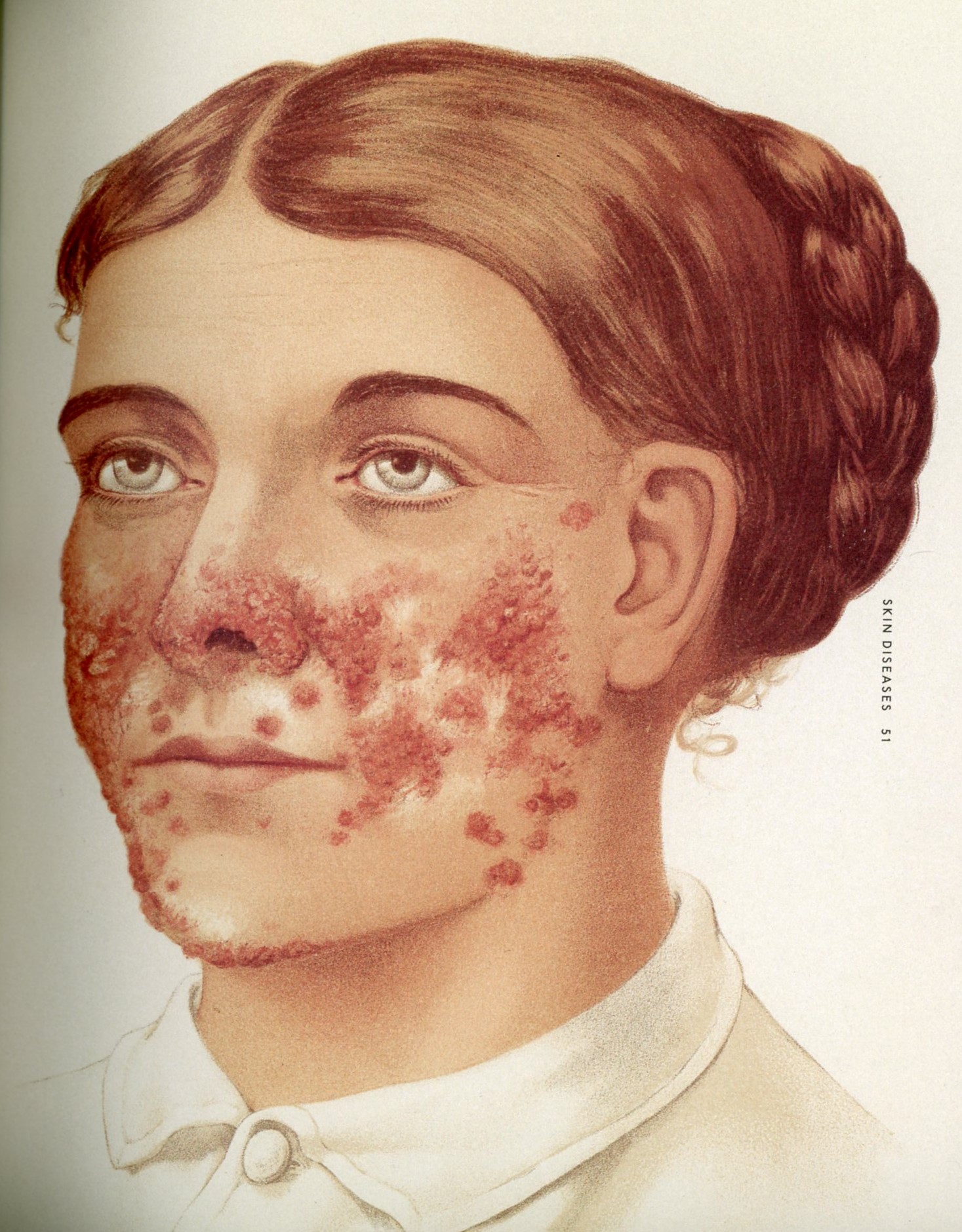
An illustration of lupus vulgaris – a skin infection caused by Mycobacterium tuberculosis, the bacterium responsible for pulmonary tuberculosis – on the cheeks, nose and chin of a female patient.
Culled from: The Sick Rose: Disease and the Art of Medical Illustration