Today’s Smoky Yet Truly Morbid Fact!
In order to understand toothache, Renaissance-era surgeons drew on the theories of Classical Greek and Roman writers, refracted through the prism of Islamic Renaissance scholars such as Ibn-Sina and Al-Zahrawi (Latinized as Avicenna and Albucasis, respectively). Most endorsed the tooth worm theory of decay, and the Elizabethan courtier Sir John Harington’s verse translation of the Regimen Sanitatis Salernatanum (The Salernitan Rule of Health), an eleventh-century Italian treatise, describes one of the standard remedies:
If in your teeth you hap to be tormented, by mean some little wormes therin do breed, which paine (if heed be ta’en) may be prevented, by keeping cleane your teeth, when as you feed: burne Frankinsence (a gum not evil sented), put Henbane unto this, and onyon-seed and with a tunnel to the tooth that’s hollow, convey the smoake thereof, and ease shall follow.
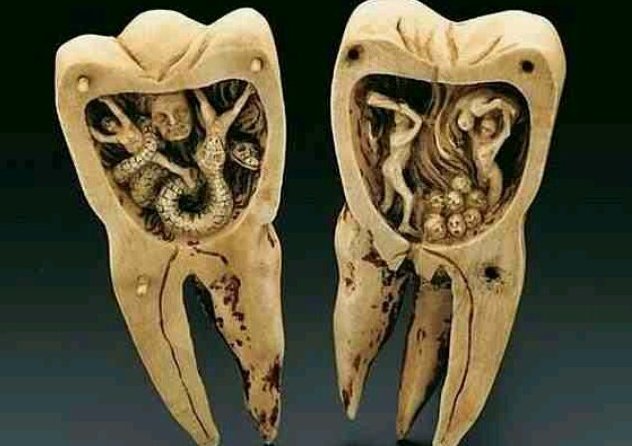
Dreadful Tooth Worms!!!
Having literally smoked out what they believed to be the cause of tooth decay, a Renaissance barber-surgeon might employ a new technique to keep the tooth worms away. In the late fifteenth century, the Italian writer Giovanni d’Arcoli described the use of a finely beaten old foil to fill cavities in the teeth, and a century or so later the Italian surgeon Giovanni da Vigo set down the principles of this new practice: remove all decayed dentine with picks and trephines, treat the exposed pulp with arsenic compounds and make sure each layer of gold is pressed firmly into the cavity. Although a well-made filling could save a tooth and last for years, it required hours of scraping and hammering, and the technique did not become widespread until the development of anaesthesia. Barber-surgeons also cleansed discoloured teeth with a rag dipped in aqua fortis – nitric acid. Though this whitened the teeth, it served only to erode the enamel even further. Some practitioners turned this to their advantage, claiming that they could extract teeth sine ferro (without iron tools) by weakening them with acid until they were so loose they could be pulled out by hand.
Culled from: The Smile Stealers: The Fine and Foul Art of Dentistry
Dissection Photo Du Jour!
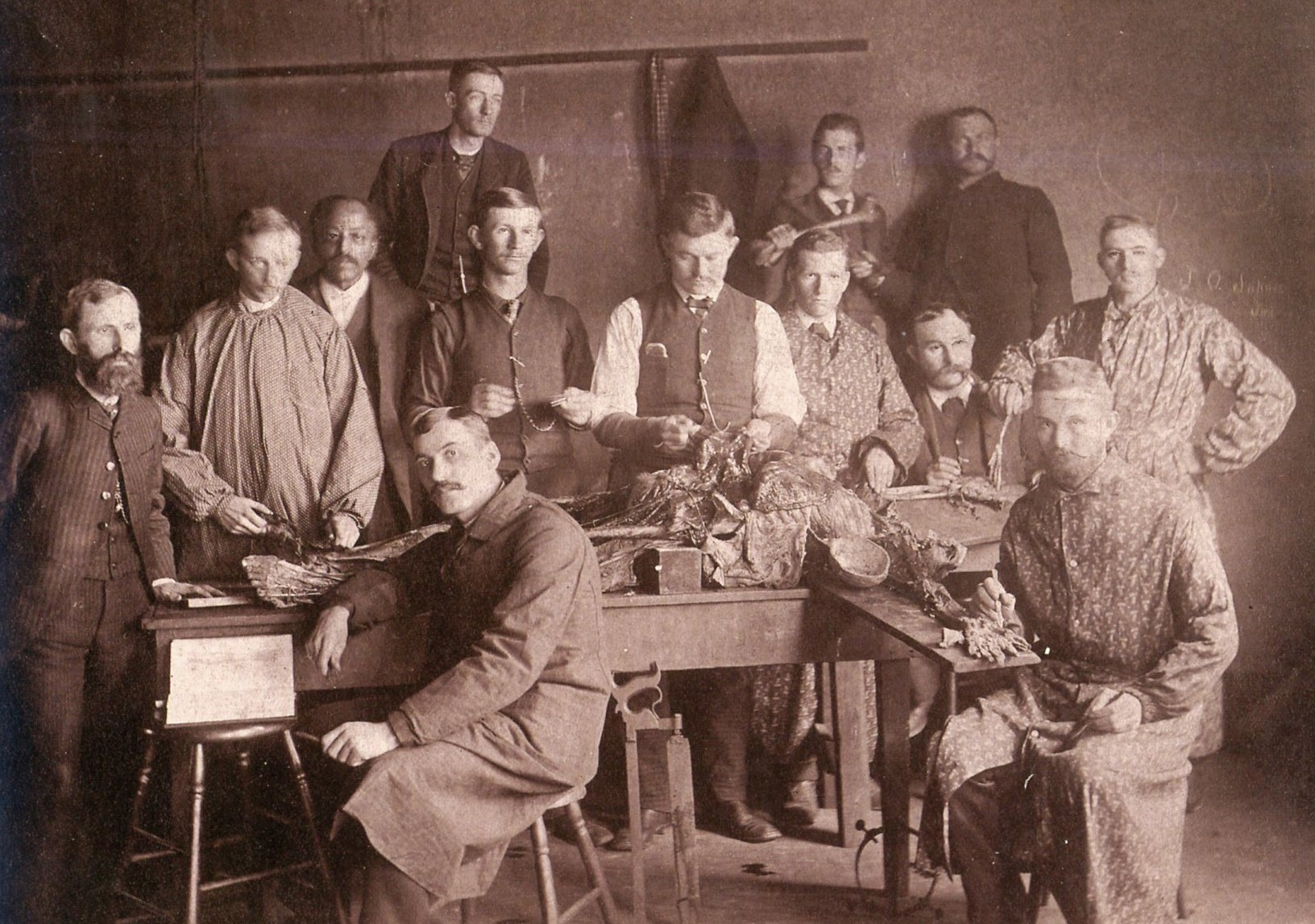
Medical College of Virginia, Richmond, date unknown.
Culled from: Dissection: Photographs of a Rite of Passage in American Medicine: 1880-1930