Today’s Customary Yet Truly Morbid Fact!
Now for more sad stories of the hapless Christian martyrs:
If the Christian was to be killed without bloodshed, he might be shut in a lead box and drowned in a river. There was a custom which persisted into the Middle Ages to put the condemned man in a sealed bag with a cock, a viper, a dog, and an ape. The bag and its contents would then be thrown into deep water. [Really? Where do you even find an ape in Italy? – DeSpair]
Stories of Christians being thrown as fodder for wild animals are well documented. Sometimes the victim was wrapped in hide to further excite the animals, which might include dogs, lions, or bulls.
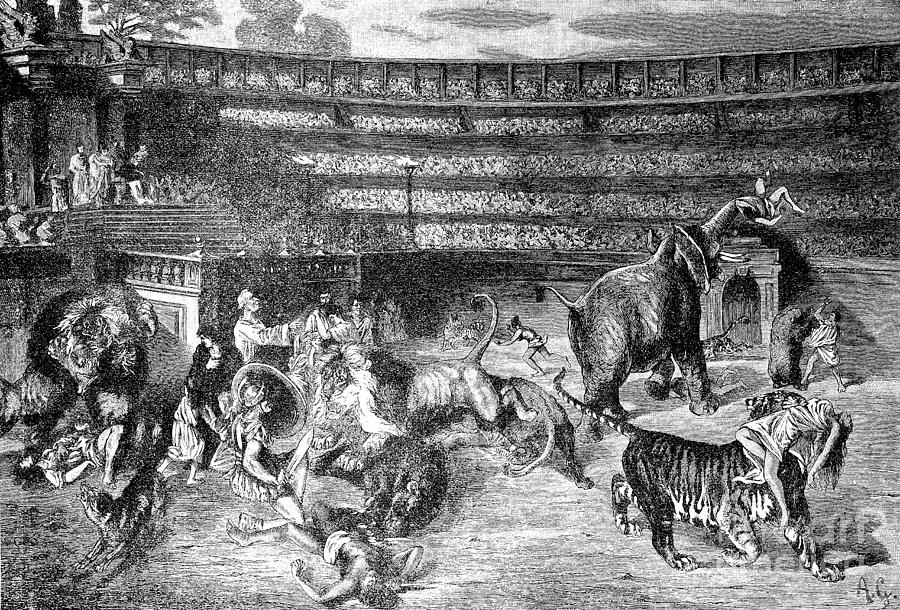
God Fodder
Even among this appalling variety, some methods appeared markedly more sadistic than the rest. There were cases of men with their hands tied behind their backs being hoisted up by the wrists and dropped on to a bed of spikes.
Pinioned martyrs might be smeared with honey to attract a swarm of bees, Consequently, they would be stung to death. [Again, really? Honey bees aren’t particularly violent unless provoked and how can a pinioned person provoke them? These Christian martyr tales are nearly as hard to believe as a talking snake or a virgin birth! — DeSpair]
If there were two mature saplings in the vicinity, the trees were pulled down to ground level and the victim tied upside-down to them. The curled branches were then released like springs, violently ripping the body in different directions. All these grievous punishments were recorded in 16th century Papal papers [Ah, that would explain it – tall tale tellers! — DeSpair] although the abominations took place centuries earlier.
Culled from: The History of Punishment & Torture
Prisoner Du Jour!
Prisoners: Murder, Mayhem, and Petit Larceny is a collection of seventy portraits of turn-of-the-century prisoners in the town of Marysville, California and the fascinating contemporary newspaper and prison accounts describing the crimes of which they were accused. The photos themselves are more fascinating than most of the crimes. There’s something magical about glass plate negatives that you just can’t reproduce with modern photography. And I think people just had more character back in the day – or at least it seems that way.
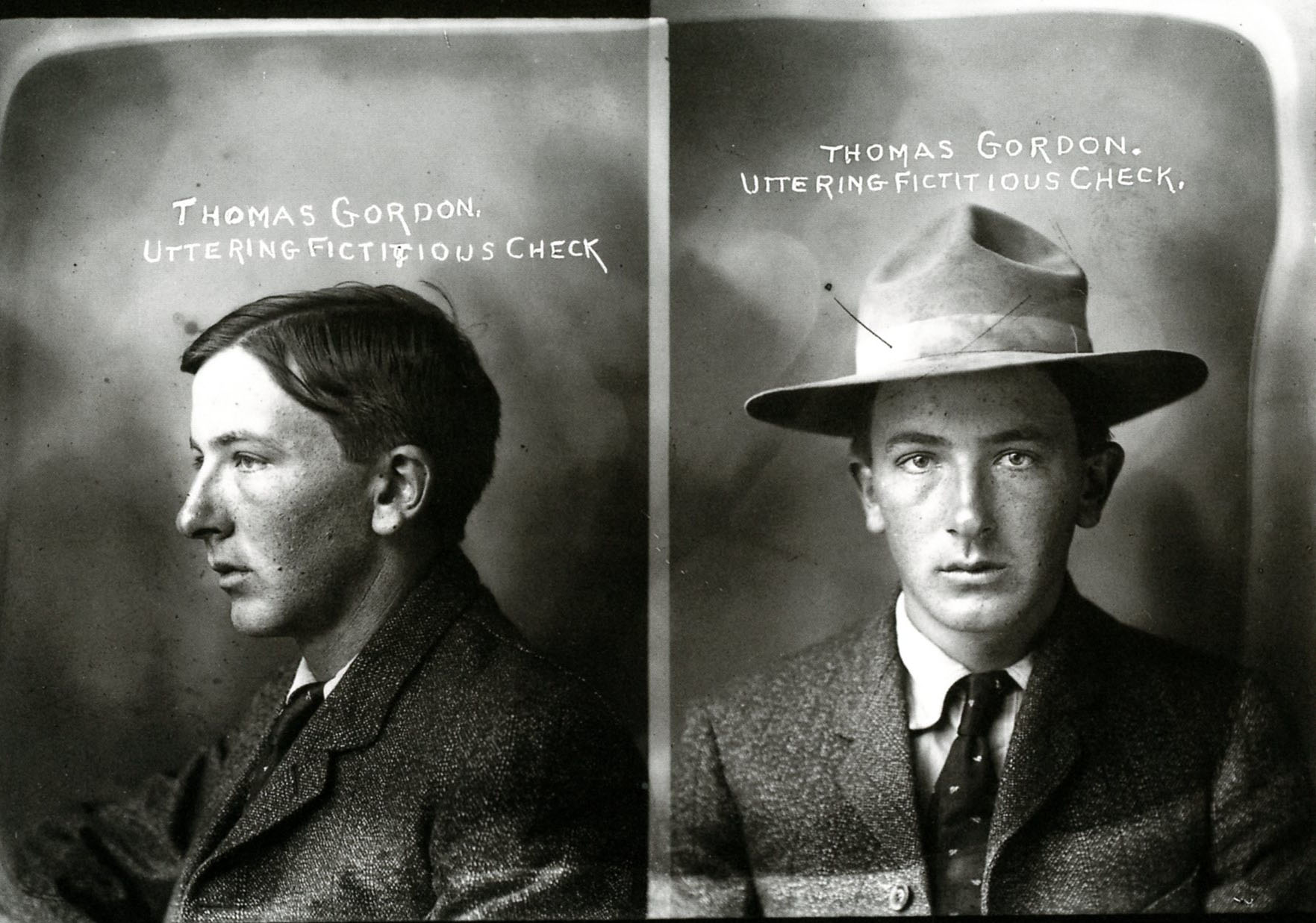
THOMAS GORDON
FORGED A CHECK AND IS IN JAIL
YOUNG MAN COMES FROM WHEATLAND AND IMMEDIATELY GOES WRONG.
Thomas Gordon, twenty-two-years old, was arrested by Officer McCoy and Burroughs last evening and charged with forgery. He admits the truth of the charge and stands to serve a term in the penitentiary.
Gordon came here from Wheatland, where he had been working on the Horst hop ranch. He asked for and was given three blank checks of the Rideout Bank at the store of the W. T. Ellis Company yesterday. Later he tried to pass one of them, which had been filled out for $27.60, at the store of M. Schwab. The name of the Rideout Bank had been cancelled and the words “Farmers’ and Merchants’ Bank of Wheatland” had been written. The check did not look good to Mr. Schwab and he investigated, learning enough to cause him to refuse to accept it in payment of a pair of shoes.
In the evening the young man passed the check at the saloon of Joseph Whyler at Second and C streets. Officer McCoy had been on the trail since the appearance of Gordon at Schwab’s store and he finally succeeded in getting S. E. Conrad, foreman of the Horst ranch, on the telephone. He learned that the only check given Gordon had been cashed in Wheatland and that the paper passed here was undoubtedly a forgery. Upon this the arrest was made.
The name of Mr. Conrad had been signed on the check, but it was written “Samuel” Conrad instead of “S. E. Conrad,” the latter being the way the gentleman signs his checks. The name of the bank was wrong, too. [Tommy isn’t very good at this, is he? – DeSpair] It is the Farmers’ Bank of Wheatland. The endorsement on the back of the check is in a different handwriting, but Gordon claims he wrote both sides of the check.
He had $17.60 left when arrested, showing that he had spent $10. Part of the money was spent with Mr. Schwab, probably to show that he bore no ill will for having been turned down by that gentleman. [July 14, 1906]
BAD CHECK MAN GETS THREE YEARS
THOMAS GORDON IS THE SAME PARTY WHO OPERATED IN OROVILLE LATELY.
The preliminary examination of Thomas Gordon, who passed a fictitious check in this city a few days ago, it being cashed by Joseph M. Whyler, was held last evening before Judge Raish in the Police Court and Gordon was held to answer before the Superior Court, his bonds being fixed at $1000.
Mr. Shyler, who is the complaining witness, told of how he was induced to part with $27.60 of good old United States money for the worthless piece of paper that purported to be signed by Foreman Conrad of the Horst Ranch at Wheatland.
F. M. Hollingshead of Wheatland testified that he had cashed many checks signed by Mr. Conrad and knew the one cashed by Mr. Whyler was not signed by that man.
Officer McCoy, the arresting officer, told of his connection with the case and how he found that the young man was getting money for worthless paper, and also of a conversation had with the prisoner after the arrest.
Young Gordon took the stand, admitted that he had made out the check and signed it with what he thought was the correct name of Mr. Conrad. He said the act was committed because he needed money with which to return to San Francisco. He identified the check in evidence as the one he had passed.
The prisoner was taken to the County Jail and turned over to Sheriff Voss this morning.
Last evening Sheriff Chubbuck of Oroville telephoned to Marshal Maben that on June 25th a forged check was passed in that city by a young man who endorsed it as M. F. Gordon. The check was for $35 and the Sheriff stated that some person who had seen the prisoner here is sure he is the man who perpetrated the act at Oroville.
This afternoon Gordon was arraigned in the Superior Court, pleaded guilty, and was sentenced to serve three years in San Quentin Prison. He has admitted that he forged the check at Oroville. [July 19, 1906]
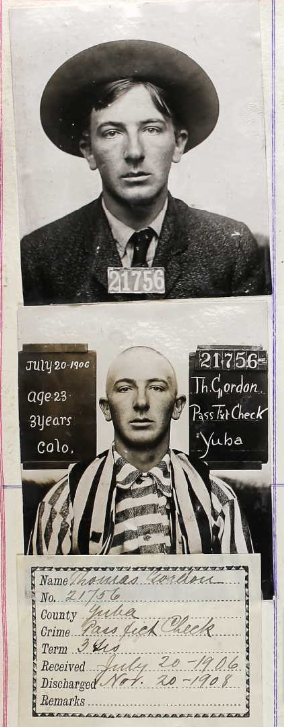
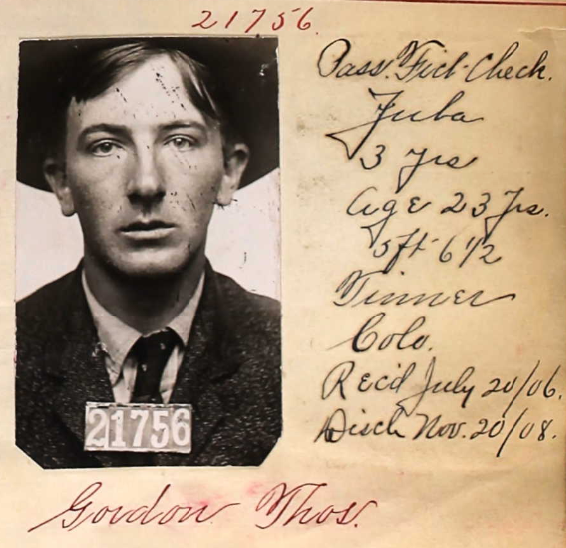
SAN QUENTIN PRISON RECORD
DATE: JULY 20, 1906
COMMITMENT NO.: 21756
CRIME: PASSING FICTITIOUS CHECK
COUNTY: YUBA
TERM: 3 YEARS
NATIVITY: COLORADO
AGE: 23
OCCUPATION: TINNER
HEIGHT: 5′ 6 1/2″
COMPLEXION: MEDIUM
EYES: GREEN
HAIR: BROWN
WEIGHT: 147
FOOT: 5
HAT: 7 1/2
DISCHARGE DATE: FEBRUARY 20, 1909 (LOST 3 MONTHS’ CREDIT)
MOLE RT SHOULDER BLADE, MOLE M. L. BACK OF HEAD, BRWN MOLE BELOW RT NIPPLE, BRN MOLE LOBE RT EAR, 2 MOLES RT CHEEK, MOLE ON LEFT TRAGUS
ONE TIME BEEN ARRESTED FOR THE SAME CRIME AND SERVED TIME IN WALLA WALLA, WASHINGTON.
I found Thomas’ prison records on Ancestry. He looks snazzy in stripes!
Andersonville Prisoner Diary Entry Du Jour!
This is the continuation of the 1864 diary of Andersonville prisoner Private George A. Hitchcock (see the archived version for all entries up until now).
Here’s today’s entry:
June 19th. Very hot. Heavy shower in the afternoon. A lot of prisoners from Sherman’s and Butler’s army came in. [James A.] Miller and [Thomas B.] Dyer sick with the diarrhea. Found Walter Lamb of the 25th Massachusetts, who was taken prisoner June 3rd at Cold Harbor. Two men were shot by a sentry who fired at another prisoner, who had gotten over the “dead-line,” a little rail running around the entire stockade about twenty feet inside from it, over which if a man passes or reaches he becomes the mark of the two or three sentries nearest him. The rule is over diligently carried out, and it is very dangerous to approach the line. It is rumored that Grant has got into Petersburg. A man killed about two rods from us last night by falling into a well.
Culled from: Andersonville: Giving Up the Ghost